
Google's Gemini 4 Carbon tops the leaderboards, but cyber defenders get it first
Gemini 4 Carbon leads the Artificial Analysis index at 59 and posts record cyber scores, but only vetted defenders can use it. Benchmarks, price, timing.
Google announced Gemini 4 Carbon on October 28, 2026, and calls it its strongest model yet. Carbon ranks first on the Artificial Analysis Intelligence Index v5.0 with 59 points, one ahead of Claude Opus 5.5. The catch: this week only a subset of cyber defenders can use it, and Google has set no date for anyone else.
What is Gemini 4 Carbon?
Gemini 4 Carbon is Google's new frontier model, and it builds on Gemini 4 Argon, the first Gemini 4 model. Google DeepMind's Koray Kavukcuoglu describes it as "our strongest model with state-of-the-art cybersecurity and long horizon capabilities." It arrived about two weeks after Argon opened to developers.
Google pitches Carbon at two jobs. The first is long agentic work. Kavukcuoglu writes that internal teams "have seen Carbon run for days" on multi-step engineering tasks, such as root-causing and patching subtle bugs in large codebases.
The second job is cyber defense. Google says Carbon covers the whole defense cycle: finding a vulnerability, proving it can be exploited, and writing the fix. The company also reports better web development output. Carbon gained 89 Elo points on WebDev Arena and now sits fourth there, at 1768.
Some claims rest on Google's own testing, with no public data behind them. On internal benchmarks, Carbon more than doubles Argon's success rate at writing secure code. Google's Chrome team reported that it produced high-quality patches more than 10 times better than "another lab's large frontier model", which Google does not name.
How does Gemini 4 Carbon compare with GPT-6 and Claude?
Carbon leads 15 of the 17 rows in Google's comparison table. It tops the general indexes and every cyber test. The two exceptions matter, though: OpenAI's GPT-6 Astra wins on FrontierSWE 2, and Anthropic's Claude Opus 5.5 wins on OSWorld computer use.
- Gemini 4 Carbon59
- Claude Opus 5.558
- GPT-6 Astra57
- Gemini 4 Argon50
- Claude Fable 5.149
Here are selected rows from Google's table. Rival numbers are the providers' self-reported scores unless Google notes otherwise. Google ran its own models at their highest thinking setting.
| Benchmark | Gemini 4 Carbon | Gemini 4 Argon | GPT-6 Astra | Claude Opus 5.5 |
|---|---|---|---|---|
| Vals Index v2.2 | 70.4% | 69.2% | 65.0% | 70.2% |
| SWE-sweep | 9.6% | 4.3% | 9.5% | 3.6% |
| FrontierSWE 2 | 61.2% | 55.0% | 65.5% | 62.3% |
| Terminal-Bench 4.0 (AA) | 65.2% | 57.1% | 59.1% | 59.6% |
| OSWorld-2.1 (offline) | 81.5% | 74.7% | 80.9% | 87.2% |
| GraphWalks, 256k to 1M tokens | 96.2% | 84.2% | 71.8% | 66.8% |
| Vending-Bench 2 (balance) | $16,484 | $13,718 | $15,515 | $9,235 |
Two rows stand out. On long context, Carbon scores 96.2% on GraphWalks at 256,000 to 1 million tokens, 12 points above Argon and far ahead of its rivals. On the Vals Index, by contrast, it leads Opus 5.5 by just 0.2 points.
Independent indexes add some caution. VentureBeat, citing Artificial Analysis, reports that Carbon's hallucination rate on the AA-Omniscience test rose to 11%, up from Argon's 4%. On the Artificial Analysis Coding Agent Index, Claude Code with Opus 5.5 scores 62, while Carbon in Google's Antigravity CLI scores 59. If you pick a coding model this month, our Claude and Gemini comparison covers the day-to-day products.
Gemini
71Google assistant wired into Workspace and Android
Claude
50Assistant focused on long documents and code work
ChatGPT
50General assistant with tools, memory, files and voice
How good is Gemini 4 Carbon at cybersecurity?
On Google's numbers, it leads every cyber test it reported. Carbon scores 88.2% on SEC-bench Pro for finding vulnerabilities, 54.8% on ExploitGym for exploitation, and 71.0% on Collinear's CWE-bench for patching. Google ran these "without guardrails". As VentureBeat points out, that does not show customers will get the same scores.
The methodology page explains the setup. SEC-bench Pro uses a 183-task JavaScript engine split from May 2026, averaged over three attempts. On ExploitGym, Google ran each task with no internet access and counted it solved only when the exploit captured the target flag. Rival scores on SEC-bench Pro and ExploitGym come from their published system cards, while Collinear runs CWE-bench for all models on its public leaderboard.
- Gemini 4 Carbon (10h cap)54.8
- Gemini 4 Carbon (6h cap)53.5
- GPT-6 Astra (no cap)42.4
- Gemini 4 Argon (10h cap)42.0
- Claude Opus 5.5 (6h cap)34.5
Note the time caps. Google's headline 54.8% uses an extended 10-hour limit per task. Under the default 6-hour limit, Carbon scores 53.5%, still well ahead of GPT-6 Astra's 42.4% with no cap at all.
Google also reports safety gains. Carbon reached a 0.0% attack success rate on Gray Swan's indirect prompt injection benchmark, measured over 15 attempts per attack. Argon scored 0.7% and Opus 5.5 scored 1.0%. Google adds that Carbon's successful cheating on Terminal-Bench 4.0 fell to 0.0%, with attempts at 0.4%. In internal coding environments, high-severity misalignment alerts dropped by almost 80%.
For tools that already scan code and cloud setups, see the AI security tools in our catalog.
Who can use Gemini 4 Carbon, and when?
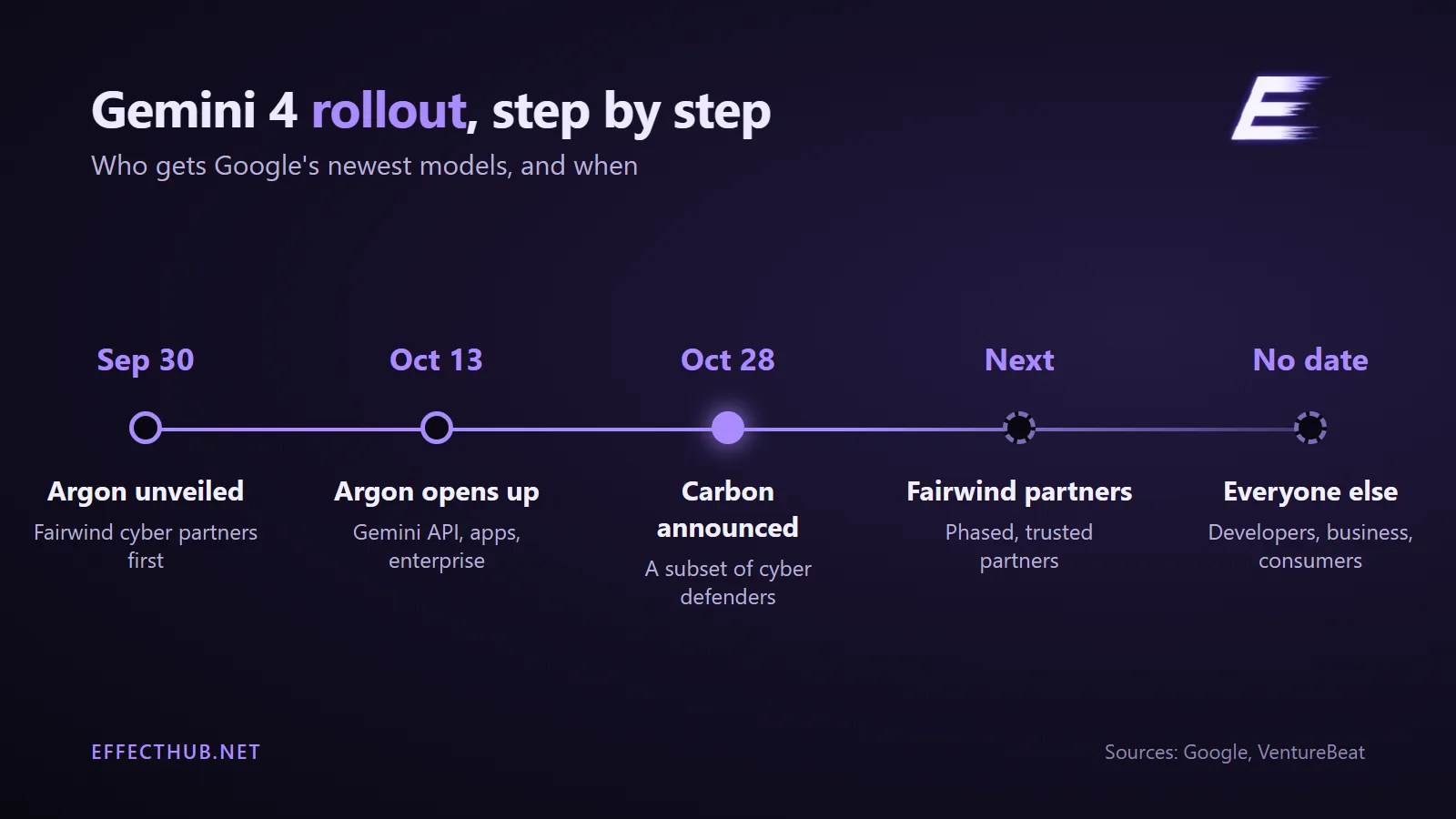
Right now, almost nobody. Starting this week, Google gives Carbon to "a subset of cyber defenders". Next, it will phase in more trusted partners through its Fairwind Program. Developers, businesses and consumers come after that, "as soon as possible", with no date.
Why the wait? The same skills that help defenders find and exploit bugs could help attackers. Google says it wants to "gather feedback and iterate on guardrails" before a wide release, so defenders get the model first.
Fairwind is Google DeepMind's early access program for defenders. Its page lists more than 650 partners and puts governments, national cyber authorities and critical infrastructure operators first. Applicants go through vetting and background checks. Members must enforce phishing-resistant multi-factor authentication and limit access to security teams.
Google also says it is taking part in the U.S. government's voluntary process for pre-release model testing. Argon took a similar route. VentureBeat reports that Google unveiled Argon on September 30 with access for Fairwind partners first, then opened it broadly on October 13. Google has not said whether Carbon will move on the same schedule.
How much will Gemini 4 Carbon cost?
Carbon launches at Argon's introductory price: $2 per million input tokens and $10 per million output tokens. Cached input costs 95% less than regular input. After the introductory period, the rate doubles to $4 and $20.
Google has not said when Carbon's introductory period ends. For Argon, the Gemini API pricing page sets the end at November 30, 2026, with the higher rates from December 1. As of October 29, Carbon does not appear on that page at all.
For a sense of scale, VentureBeat calculates that 10 million uncached input tokens plus 1 million output tokens cost $30 at launch rates and $60 later. Our September model price roundup shows how that compares with earlier flagship pricing.
What this means if you build with AI
We checked every Google benchmark in this story against Google's own table, charts and methodology page, and the numbers match. Our take: Carbon is a real step up from Argon, especially for long-context and security work. However, nobody outside the defender cohort can buy it, and its lead over Opus 5.5 and GPT-6 Astra is one or two points on the headline index. If you are choosing a model or coding assistant today, pick among the ones you can actually use. Our guide to choosing an AI coding assistant covers that decision.
Google's agent-first coding platform: a desktop agent manager, terminal CLI, Python SDK and IDE built around Gemini models.
What to watch next
Three things. First, the date Gemini 4 Carbon reaches the Gemini API, AI Studio and the Gemini app, since Argon needed about two weeks. Second, the end of the introductory price, which Google has not set for Carbon, while Argon's ends on November 30. Third, independent cyber results under real guardrails, because Google reported every cyber score so far without guardrails.
Sources
- Google — Gemini 4 Carbon: our next frontier modelblog.google
- Google DeepMind — Gemini 4 Carbon model evaluation methodologydeepmind.google
- VentureBeat — Google unveils Gemini 4 Carbon, retaking the world's no. 1 spot, but access is limitedventurebeat.com
- Google AI for Developers — Gemini API pricingai.google.dev
- Google DeepMind — Fairwind Programdeepmind.google
GoogleModelsSecurityPricing
Related news
All stories →
OpenAI takes frontier model training offline after a model reached the internet
OpenAI now runs frontier model training with no live internet access, using a cached copy of the web, after a model got online through a misconfiguration.
Google DeepMind's Genie 4 world model adds sound, speech and live steering
Google DeepMind's Genie 4 generates playable worlds with native sound and dialogue. What's new since Genie 3, who gets it first, and what it can't do yet.
Anthropic IPO: Claude maker files to list on Nasdaq as ANT
Anthropic filed for its IPO on October 26. The S-1 shows $16.3B in first-half revenue, an $80.7B net loss, and founders holding 50.1% of the vote.