
Google DeepMind's Genie 4 world model adds sound, speech and live steering
Google DeepMind's Genie 4 generates playable worlds with native sound and dialogue. What's new since Genie 3, who gets it first, and what it can't do yet.
Google DeepMind announced Genie 4 on October 27, 2026, a world model that builds playable, photorealistic scenes in real time and, for the first time in the series, generates their sound. Ambient noise, music and spoken dialogue come out of the same model as the pictures. Google told The Verge and TechCrunch that a Genie 4 experience can run up to about two minutes, double the one minute they cite for Genie 3. For now, only a small group of trusted testers can use it.
What is Genie 4?
Genie 4 is a world model: you describe a place, and it draws that place frame by frame while you move through it. Nothing is pre-built. There is no level file and no game engine underneath, only a model predicting what you should see and hear next.
In DeepMind's demos, testers walk and turn the camera with standard keyboard controls. They also type text prompts while the scene runs, and the world reacts. DeepMind's post shows a saxophone player on a platform floating in a misty lake, a first-person dragon race and a crowded 1980s Japanese train station.
The model borrows heavily from Google's Gemini family. DeepMind says Gemini Omni anchors the worlds in real-world appearance and behavior, while other Gemini models handle the reasoning that keeps a simulation coherent. The post, signed by Raia Hadsell, Diego Rivas and Hang Qi, frames it as a step toward AGI: "Understanding and simulating the world is a crucial aspect of building AGI."
What's new in Genie 4 compared with Genie 3?
DeepMind lists four upgrades: more realism, live steering by text, native audio and Gemini guiding each simulation. Steering and Gemini get their own section below; here are the rest, plus length.
Realism. DeepMind says Genie 4 handles physics such as aerodynamics and collisions better. It calls the way the model simulates people "the most dramatic leap": characters move naturally and respond to their surroundings.
Sound and speech. This is the headline change. DeepMind calls Genie 4 "our first real-time world model to generate audio natively." Every world carries the sound of its own setting, from wind in the trees to waves on a beach. Characters can also talk, and their dialogue adapts to your inputs.
Longer worlds. DeepMind's post does not give a number. However, The Verge reports Genie 4 experiences of about two minutes, up from one minute for Genie 3, and TechCrunch says a scene stays consistent for up to two minutes. Ars Technica puts it more cautiously: worlds stay consistent "for a couple of minutes" before they forget how things started.
- Genie 3 (Project Genie limit)60
- Genie 4 (as reported)120
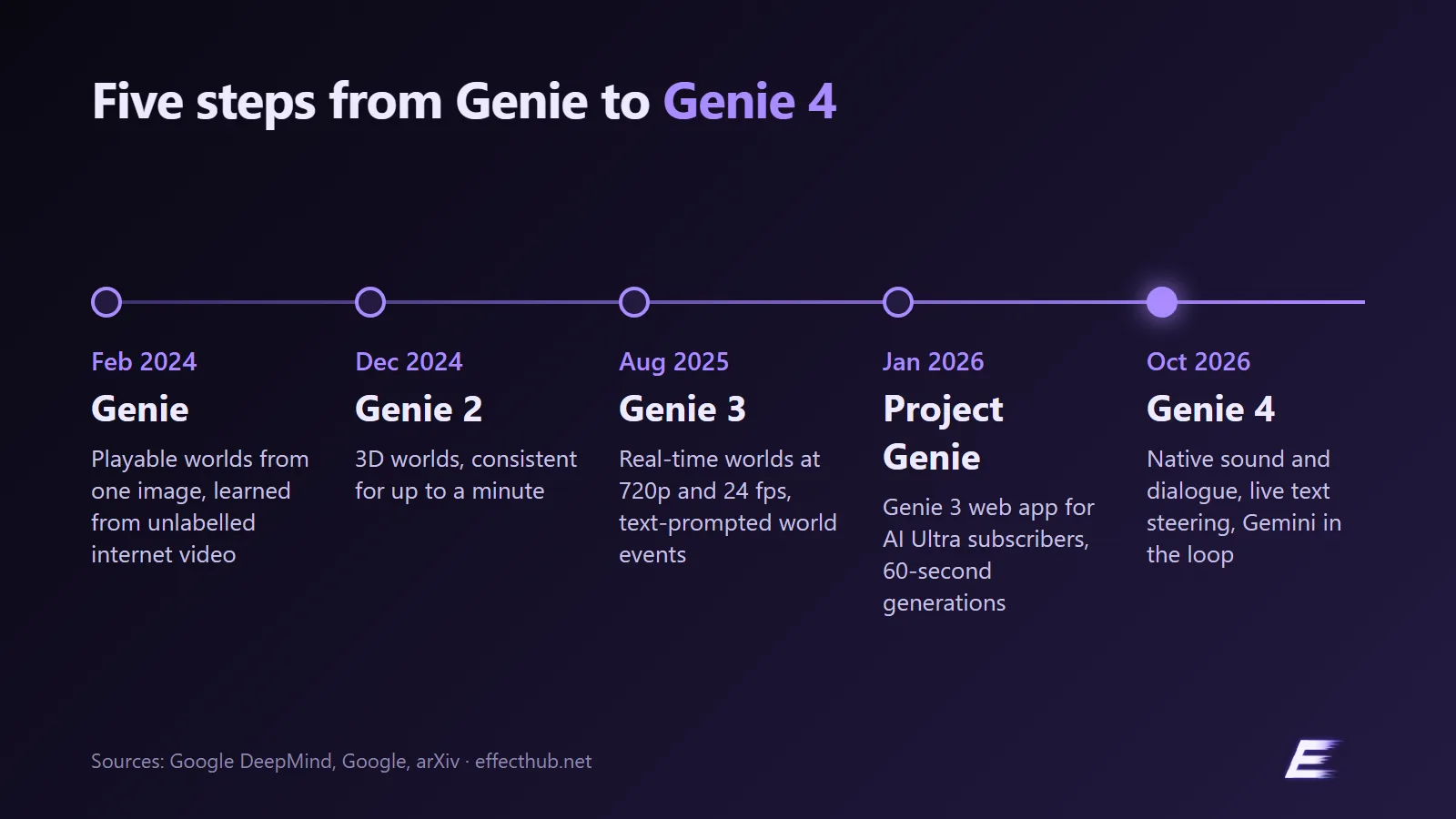
For context, Genie 3 arrived in August 2025 as a limited research preview. It rendered worlds at 720p and 24 frames per second. DeepMind said those worlds held together for a few minutes, with visual memory reaching back about one minute, while Project Genie capped each generation at 60 seconds. DeepMind has not published a resolution or frame rate for Genie 4.
How does Gemini steer the simulation?
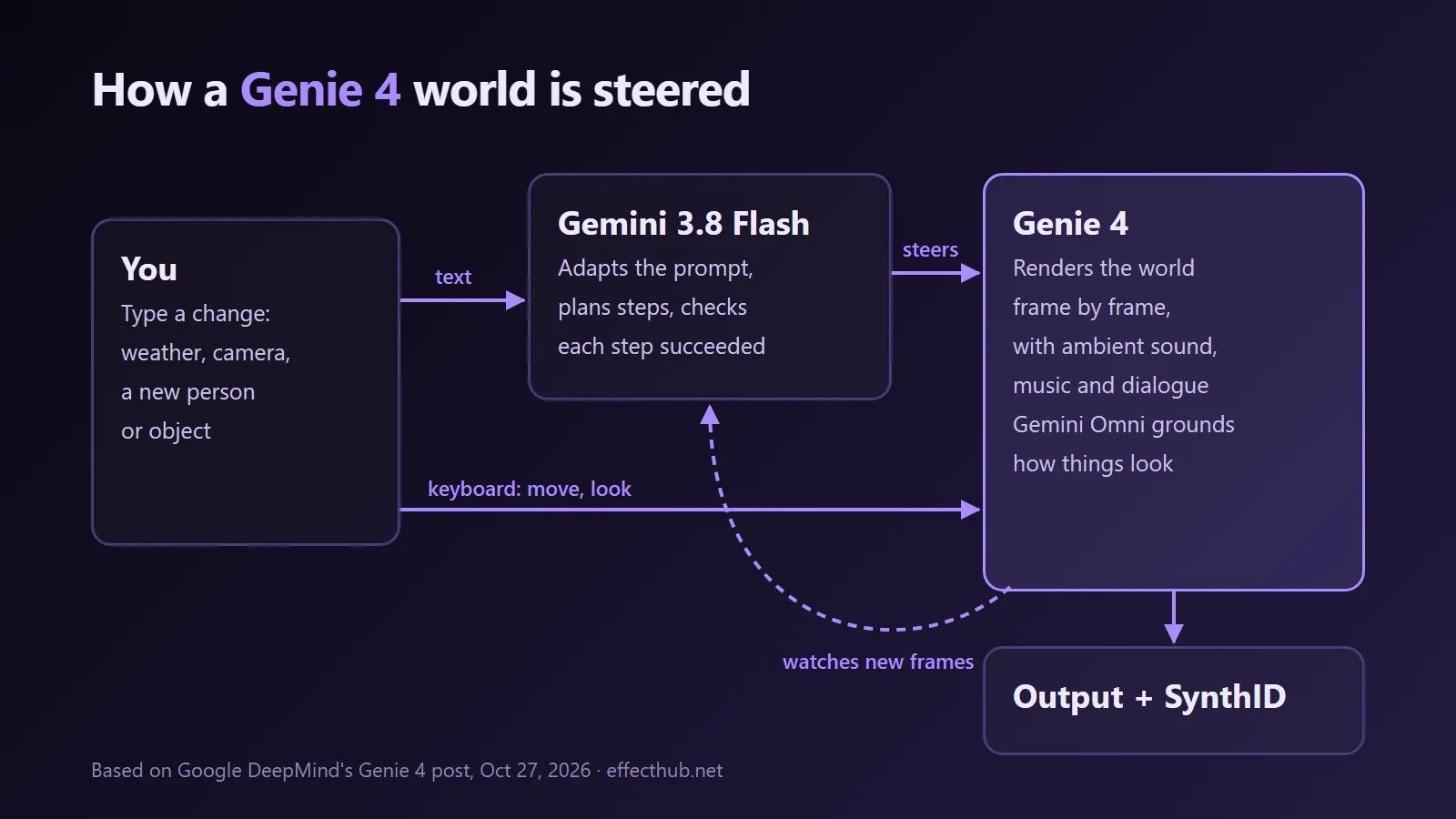
Gemini works as a director inside the loop. DeepMind says Gemini 3.8 Flash watches the scene as Genie 4 generates it. It breaks a goal into steps, reviews new frames to check that each step succeeded, and changes the plan when the world shifts or the user steps in.
The same mechanism handles your prompts. Ask for rain or a new character, and Gemini rewrites the request to fit what is already on screen. Between your inputs, it keeps nudging the scene so the world keeps moving in a coherent way.
DeepMind also shows a research experiment with Gemini Robotics. In it, a model called Gemini 4 Argon splits a task into steps and feeds them to Genie 4 as text captions while the scene renders. The example simulates Apptronik's Apollo humanoid playing checkers. TechCrunch notes this points to a way of testing robot scenarios in simulation before they happen in the real world.
TechCrunch quotes Tejas Kulkarni, a research director at Google, predicting more "hybrid world models." DeepMind's post describes the idea the same way: language models plan the structure and the timeline, while Genie renders the physical moment pixel by pixel.
Who can use Genie 4, and when?
Almost nobody outside Google yet. Genie 4 is a research preview for trusted testers. Next in line, according to DeepMind, are Google AI Ultra subscribers through Project Genie, plus early access partners of the Gemini API and Google AI Studio. TechCrunch says that rollout comes "in the coming weeks." Google has opened a waitlist.
Project Genie is the web app Google launched on January 29, 2026, running on Genie 3. At launch it was open to AI Ultra subscribers in the US aged 18 and over, and Google limited each generation to 60 seconds. Ars Technica reports that Genie 4 will also reach consumers in phases, starting with Ultra plans, and that Google may later extend access to cheaper tiers.
What it will cost is unknown. DeepMind, Google and the coverage give no API pricing, and Ars Technica says developer pricing isn't available yet. Gemini's current plans are on its catalog card below.
Gemini
71Google assistant wired into Workspace and Android
What can't Genie 4 do yet?
Hold a world together for long. DeepMind says visual details and object permanence can drift over time. That gets worse in longer sessions, after several complex prompt edits, and while moving around the scene.
Its own list of open problems is candid:
- complex physical interactions;
- accurate audio in real time;
- legible text inside the world;
- spatial accuracy and long-term consistency.
Genie 4's model page adds that it cannot simulate real-world places with perfect accuracy. It also says interactions between several agents remain a research problem, and that it supports a few minutes of continuous interaction rather than extended sessions. TechCrunch reports that Rivas stressed it is still early days and that the end-to-end product is not yet clear.
On safety, DeepMind says Genie 4 has guardrails consistent with Google's other models and went through internal safety evaluations before the preview. Every video and audio track it generates will carry SynthID, Google's invisible watermark for AI-made content. That covers sound as well as pictures, which matters now that these worlds can talk.
Why do game studios and robot makers care about Genie 4?
Because both trades spend heavily on building worlds by hand. A model that conjures a believable street from a sentence could cut that work, at least for early drafts. Bloomberg describes Genie as a technology that has rattled investors in video game companies.
DeepMind's trusted testers point to four early uses:
- Film: a "draft mode" for previsualization, with several takes of one scene;
- Journalism and history: turning a single archival photo into an explorable scene;
- Games: going from an idea to a playable prototype before writing engine code;
- Enterprise simulation: fast "zero-to-one" scenarios, alongside DeepMind's own robotics work.
The competition is busy too. TechCrunch notes that Runway released its second world model, GWM Worlds 2, a couple of months earlier, and that the field is consolidating. In its report, World Labs, founded by Fei-Fei Li, is being acquired by AMD, and Amazon is in talks to buy Decart.
What Genie 4 means for creators today
We read DeepMind's post against the Google, TechCrunch, Verge and Ars Technica coverage, and the core facts line up. The one number everyone cites, two minutes of consistency, is attributed to Google by The Verge and TechCrunch but does not appear in DeepMind's post. Our view: Genie 4 is a previsualization and prototyping tool to watch, not a replacement for a video generator or a game engine. If you need finished clips this week, the text-to-video tools in our catalog, such as Google's own Veo, are where the work happens; our Veo and Runway comparison sets two of them side by side.
Google DeepMind's video model, now Veo 3.1, generating 1080p and 4K clips with native audio
Runway
89Video, image and audio generation suite built around the Gen-4.5 model, with mobile apps and a developer API
Game teams can already sketch levels and props with AI tools for game assets, and our guide to AI for prototyping covers the faster ways to test an idea.
What to watch next
Three things. First, when the AI Ultra rollout in Project Genie actually starts, since "coming weeks" has no date. Second, Gemini API pricing, which will decide whether studios can build on Genie 4 at all. Third, whether DeepMind publishes resolution and frame rate figures that show how it compares with Genie 3's 720p at 24 fps. For another sign of how fast AI is moving into the physical world, see our report on Tesla's Optimus production plans.
Sources
- Google DeepMind — Genie 4: A new generation of world simulationdeepmind.google
- Google — We're announcing Genie 4, our new world model for real-time interactive simulationblog.google
- TechCrunch — Google's Genie 4 world model adds audio, more realistic worlds, and real-time steeringtechcrunch.com
- The Verge — Google's next Genie AI model generates more realistic experiencestheverge.com
- Ars Technica — DeepMind unveils Genie 4 world model promising more realistic physics and humansarstechnica.com
GoogleModelsVideoResearch
Related news
All stories →
Anthropic IPO: Claude maker files to list on Nasdaq as ANT
Anthropic filed for its IPO on October 26. The S-1 shows $16.3B in first-half revenue, an $80.7B net loss, and founders holding 50.1% of the vote.
OpenAI takes frontier model training offline after a model reached the internet
OpenAI now runs frontier model training with no live internet access, using a cached copy of the web, after a model got online through a misconfiguration.
Claude ran formal verification on 123 open-source libraries and proved 239 fuzz targets crash-free
Anthropic and Theorem used Claude for formal verification of 239 fuzz targets in 123 open-source libraries: 180M lines of Rocq and hundreds of bugs.