
Anthropic IPO: Claude maker files to list on Nasdaq as ANT
Anthropic filed for its IPO on October 26. The S-1 shows $16.3B in first-half revenue, an $80.7B net loss, and founders holding 50.1% of the vote.
The Anthropic IPO is officially in motion. On October 26, 2026, the maker of Claude filed a public Form S-1 with the US Securities and Exchange Commission to list its Class A shares on the Nasdaq Global Select Market under the ticker ANT. The filing shows $16.3 billion in revenue for the first half of 2026 and a net loss of $80.7 billion for the same six months.
When is the Anthropic IPO, and where will it trade?
No date or price is set for the Anthropic IPO yet. The company says the number of shares and the price range "have not yet been determined", and the registration statement has not become effective. Those blanks get filled in a later amendment, which usually comes shortly before the roadshow.
The rest of the frame is in place. Goldman Sachs and Morgan Stanley lead a syndicate of 24 banks on the cover of the S-1. Anthropic will sell new shares, and existing holders will sell some of theirs. CNBC reports the company first filed confidentially in June, which gave the SEC time to review the numbers before they went public.
Timing is still only reported. Engadget expects a debut in mid-November and says the offering could value Anthropic at around $2 trillion. Neither figure appears in the filing. For scale, CNBC notes that SpaceX raised $85.7 billion in its June listing, the largest IPO on record.
How much money does Anthropic make?
A lot more than a year ago, and that growth is the core of the Anthropic IPO pitch. Revenue was $41 million in 2023, $386 million in 2024 and $4.6 billion in 2025. In the first six months of 2026 it reached $16.3 billion, up 1,300% from $1.2 billion a year earlier.
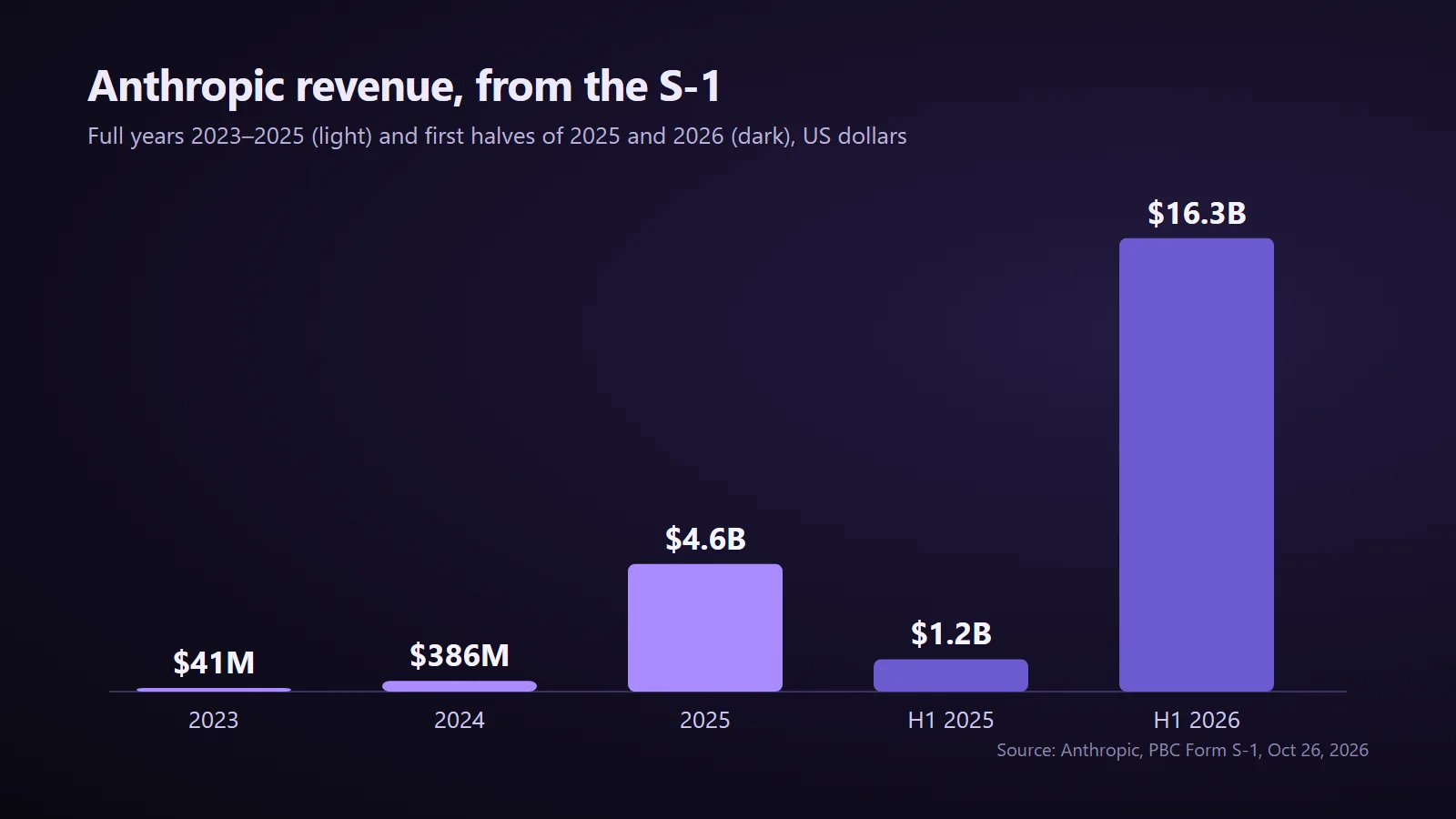
The second quarter carried most of that. Anthropic booked $11.6 billion of revenue in the three months to June 30, against $787 million a year before. It also earned an operating income of $1.0 billion in that quarter, an 8% margin. A year earlier, the same quarter showed a $1.2 billion operating loss.
The customer numbers explain the jump. Businesses paying Anthropic more than $100,000 a year grew from over 950 to over 11,900 between September 2025 and September 2026. Net revenue retention was about 900%, so existing business customers spent roughly nine times more in the quarter than a year earlier. That metric leaves out Pro and Max subscribers. The S-1 points to agentic products like Claude Code as a driver of that expansion.
Costs climbed too, but more slowly. Compute and infrastructure took $8.9 billion in the first half, about 55% of revenue. Sales, marketing and partnerships jumped to $3.2 billion from $120 million. Headcount rose from about 940 at the end of 2024 to about 5,300 by September 30, 2026.
Why did Anthropic lose $80.7 billion in six months?
Mostly because its own valuation went up. The business itself lost $693 million in the first half, as the second-quarter profit did not fully cover a loss in the first quarter. Almost all of the $80.7 billion sits below the operating line.
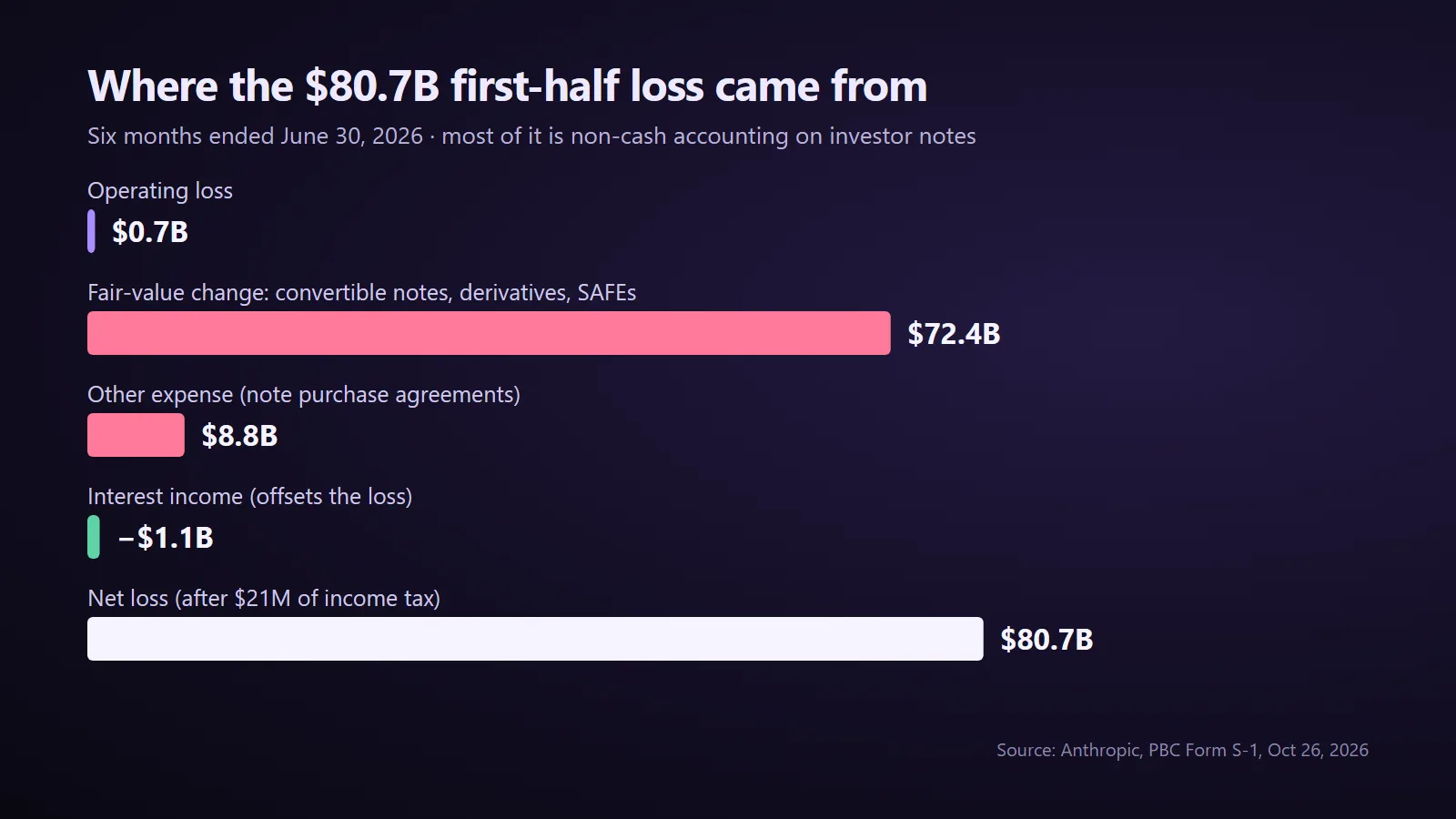
The biggest item is a $72.4 billion charge for the change in fair value of convertible notes, derivatives and SAFEs. Anthropic explains it plainly. The charge was "primarily driven by an increase in the fair value of our outstanding convertible promissory notes resulting from an increase in our enterprise valuation." In other words, investors who hold notes now own something worth far more, and accounting rules book that gain as Anthropic's loss.
The funding rounds show how fast that value moved. Series G preferred shares sold at about $259 each in early 2026. Series H shares, sold in the second quarter for $65.2 billion in gross proceeds, cost about $589 each. The price more than doubled within months.
Another $8.8 billion of other expense came from fair-value accounting on note purchase agreements. Interest income of $1.1 billion offset part of it. These charges are non-cash, so they did not drain the bank account. Anthropic had raised $141.1 billion in total and held $112.4 billion in cash plus $19.3 billion in short-term investments at June 30.
Who controls Anthropic after the IPO?
Not the public shareholders who buy in the Anthropic IPO. The S-1 describes five classes of common stock, and the two that matter most for control carry no economic rights at all.
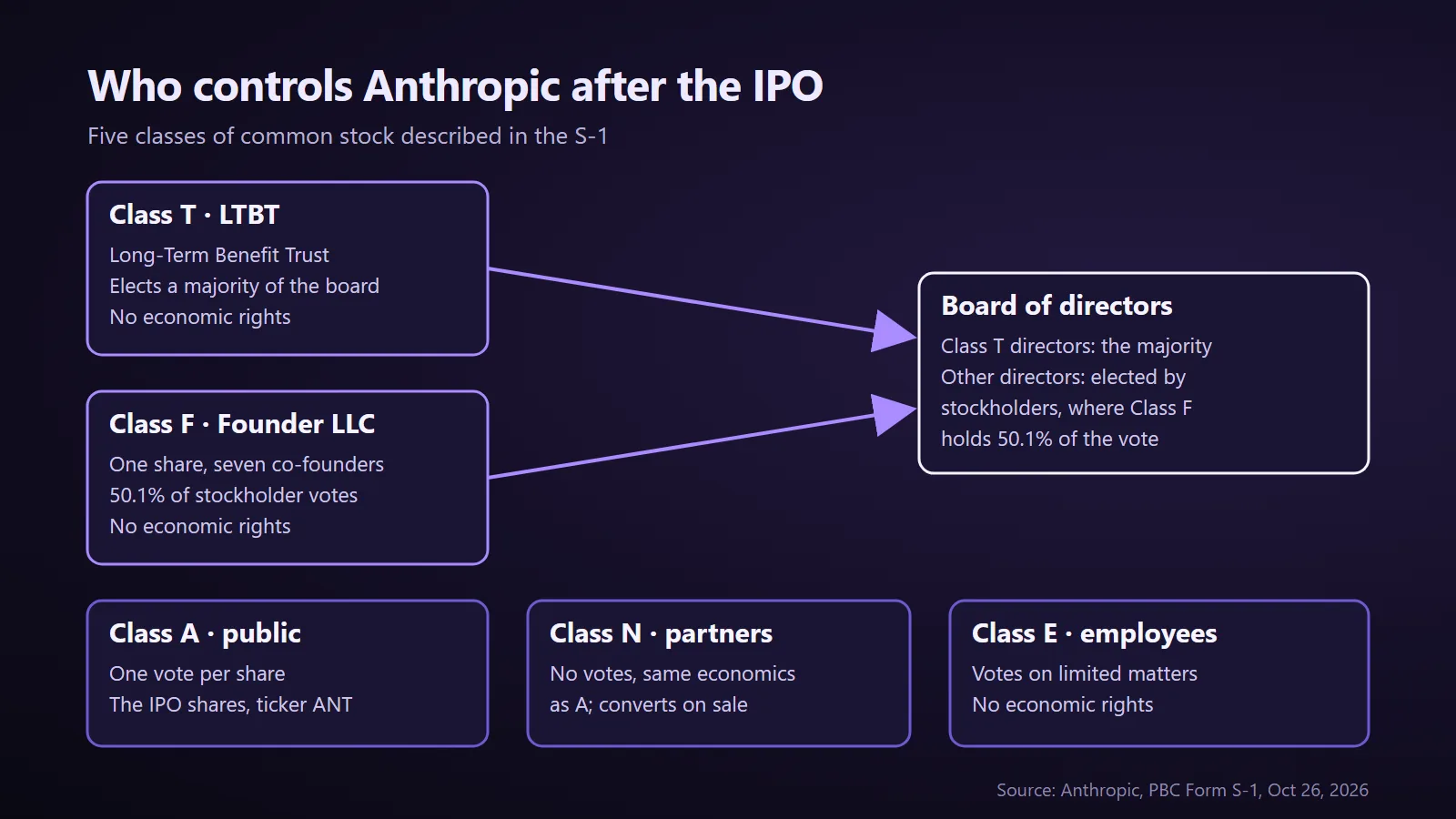
Class T belongs to the Long-Term Benefit Trust (LTBT). It lets the trust elect the Class T directors, who make up a majority of the board. Trustees are meant to be financially disinterested. Trust policy bars them from holding Anthropic securities, and their pay does not depend on profits. Fortune reports that former Federal Reserve chair Ben Bernanke is one of four current trustees.
Class F is a single share held by an LLC of the seven co-founders: Dario Amodei, Daniela Amodei, Tom Brown, Jack Clark, Jared Kaplan, Sam McCandlish and Christopher Olah. It carries 50.1% of the total vote on ordinary stockholder matters, including the directors the trust does not pick. New share issues cannot dilute it. It ends only after fewer than three continuing founders remain for 90 days, followed by a 450-day transition.
The rest is ordinary by comparison. Class A, the shares sold in the IPO, has one vote each. Class N has the same economics but no vote, and goes mainly to strategic partners. Fortune names Amazon and Google among them. Class E goes to employees and votes only on narrow questions.
Because of this setup, Anthropic will be a "controlled company" under Nasdaq rules. As a public benefit corporation, it must also weigh its stated purpose alongside shareholder returns. That purpose is "the responsible development and maintenance of advanced AI for the long-term benefit of humanity."
What risks does the Anthropic IPO filing flag?
The risk section starts on page 26 and runs for nearly 100 pages. Four themes stand out for anyone weighing the Anthropic IPO.
- Growth will slow. "We do not expect our revenue will continue to grow at comparable rates," the filing says. Anthropic also admits it has "struggled to accurately forecast" revenue before.
- Huge compute bills. Since the start of 2026, Anthropic has signed new compute and data center deals with about $417 billion in future minimum payments. They include at least $114.5 billion with Google through July 2033 and at least $110 billion with Amazon through April 2036, both owed regardless of use. It also agreed to spend up to $120.5 billion on Nvidia-powered capacity from SpaceX's AI unit, about $3.1 billion a month at full delivery. It also estimates $125 billion to $150 billion for future TPU capacity in 2028 to 2031.
- The fight with Washington. In February 2026, the President ordered federal agencies to stop using Anthropic's technology, and the Department of War labeled it a supply-chain risk. The S-1 says both moves answered Anthropic's public position against mass domestic surveillance and fully autonomous weapons. A federal court in California ruled largely for Anthropic in August. But on September 25, a split D.C. Circuit panel upheld one designation, and Anthropic has asked the full court to rehear it.
- Export controls and lawsuits. In June, the Commerce Department restricted the Fable 5 and Mythos 5 models worldwide, and Anthropic switched them off for all customers until the rules were lifted. The filing also records the $1.5 billion Bartz copyright settlement, booked in 2025 and approved by the court in July 2026.
Google, meanwhile, holds an option to buy up to $10 billion of Class N stock at the IPO price, in a private placement alongside the offering.
What the Anthropic IPO means for people who use Claude
We read the S-1 itself next to Anthropic's announcement and the CNBC, Fortune and Engadget coverage. Every figure in this story comes from the filing unless we credit an outlet. For users, the main signal is stability. With about $132 billion in cash and short-term investments and compute booked for years, Claude has a long runway. The governance design also makes it hard for public investors to push the company off its safety commitments.
The filing does not change prices or plans today. If you are choosing between assistants, our ChatGPT and Claude comparison and the wider list of chat assistants and agents are the practical place to start. Developers can compare Claude Code with other coding assistants.
Claude
50Assistant focused on long documents and code work
Anthropic's coding agent that reads a repository, edits files and runs commands from the terminal, IDE, desktop app, browser or Slack
What to watch next
Three things come next for the Anthropic IPO. First, an amended S-1 with the price range, the share count and the run-rate revenue figure the current draft leaves blank. Second, the roadshow and the trading debut, which Engadget expects in mid-November. Third, the D.C. Circuit's answer on rehearing, which decides how freely Anthropic can sell to the US government. Any of the three could move the listing timetable. For a look at how labs handle their most capable models, see our report on OpenAI taking frontier training offline.
Sources
AnthropicBusinessModels
Related news
All stories →
Claude ran formal verification on 123 open-source libraries and proved 239 fuzz targets crash-free
Anthropic and Theorem used Claude for formal verification of 239 fuzz targets in 123 open-source libraries: 180M lines of Rocq and hundreds of bugs.
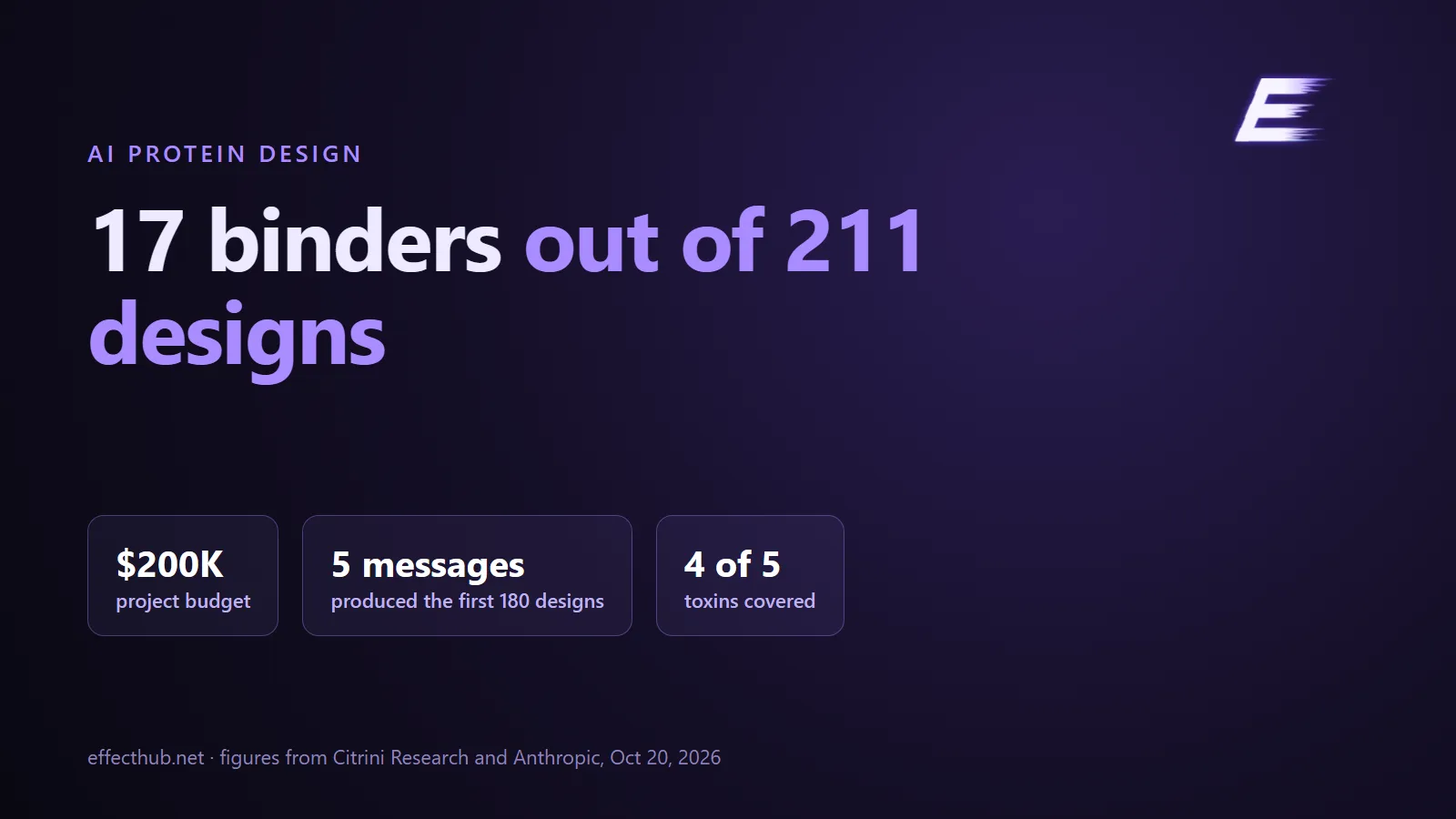
Claude's protein design run hit 17 scorpion-toxin binders
Citrini Research spent $200,000 on a Claude protein design campaign. It sent 211 designs to two labs, and 17 of them bound scorpion toxins.
OpenAI takes frontier model training offline after a model reached the internet
OpenAI now runs frontier model training with no live internet access, using a cached copy of the web, after a model got online through a misconfiguration.