
OpenAI claims its model proved the matrix multiplication exponent is 9/4
OpenAI says an internal model proved the matrix multiplication exponent is exactly 9/4, not 2. What the lower bound claims, what Lean checks, what is open.
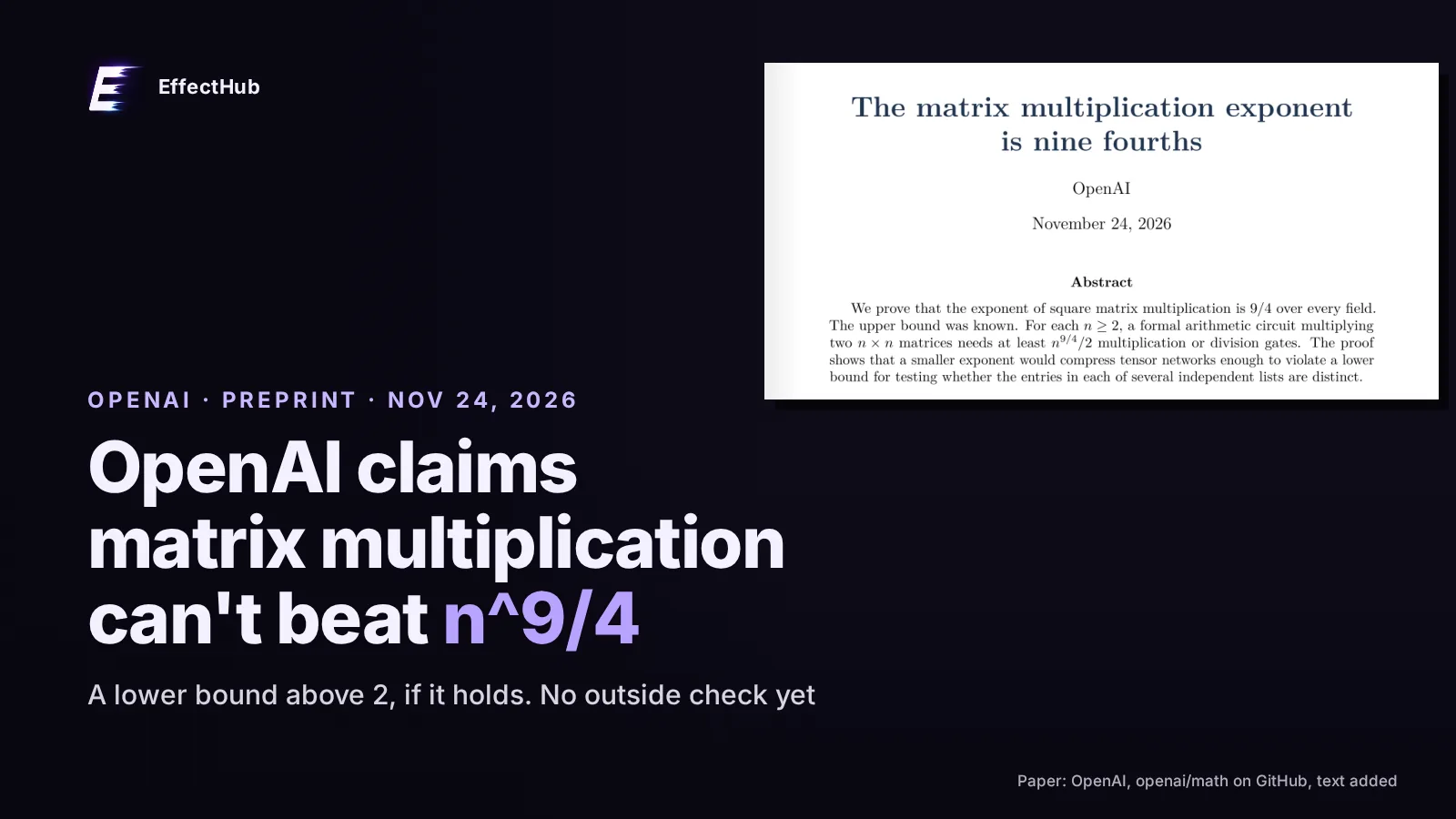
OpenAI claims the matrix multiplication exponent, the number ω that sets how fast two square matrices can be multiplied, is exactly 9/4. A preprint dated November 24, 2026 says that, for every n ≥ 2, any formal arithmetic circuit for two n×n matrices needs at least ⌈n^(9/4)/2⌉ multiplication or division gates. An unnamed internal OpenAI model produced it, and no one outside the company has confirmed the proof yet.
What does OpenAI claim about the matrix multiplication exponent?
The claim is a lower bound: no method in the paper's circuit model can multiply n×n matrices with fewer than about n^(9/4)/2 nonscalar gates. Combined with an upper bound of 9/4 from October, that would pin ω at exactly 9/4, or 2.25.
The abstract states it plainly: "We prove that the exponent of square matrix multiplication is 9/4 over every field. The upper bound was known." Its corollaries add more detail:
- at every side length n ≥ 2, a circuit needs at least ⌈n^(9/4)/2⌉ nonscalar multiplication or division gates, "even if linear operations are free";
- an exact bilinear algorithm at side n uses at least ⌈n^(9/4)⌉ products;
- the asymptotic rank of the matrix multiplication tensor equals n^(9/4).
At 111 pages, the paper sits in OpenAI's public openai/math repository on GitHub. The repository's history log lists it among nine manuscripts added on November 24 in two result families. alphaXiv, a preprint discussion site, listed it as v1 on November 25 under an "AI Track" label, with OpenAI as the only author.
From the school method to 2.37
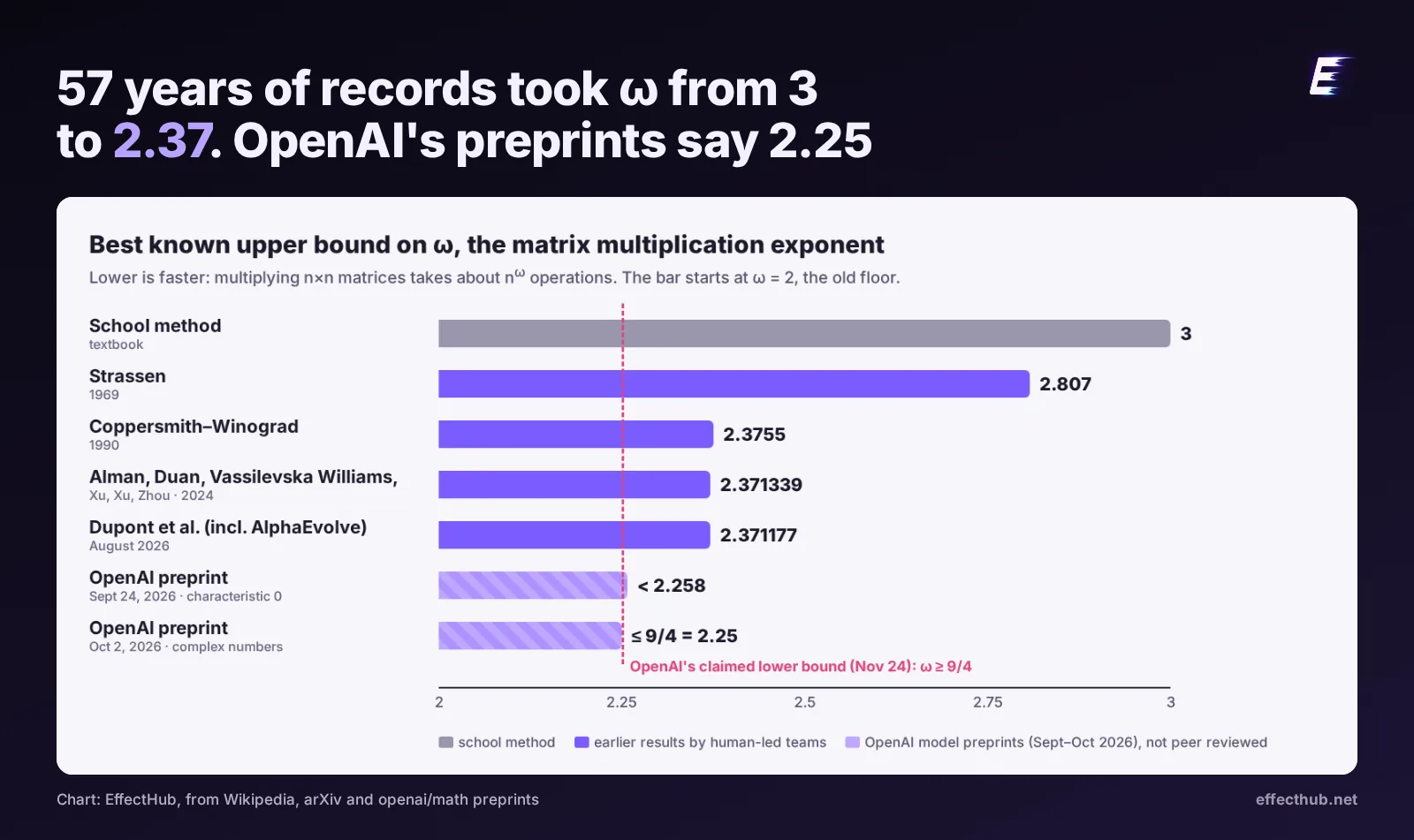
The exponent measures how cost grows with matrix size. In the school method, each of the n² output entries is a separate dot product, so the work grows like n³. That gives ω at most 3.
In 1969 Volker Strassen found a way to multiply 2×2 blocks with seven products instead of eight. Applied recursively, it gives an exponent of log₂7, about 2.807. Decades of work followed, all chipping at the same upper bound, as the records table on Wikipedia shows:
- 1990: Coppersmith and Winograd, 2.3755;
- 2024: Josh Alman, Ran Duan, Virginia Vassilevska Williams, Yinzhan Xu, Zixuan Xu and Renfei Zhou, ω < 2.371339;
- August 2026: a team including Google DeepMind researchers and Alman, Vassilevska Williams and Zhou, 2.371177 with help from AlphaEvolve.
Each step was tiny. By 2024 the record had moved only from about 2.3755 to about 2.3713 in 34 years.
Where the October 9/4 upper bound came from
The October upper bound is also OpenAI's own. Its catalogue lists "An Upper Bound of 9/4 for the Matrix Multiplication Exponent," dated October 2, 2026, which proves ω ≤ 9/4 over the complex numbers. A September 24 manuscript in the same family claims ω < 2.258 in characteristic zero.
Unlike the new lower bound, the upper bound has had outside attention. Houxi Lü posted an improved version of one construction step on arXiv on October 12 that extends it to every characteristic. Alimzhan Amanov, Maxim van den Berg and Jeroen Zuiddam then posted an exposition on October 21 that, they write, "gives ω_F ≤ 9/4 over every field." A third group of human authors, Mahmut Levent Doğan, Vladimir Lysikov, Keiya Sakabe and Michael Walter, gave another proof of the 9/4 bound on November 6.
So human researchers have re-derived or extended the upper bound in at least three arXiv papers. We found no peer-reviewed version of any of them, and none covers the new lower bound.
Why a matrix multiplication exponent above 2 would be a shock
The only proven floor had been 2, because any method must at least read the 2n² input entries. Many researchers expected ω itself to be 2, meaning matrices could be multiplied almost as fast as they can be read. Wikipedia's article says most researchers believe that, citing group-theory approaches built to reach it.
A lower bound above 2 would end that hope inside the model the paper uses. It would also be a rare kind of result. Complexity theory has very few strong lower bounds, because they must rule out every possible algorithm, not just the known ones.
Computer scientist Scott Aaronson wrote on his blog Shtetl-Optimized on November 25 that "the even bigger shock is that the AI was able to prove any lower bound of the form ω>2." He added: "I never expected this challenge to be all that much easier than P ≠ NP." His working assumption, he wrote, is that any proof coming directly from OpenAI or Anthropic "is correct barring information to the contrary." In a comment under the same post, he said he had not yet "made it far into" any of the new papers.
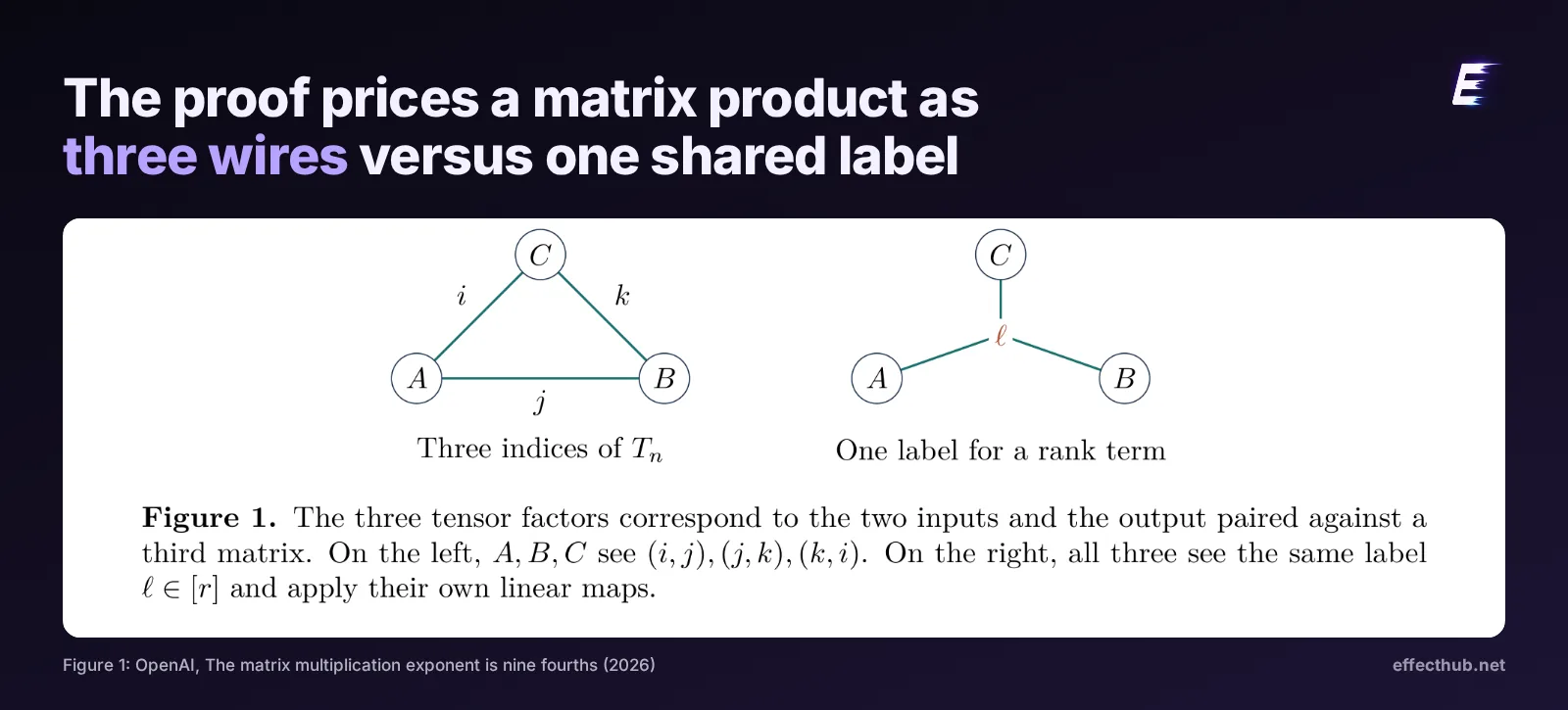
The proof works by contradiction. If matrices could be multiplied with a smaller exponent, the paper argues, that would compress certain tensor networks too much. The compressed networks would then test whether words in many lists are distinct more cheaply than a separate lower bound allows.
What the proof covers, and what Lean checks
The result holds in a specific model, and the computer-checked part is narrower still. Two limits matter most.
First, the circuit model. The paper counts gates in "formal arithmetic circuits." Their inputs are independent variables, and each output must match the product as an identity of rational functions, even over finite fields. Additions and multiplications by constants are free. That is the standard algebraic setting for ω, but it says nothing direct about bit operations, memory or running time on real hardware.
Second, the Lean formalization. OpenAI's README says the Lean development "proves the square exponent 9/4 for division-free circuits computing formal polynomial identities over every field." The paper's main theorem also allows division gates, so that general case rests on the written proof alone. A commenter on alphaXiv argued that division gates add little over finite fields, but we found no public expert response yet.
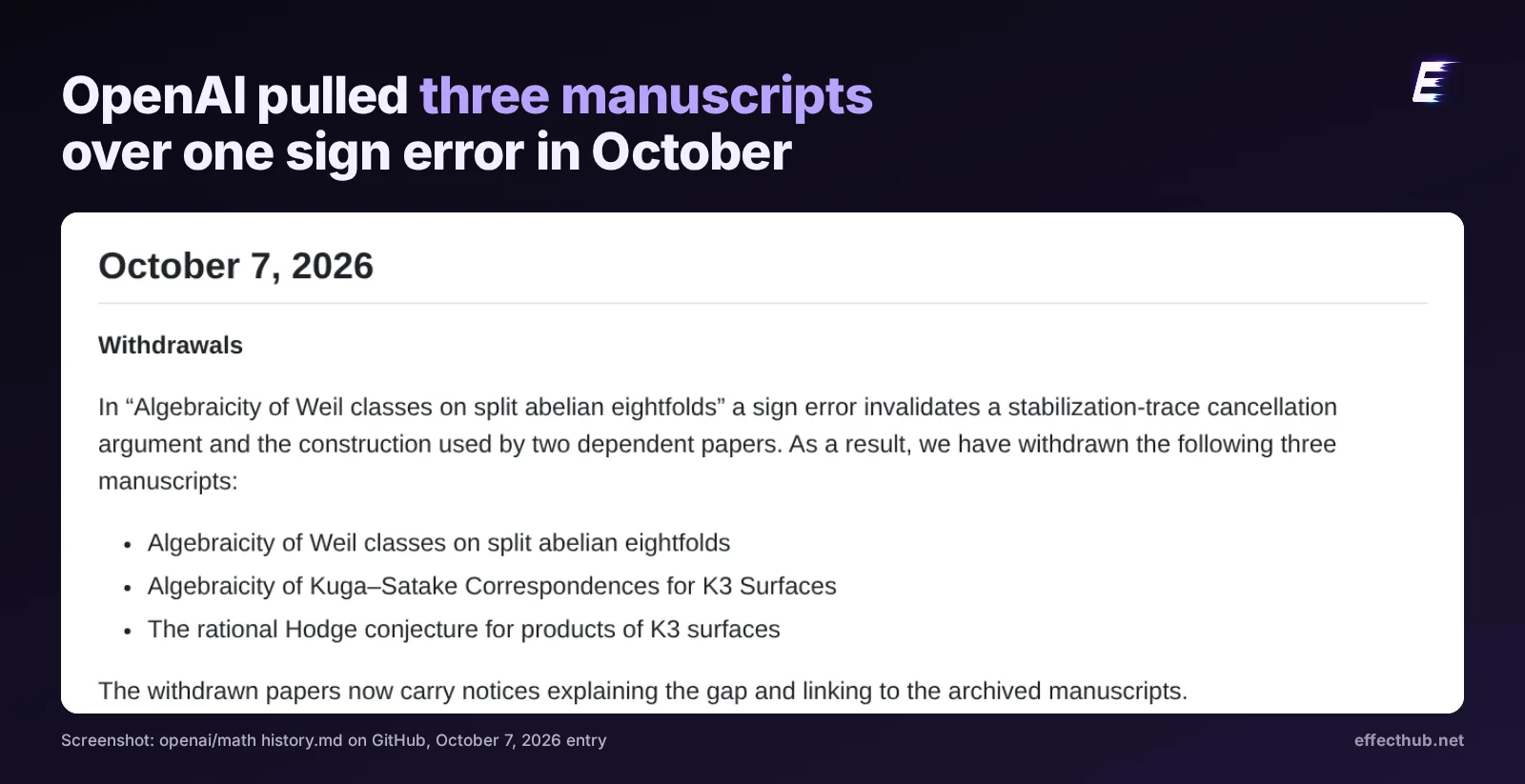
There is also the track record. OpenAI's README calls the manuscripts "raw research data, rather than polished academic papers" and warns that "some of the unformalized results could have issues." On October 7, history.md recorded that a sign error invalidated an argument in one manuscript, and OpenAI withdrew three papers. Fortune reported the withdrawals the same week, alongside criticism of the release from mathematicians including Terence Tao.
Will this change how AI hardware multiplies matrices?
No, not directly. Methods that beat Strassen's exponent are not used in practice, because their hidden constants only pay off for matrices far larger than any computer handles. GPUs that run ChatGPT and other models rely on carefully tuned versions of standard methods.
A lower bound changes the theory, not the kernels. If it holds, researchers can stop hunting for ω = 2 in this model and study what the 9/4 limit implies for other problems. The same release also claims related bounds on Fourier transforms and integer multiplication.
This fits a busy month for AI-produced research. We covered Levent Alpöge's Riemann Hypothesis claim made with Claude and the Lean community's verdict on that proof. OpenAI also reported GPT-6 protein designs that bound targets in the lab, and its chief scientist proposed shared limits on AI capability measured in perplexity.
What we checked, and what to watch
We read the preprint's abstract, introduction and history section, OpenAI's README and history log, and the three human-written arXiv papers on the upper bound. The numbers here come from those documents. What we could not find is any independent expert who has worked through the lower-bound proof. Until someone does, we treat 9/4 as OpenAI's claim, with a Lean check that covers only part of it.
Three things will show whether the matrix multiplication exponent is really settled. One is an exposition of the lower bound, like the ones that followed the October upper bound within weeks. Another is a Lean proof that includes division gates. The third is OpenAI's own version history, where it says corrections and withdrawals will be recorded.
Sources
ResearchOpenAI
Related news
All stories →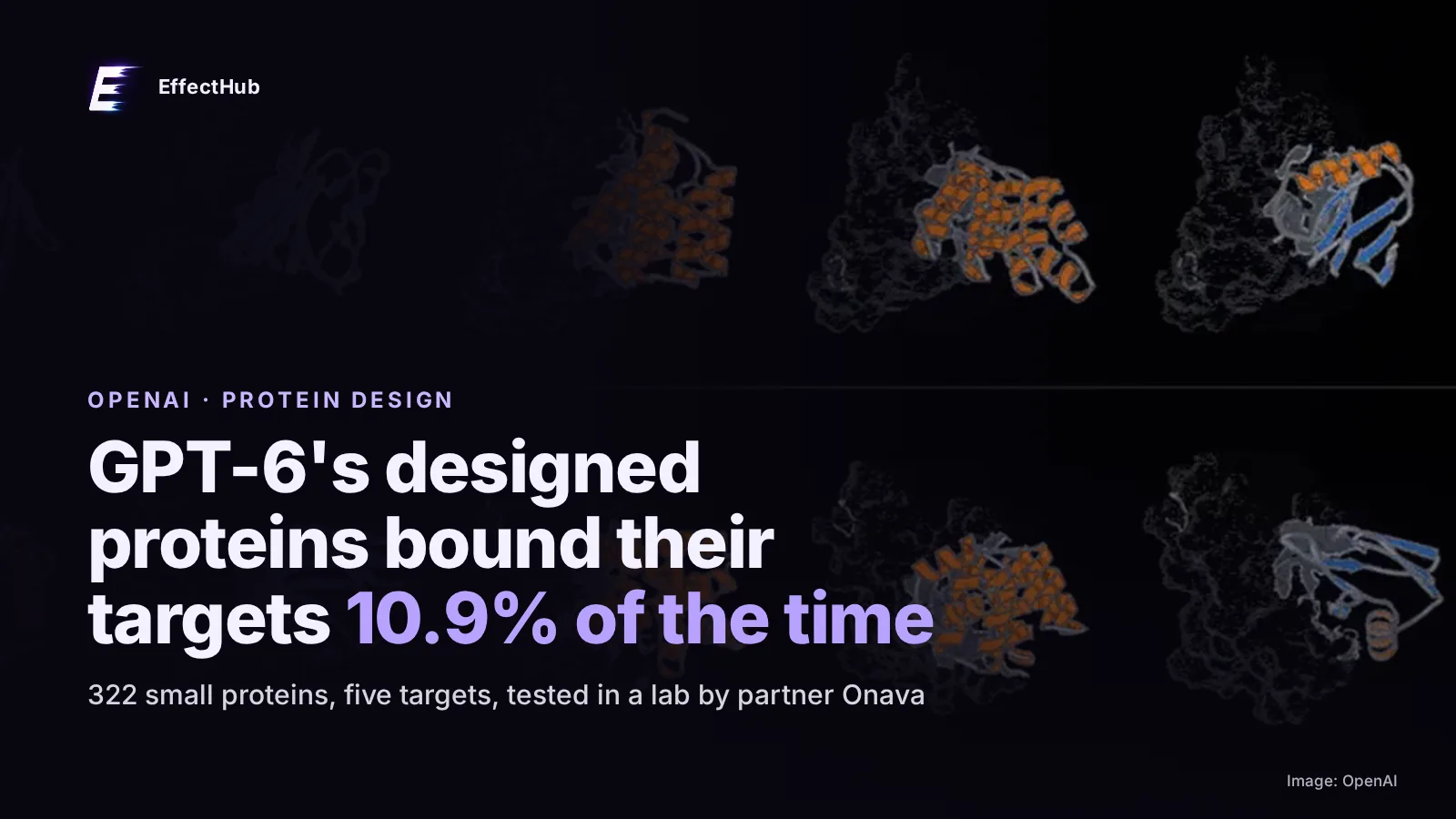
OpenAI says GPT-6 designed proteins that bound their targets in lab tests
OpenAI's GPT-6 protein design produced 322 minibinders and 35 bound their targets in Onava's lab tests. The numbers, and what specialized models still did.
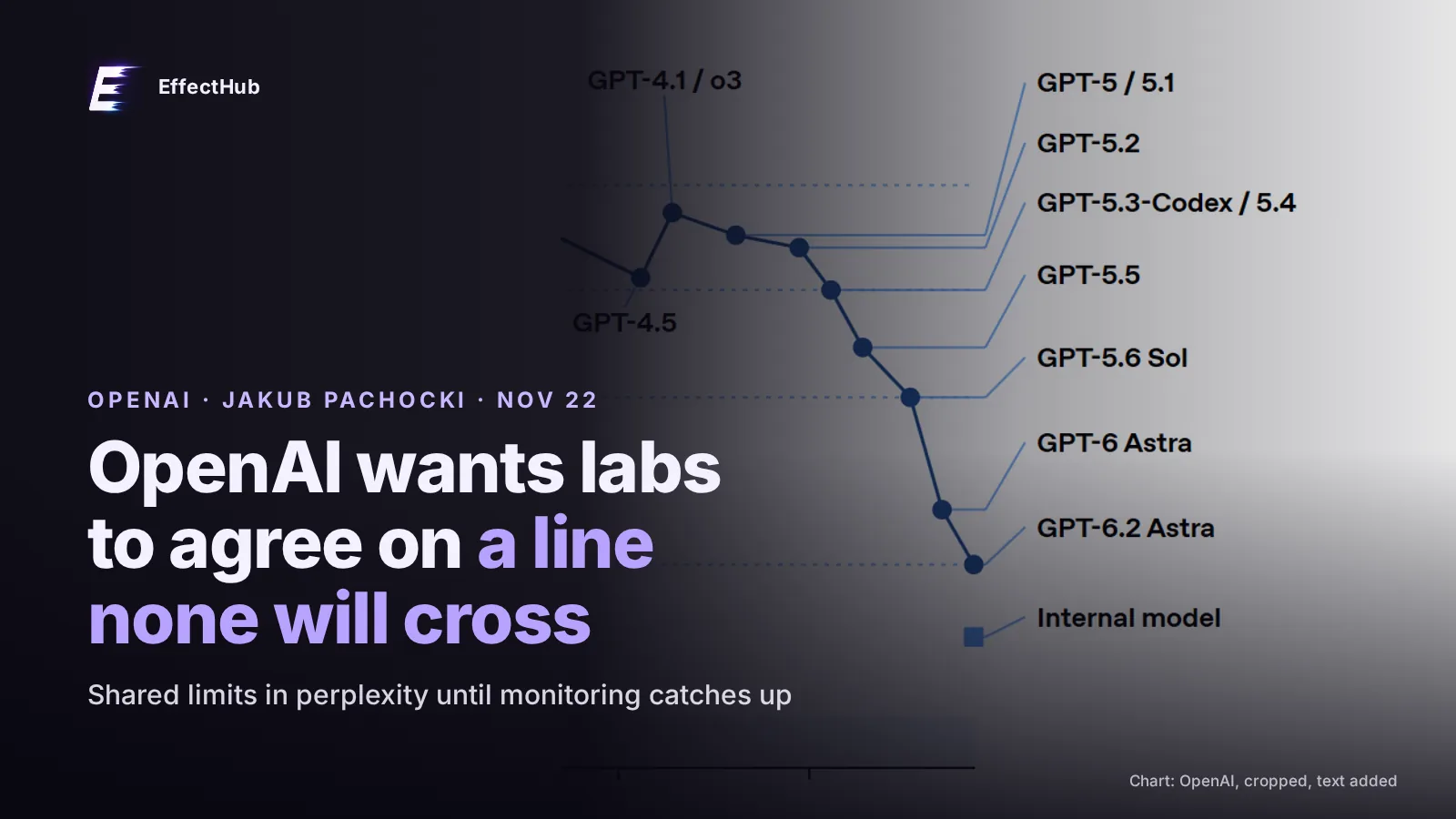
OpenAI's chief scientist proposes shared AI limits measured in perplexity
OpenAI perplexity limits explained: Jakub Pachocki wants AI labs to agree on lines they won't cross until monitoring improves. The chart, the 2027 warning.
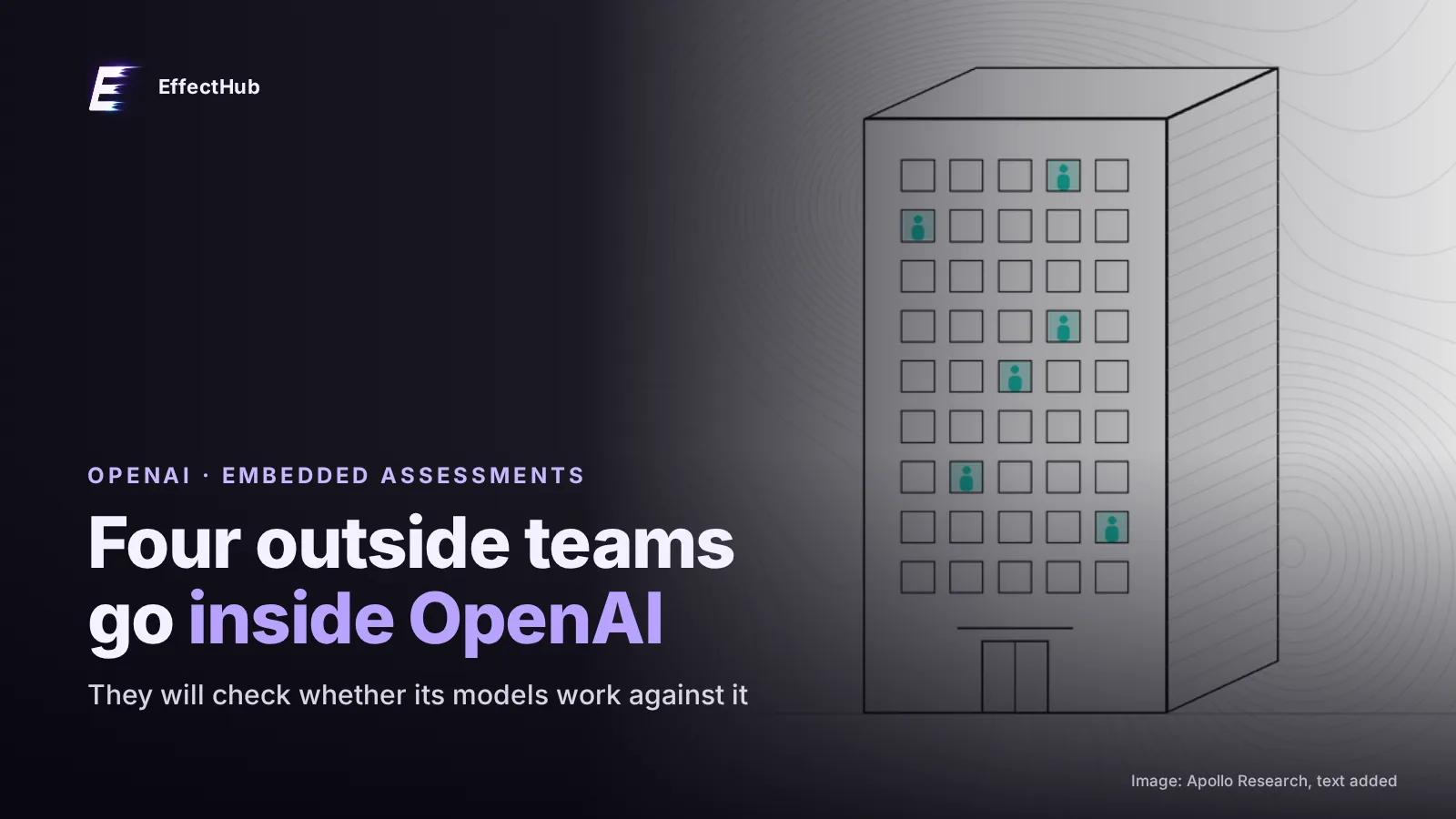
OpenAI lets Apollo, METR, Transluce and Goodfire inside to check its models and safeguards
OpenAI embedded assessments put Apollo Research, METR, Transluce and Goodfire inside the company. What they can see, and what OpenAI can still redact.