
OpenAI's chief scientist proposes shared AI limits measured in perplexity
OpenAI perplexity limits explained: Jakub Pachocki wants AI labs to agree on lines they won't cross until monitoring improves. The chart, the 2027 warning.
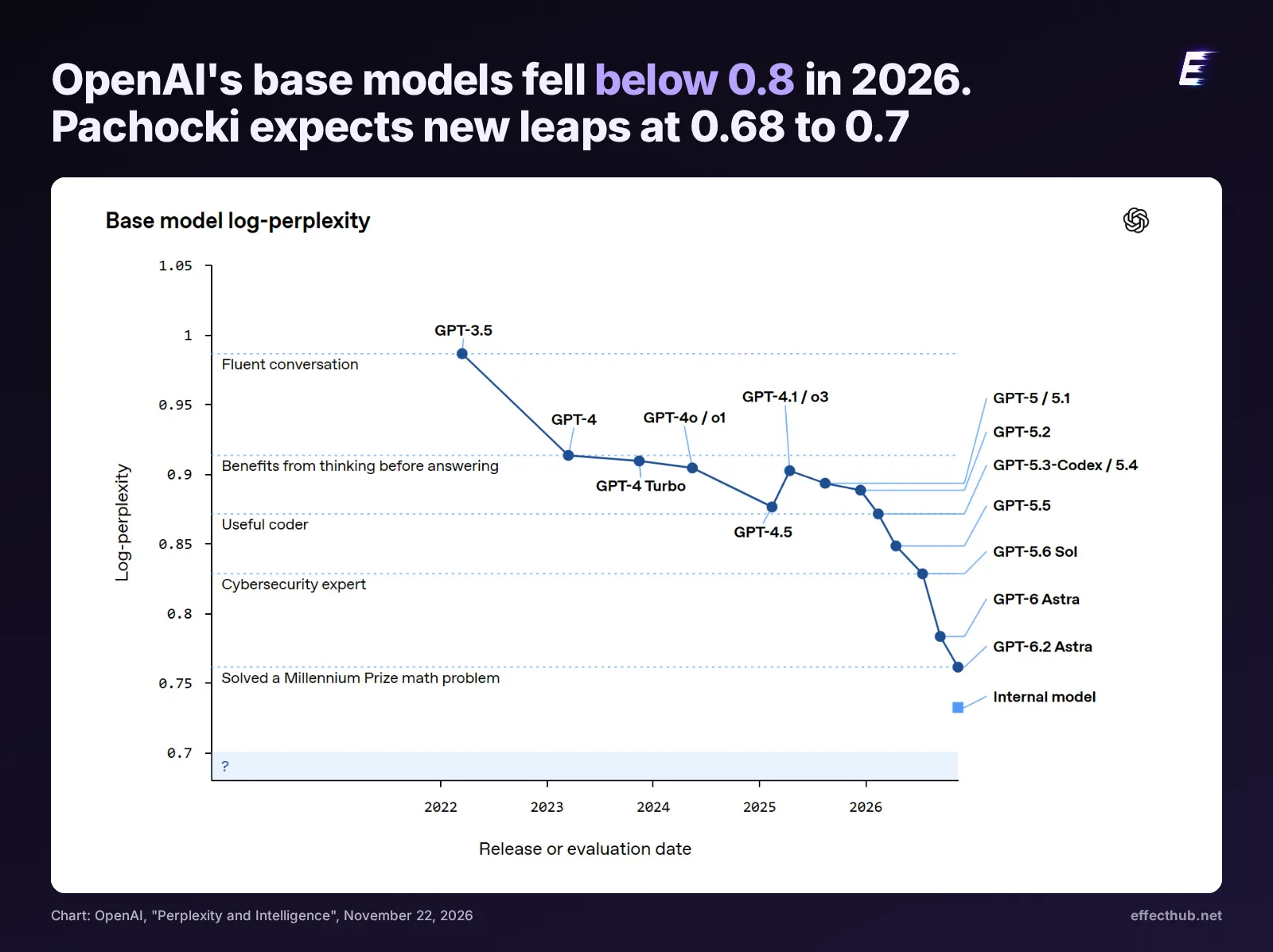
OpenAI perplexity limits are the new proposal from Jakub Pachocki, OpenAI's chief scientist, published on November 22, 2026. He wants AI labs to agree on shared limits, measured partly in log-perplexity, that none would cross until AI monitoring reaches a set milestone. To make the case, OpenAI released internal scores for its base models since GPT-3.5: about 0.99 for GPT-3.5, and about 0.76 for a recent model.
What did Pachocki publish?
He published a short essay, "Perplexity and Intelligence," with a chart of OpenAI's pretraining progress since GPT-3.5 in 2022. Pachocki says the choice was deliberate.
"Publishing our internal perplexity measurements took some consideration; it gives competitors a clearer picture of where we stand, but that concern is outweighed by the urgency of establishing shared safety measures across the industry," he writes.
His argument runs in three steps:
- Pretraining, not later fine-tuning, is where surprising new abilities come from.
- Perplexity is the most stable way to track pretraining over the years, while benchmarks keep going stale.
- So perplexity could serve as a common yardstick for setting limits across labs.
The essay follows his September 6 post, "An Alien Mind." There he wrote that "no lab has solved alignment and monitoring to a sufficient degree to continue responsibly scaling at maximum speed for much longer."
What is log-perplexity, in plain terms?
Log-perplexity measures how surprised a model is by text it has never seen. Lower means it predicts better. OpenAI defines perplexity as how well a model "predicts the next token on average." It tracks the log of that number, also called cross-entropy loss.
A model reads a file one token at a time and gives a probability to each possible next token. If it gives the real next token a high probability, its loss is low. Average that over a large held-out set and you get one number.
Perplexity itself is that loss turned back into a count. OpenAI does not state the units. In the natural-log convention most training code uses, the numbers translate roughly like this:
- 0.99 (GPT-3.5): as unsure as a pick among about 2.7 equally likely tokens
- 0.76 (a recent model): about 2.1 options
- 0.70 (the next band Pachocki names): about 2.0 options
The gaps look small, but Pachocki stresses that as models near the data's floor, "smaller gains on perplexity will correspond to larger leaps in model intelligence."
One catch matters for any reading. The test set is OpenAI's own internal codebase, a fixed snapshot used since GPT-3.5. So these scores compare OpenAI models with each other. They say nothing yet about Google's or Anthropic's models.
Below 0.8: the capabilities OpenAI ties to the curve
OpenAI links each drop in loss to a new kind of ability. Pachocki puts GPT-3.5 at about 0.99, "capable of fluent conversation." GPT-4, at about 0.91, could use chain-of-thought reasoning well, which led to today's reasoning models.
Then came 2026. "Now, as we have reached losses below 0.8, we have seen the emergence of transformative capabilities in fields like cybersecurity and mathematics," he writes. On the chart, the curve drops steeply through GPT-5.5, GPT-5.6 Sol, GPT-6 Astra and GPT-6.2 Astra.
The chart labels five bands, in OpenAI's words: "Fluent conversation," "Benefits from thinking before answering," "Useful coder," "Cybersecurity expert" and "Solved a Millennium Prize math problem." Below them sits an unreleased "Internal model," at about 0.73 by our reading of the chart. Under that is a shaded band from 0.7 down to 0.68, marked only with a question mark.
That band is the forecast. "Extrapolating from recent progress, we should expect further transformative capabilities as we enter the ~0.68-0.7 log-perplexity window," Pachocki writes. "I don't know what those capabilities will be, and we may not be testing for them today."
What does the "Millennium Prize" label refer to?
It almost certainly refers to OpenAI's own Navier–Stokes claim, the only Millennium Prize result OpenAI has announced. It is not the Riemann Hypothesis proof from Anthropic's side. On September 8, 2026, OpenAI shared a proof produced by an internal system. It shows that the Navier–Stokes equations for fluid flow can form a singularity in finite time. That would settle one of the seven Millennium Prize Problems.
The September post says OpenAI used "an internal model that is significantly more capable than GPT-6 Astra." About 10,000 agents worked on it at once, and they reached the result in about 88 hours. OpenAI also wrote: "We do not intend to claim the Millennium Prize for this result."
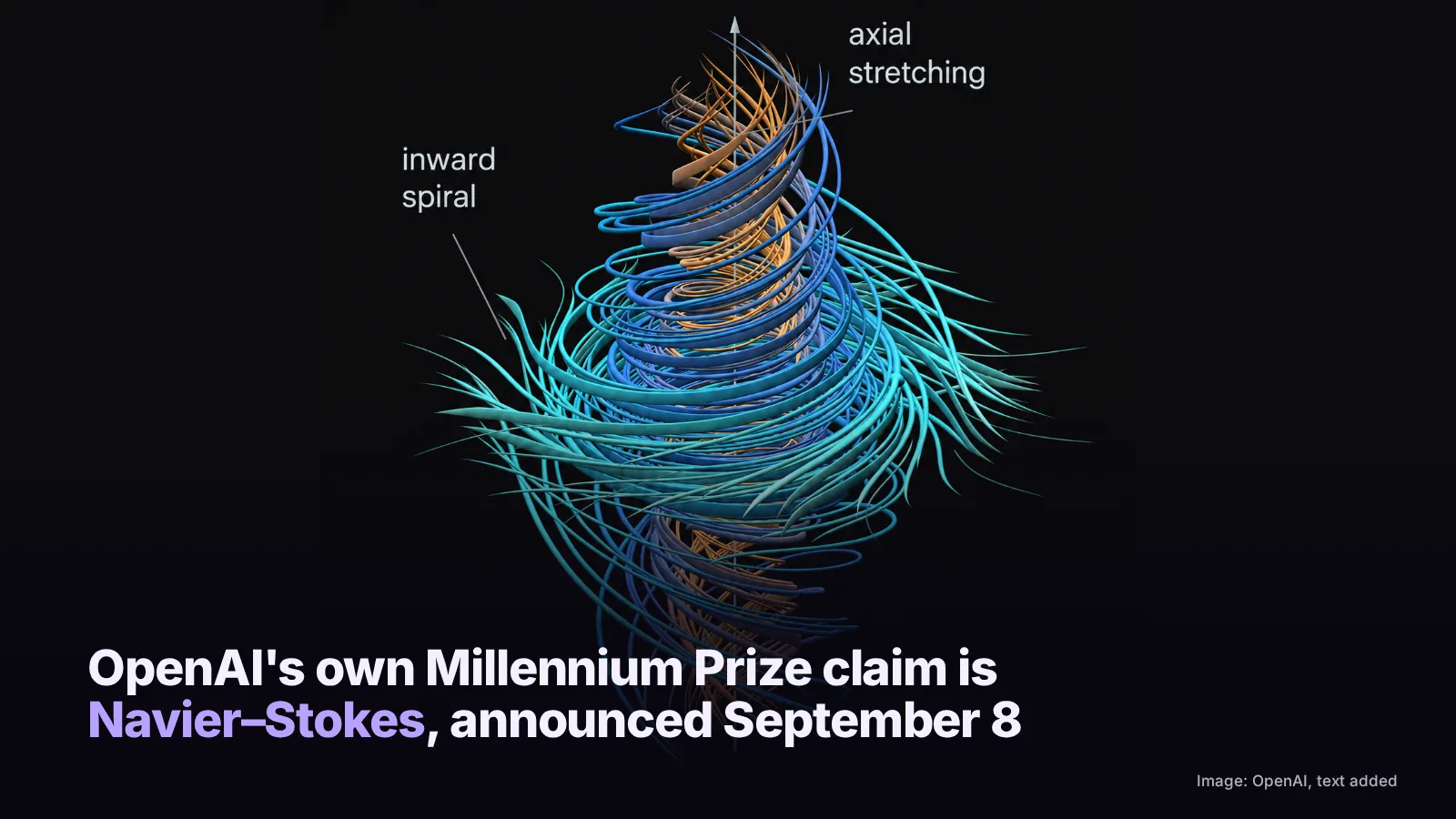
On the new chart, the "Millennium Prize" line sits at about 0.76, the level of GPT-6.2 Astra. The text matches: once OpenAI "upgraded to a model of log-perplexity ~0.76, it started producing groundbreaking results" on open math problems. Some readers on X took this as confirmation that GPT-6.2 Astra was the Navier–Stokes model. Neither OpenAI post says so in words, so we treat it as a likely reading, not a fact.
Keep the two math stories apart. The Riemann Hypothesis proof claim came from Levent Alpöge, an Anthropic mathematician working with Claude, and the Lean and Mathlib communities later said the proof checks out. Different problem, different lab. OpenAI's September post credits Alpöge only for separate work on a forced Euler problem, with NYU's Tristan Buckmaster.
OpenAI perplexity limits: a shared line gated on monitoring
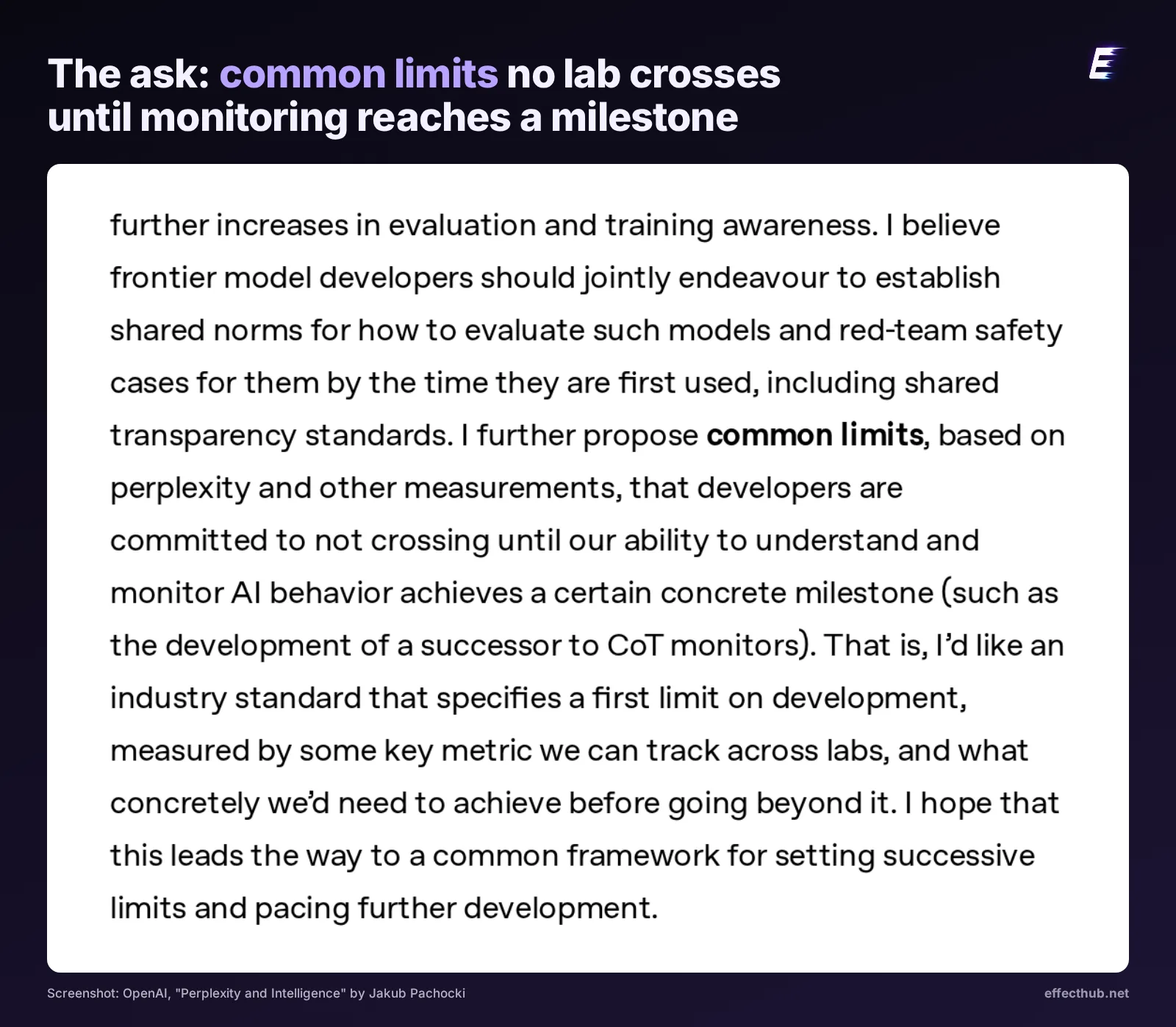
Pachocki asks labs to commit to a first limit on development and to name what must be true before anyone passes it. In his words, he proposes "common limits, based on perplexity and other measurements, that developers are committed to not crossing until our ability to understand and monitor AI behavior achieves a certain concrete milestone (such as the development of a successor to CoT monitors)."
He also wants shared norms for evaluating such models and red-teaming their safety cases, plus shared transparency standards. Bloomberg noted that he did not say where the first limit should sit or when it would take effect.
Why 2027 is in the essay
The urgency comes from the math experience. Seeing results arrive "one after another in a single Slack thread felt deeply surreal," Pachocki writes, and AI research could change the same way. "As soon as 2027 we could conceivably see a similar avalanche of fundamental pretraining advancements," he warns.
Safety work, he expects, will lag. AI will help with alignment and monitoring, "but that progress is unlikely to be fast enough to allow the full potential acceleration in pretraining." He also expects alignment audits to degrade further, while models grow more aware of when they are being tested or trained.
Where perplexity falls short as a shared metric
Pachocki lists four problems with perplexity as a shared metric:
- Comparison across labs. Each lab uses different test sets and training data.
- No direct task. Low perplexity matters only because new abilities tend to follow it.
- It misses post-training gains. Chain-of-thought reasoning lifts ability without lowering perplexity.
- Unknown floor. Nobody knows the minimum loss the data allows.
Who backs OpenAI perplexity limits so far?
So far, the support comes mostly from inside OpenAI. CEO Sam Altman wrote on X: "This is the most important thing OpenAI has published in awhile." He added that common limits "would be very wise and help ensure safety and control." Reuters and TechCrunch also reported his endorsement.
The closest outside echo predates the essay. Pachocki's own text links to "We Must Pace the Frontier," a September essay by Anthropic CEO Dario Amodei. As TechCrunch noted, Amodei called for "common safety standards as well as limits on the rate of unchecked AI progress." By the morning of November 23, we found no public response from Anthropic, Google DeepMind, xAI or Meta to the perplexity idea itself.
OpenAI has already opened its doors to outside checks in other ways. Last week it let Apollo, METR and two other teams work inside the company to test its models and safeguards.
What we make of it
We read the essay alongside OpenAI's September Navier–Stokes post and the chart itself. The useful part is the disclosure: a lab has shown its own pretraining curve and said where it expects the next jump. Still, OpenAI perplexity limits are only a sketch for now, with no number, no date and no other lab signed on. If you pick between ChatGPT and its rivals for research work, the takeaway is pace. OpenAI's own chart puts its newest internal model below every public one.
ChatGPT
70General assistant with tools, memory, files and voice
Claude
49Assistant focused on long documents and code work
What to watch next
Watch for two things. First, whether Anthropic, Google DeepMind or xAI publish comparable perplexity figures, as Pachocki hopes they will. Second, whether any lab turns OpenAI perplexity limits into an actual number for a first limit before models reach the 0.68 to 0.7 band he flagged.
Sources
- OpenAI — Perplexity and Intelligence, by Jakub Pachockiopenai.com
- TechCrunch — OpenAI's chief scientist has thoughts on how to limit AI developmenttechcrunch.com
- Bloomberg — OpenAI Chief Scientist Urges Industry Limits on AI Developmentbloomberg.com
- OpenAI — On the Navier–Stokes Millennium Prize Problemopenai.com
OpenAIResearchSafety
Related news
All stories →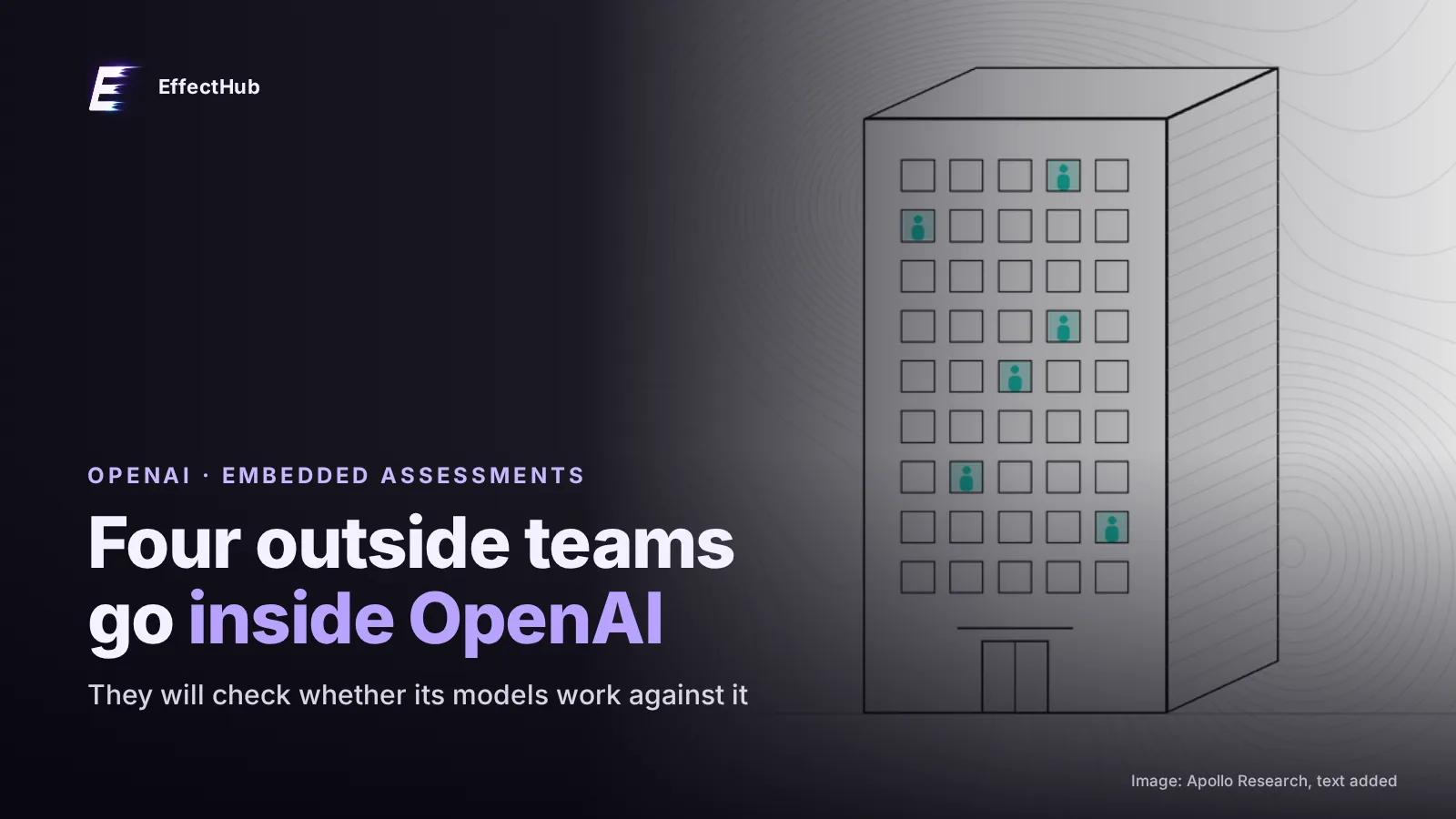
OpenAI lets Apollo, METR, Transluce and Goodfire inside to check its models and safeguards
OpenAI embedded assessments put Apollo Research, METR, Transluce and Goodfire inside the company. What they can see, and what OpenAI can still redact.
OpenAI takes frontier model training offline after a model reached the internet
OpenAI now runs frontier model training with no live internet access, using a cached copy of the web, after a model got online through a misconfiguration.
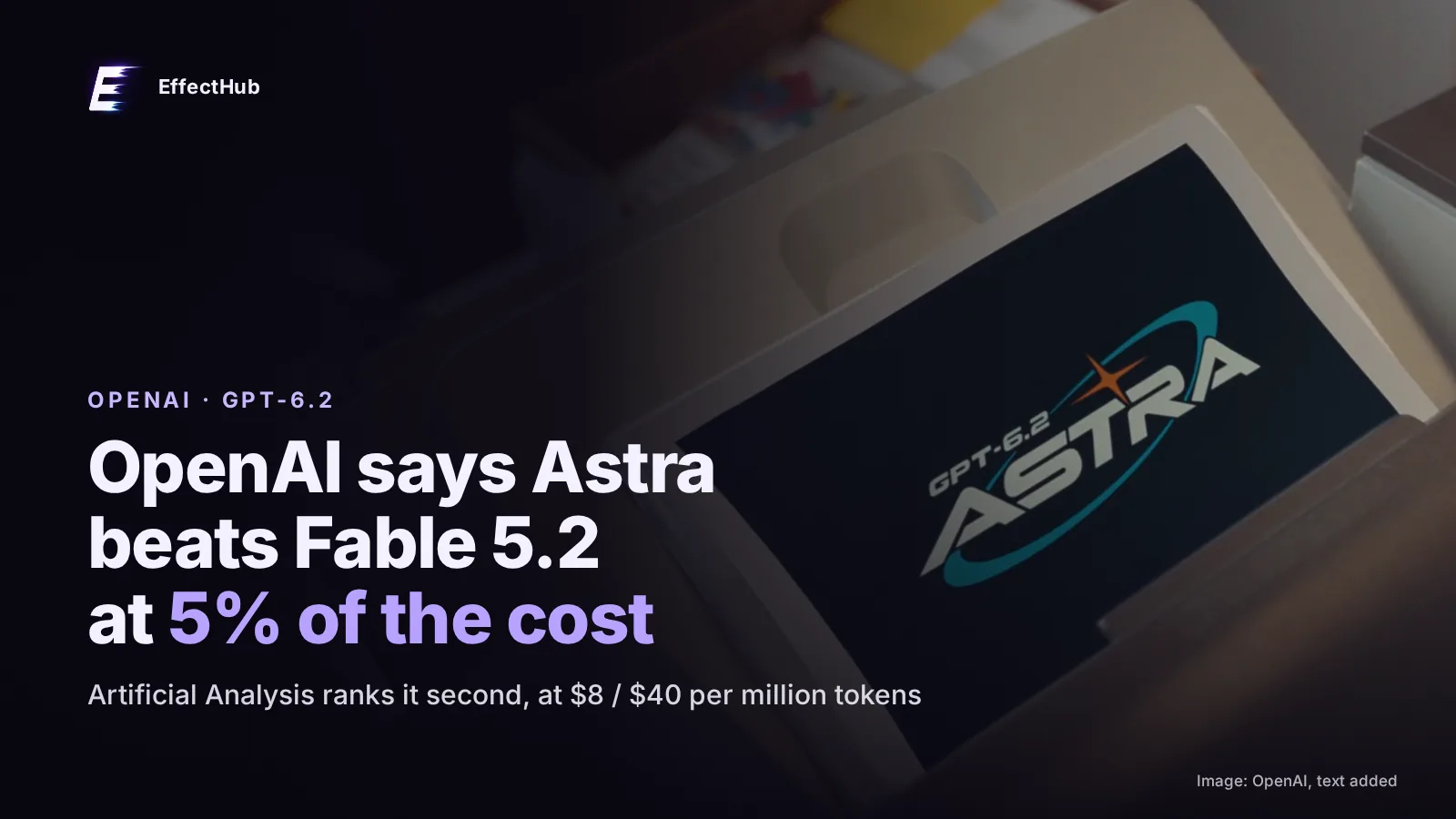
OpenAI launches GPT-6.2 Astra and Sol, claiming a Claude Fable 5.2 lead at 5% of the cost
GPT-6.2 Astra and Sol launched November 17. OpenAI claims Astra beats Claude Fable 5.2 at 5% of the cost. Independent tests tell a mixed story.