
Anthropic mathematician claims a Riemann Hypothesis proof found with Claude
Levent Alpöge says he and Claude found a Riemann Hypothesis proof, formalized in Lean. What the checks show, what experts say, and what is still open.
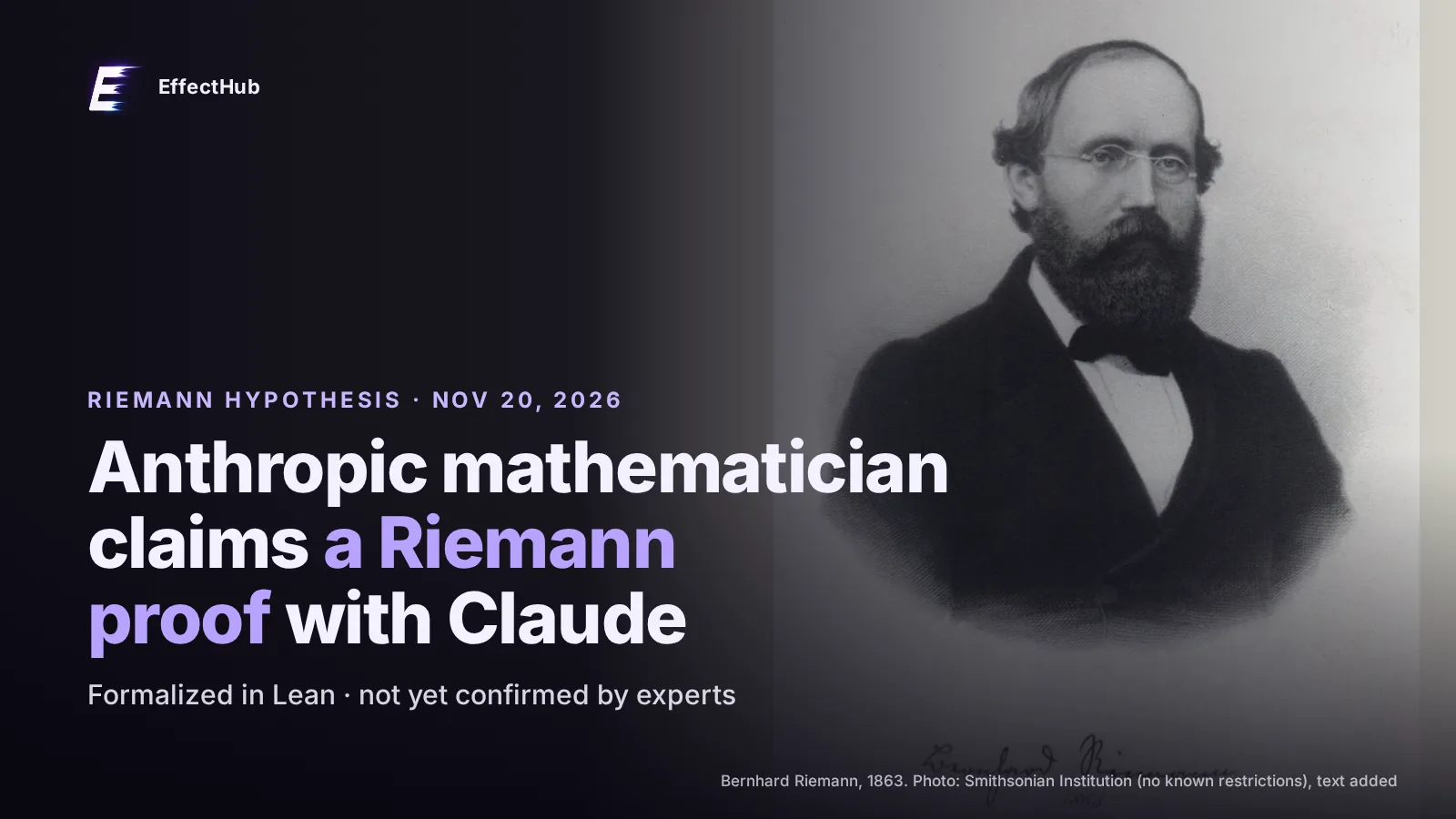
Levent Alpöge, a mathematician at Anthropic, claimed on November 20, 2026 that he has a Riemann Hypothesis proof, found while working with Claude. He released no paper, only a four-page note and a Lean formalization in 14 archive parts. Independent mathematicians have not yet confirmed the claim.
What did Alpöge claim about a Riemann Hypothesis proof?
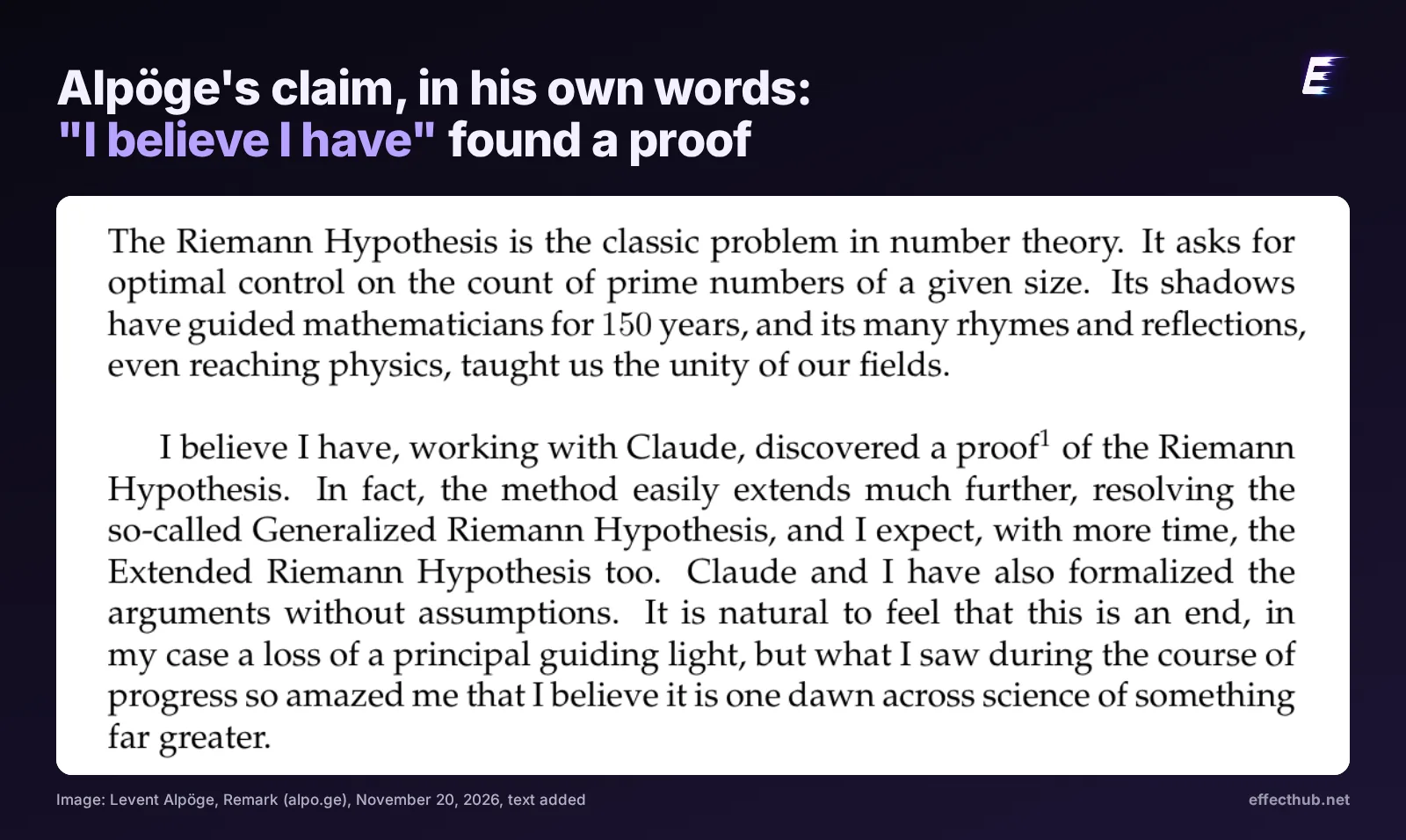
He claims a complete proof, formalized in the Lean proof assistant, of the most famous open problem in mathematics. His note, titled "Remark" and posted on his personal website, opens plainly: "I believe I have, working with Claude, discovered a proof of the Riemann Hypothesis."
He goes further. The method, he writes, "easily extends much further, resolving the so-called Generalized Riemann Hypothesis." He expects the Extended Riemann Hypothesis to follow "with more time." He also says that "Claude and I have also formalized the arguments without assumptions."
On the division of labor, Alpöge credits the model heavily. He says he guided the work toward the right setting, but "this time Claude far outpaced me near the finish line." By his own timeline, the first key step dates to October 6, and the Generalized Riemann Hypothesis fell on November 16.
He is also candid about the form. "The argument is incredibly long at the moment," he writes. Rather than post an unreadable write-up, he chose to release only the Lean code. In a footnote he says a prose version he generated ran past 250,000 pages. He plans to study the argument, simplify it and "write it properly."
What is the Riemann Hypothesis?
The Riemann Hypothesis is a claim about where the zeros of one function lie, and those zeros control how prime numbers are spread out. Bernhard Riemann proposed it in 1859, and it has stayed open since.
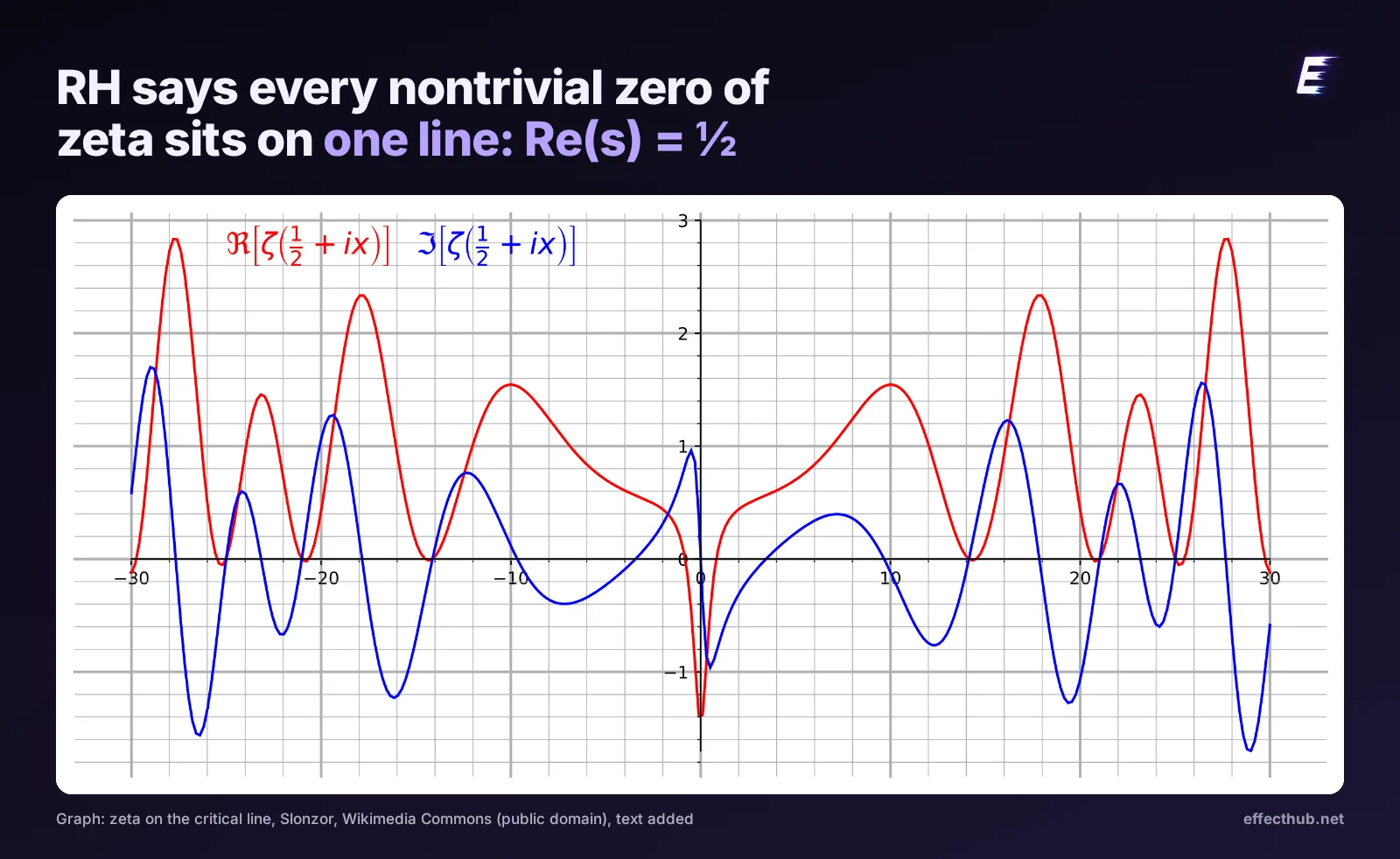
The function is the Riemann zeta function, ζ(s). It equals zero at the negative even numbers, which are called the trivial zeros. The hypothesis says every other zero has real part exactly ½. In other words, all the nontrivial zeros sit on one vertical line in the complex plane, the critical line.
Why care? The primes look random, but their count up to any size follows a smooth estimate. If the hypothesis is true, the error in that estimate is about as small as it could possibly be. A large body of published work assumes it, so a proof would turn many conditional theorems into unconditional ones.
The Generalized Riemann Hypothesis makes the same claim for a wider family of functions, called L-functions. Alpöge says his method covers it too.
Would a Riemann Hypothesis proof win the $1 million prize?
Yes, but a claim does not collect it. The Clay Mathematics Institute named the Riemann Hypothesis one of seven Millennium Prize Problems in 2000, each with a $1 million award.
Its rules set a slow path. The institute takes no direct submissions. A solution must appear in a qualifying publication, at least two years must pass after it is published, and it must win general acceptance among mathematicians. Only one prize problem has been declared solved, the Poincaré conjecture. Grigori Perelman declined that prize.
So even if every check passes, there is no paper yet, and the two-year clock has not started. A Riemann Hypothesis proof that exists only as Lean code cannot yet qualify.
What does a Lean formalization prove, and what doesn't it?
It proves that a stated theorem follows from the axioms, but only the theorem as it is written in code. Lean is a proof assistant: software that accepts a proof only if every step checks out against a small trusted core, called the kernel.
That makes a Lean proof hard to fake, but it leaves three questions open:
- Is the statement right? If the formal statement quietly says something weaker, the proof proves the weaker thing.
- Are the checkers and definitions sound? The result relies on the kernel and on the library's definitions meaning what we intend.
- Do humans understand it? A machine check is not an explanation, and mathematicians want to know why it is true.
Kevin Buzzard of Imperial College London, a leading figure in Lean, put the open check plainly in a post to the Lean community, quoted by Scientific American: "We still await a successful comparator run." That tool checks that the code does not quietly redefine the terms in the statement.
On the first question, the early evidence is encouraging. According to the checks posted by MIT mathematician Andrew Sutherland, the main theorem is stated using Mathlib's own definition of the Riemann Hypothesis. Mathlib is Lean's shared math library, and that definition was not written for this proof. It grew out of earlier work on formalizing zeta and L-functions in Lean by David Loeffler and Michael Stoll.
There is one caveat on scope. Sutherland's page notes that "GRH" in the files "means Dirichlet L-functions only." That covers a standard and important case, but it is narrower than the broadest versions of the conjecture. For a past example of what Lean checks can and cannot settle, see our report on Claude's formal verification of open-source libraries.
What have the computer checks found so far?
So far, everything that has finished has passed. Sutherland, who says he ran the checks with Claude Code, posted a public verification page on MIT's site, last updated at 22:05 UTC on November 20.
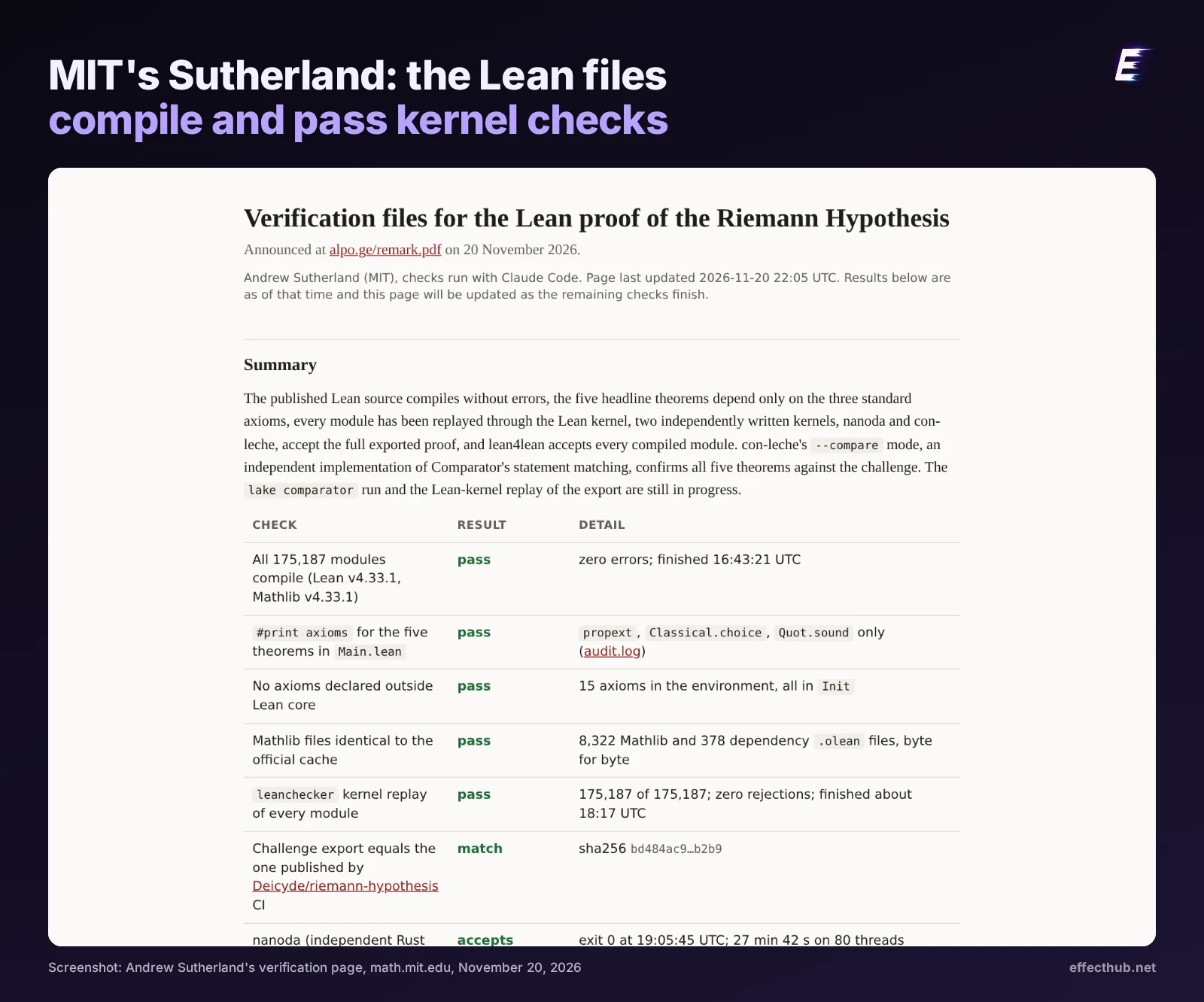
His page reports:
- All 175,187 Lean modules compile with zero errors, on Lean and Mathlib v4.33.1.
- The five headline theorems rely only on Lean's three standard axioms.
- The Mathlib files match the official cache byte for byte.
- Lean's own kernel replay, plus independent checkers named nanoda, con-leche and lean4lean, accept the proof.
- A statement-matching check confirms all five theorems against a separately exported "challenge" file.
Two runs were still in progress at the last update, including the full Comparator check. Sutherland also lists caveats: the build ran on cloud machines without a sandbox, and a sandboxed rebuild has not yet been compared. His page states that the checks rely on the kernels used and on Mathlib's definitions "being what they are intended to be."
What are independent mathematicians saying?
Mostly cautious excitement, with a clear "if." Several leading mathematicians responded on the day, and none has called the mathematics confirmed.
Sutherland, who compiled the code himself, told Scientific American: "This is indeed an historic moment." He added: "There is much work to be done to understand the mathematical details of the proof." Scientific American also quotes him as saying: "Honestly the chance that anything is fishy here is approximately zero."
James Maynard, an Oxford professor and 2022 Fields Medal winner, spoke to IBM Think. "If this fully checks out, it is clearly a historic milestone in mathematics," he said. He also said: "I suspect that the proof will turn out to be correct, although even checking the Lean verification will take some time." On understanding it: "So somewhat frustratingly, it looks like it will require quite a lot of work to really gain this understanding."
Youness Lamzouri of the University of Lorraine told IBM Think: "If this claim happens to be true, it will be a huge achievement." But he stressed that "Mathematics is mainly about understanding why something is true."
In Scientific American, Hector Pasten of the Pontifical Catholic University of Chile said a correct proof would be "something like a Rosetta Stone" between branches of math. Carlo Pagano of Concordia University, a visiting researcher at Google DeepMind, said the ideas could open "brand new avenues of thinking in number theory."
A separate, human claim surfaced the same day. Scientific American reports that Ravi Vakil, president of the American Mathematical Society, wrote on his blog that Stanford mathematician Alessandro Masullo has a proof of his own. Brian Conrad, a Stanford expert who has been giving Masullo feedback, confirmed the details, but said of the paper: "It's undergoing major revision." That claim is unverified as well.
How does this fit Claude's math record?
It is a much bigger claim than anything before it. In August, Anthropic said an unreleased Claude model raised a known lower bound on the share of zeta zeros on the critical line, from 41.6% to 67.2%. Alpöge was one of the two Anthropic mathematicians who examined that work. Anthropic wrote then: "We don't expect that the techniques Claude used will lead to proving the Riemann hypothesis."
This month Anthropic also said Claude agents formalized Fermat's Last Theorem in Lean, as covered in our report on Claude Fable 5.2. That work rewrote a known proof. Alpöge's claim is new mathematics.
The timing drew notice too. Scientific American points out that the announcement came a day after Anthropic's record stock market debut. Alpöge addresses this in his note, calling the timing "horrible" and the cynical reading of it "false."
What we make of it
We read Alpöge's note, Sutherland's check log and the expert quotes side by side. The machine checks are unusually strong for a fresh claim, and the formal statement leans on a library definition that predates the claim. Still, no human has yet read and understood the argument, and two checks were unfinished at the last update. Until that changes, we treat this as a serious claim, not a settled result. If you use AI in research work, the lesson holds either way: a verified formal statement is only as good as what it states.
Claude
49Assistant focused on long documents and code work
What to watch next
Watch for three things. First, the final Comparator result and a sandboxed rebuild on Sutherland's page. Second, a public audit of the five formal statements by Lean and number theory experts. Third, Alpöge's promised human-readable write-up of his Riemann Hypothesis proof, which would start any path toward peer review and the Clay prize.
Sources
ResearchAnthropic
Related news
All stories →
Anthropic launches Claude Fable 5.2 and says it formalized Fermat's Last Theorem in 30 hours
Claude Fable 5.2 is out at $8/$40 per million tokens. Anthropic says 1,000 of its agents formalized Fermat's Last Theorem in Lean in 30 hours.

Anthropic's Project EVE: Claude teammates almost never caught a secret saboteur
Anthropic's Project EVE hid a secret Claude saboteur in four-agent teams in EVE Frontier. Teammates almost never caught it. What it does and doesn't show.

METR estimates Anthropic's AI progress has roughly doubled, mostly due to AI
The METR Anthropic report estimates Anthropic now improves its models about twice as fast as in 2024–25, mostly due to AI. Much evidence was redacted.