
Lean and Mathlib communities say the Claude-assisted Riemann Hypothesis proof is correct
Riemann Hypothesis proof verified: Lean and Mathlib back the 17-million-line proof Levent Alpöge built with Claude. What was checked and what is open.
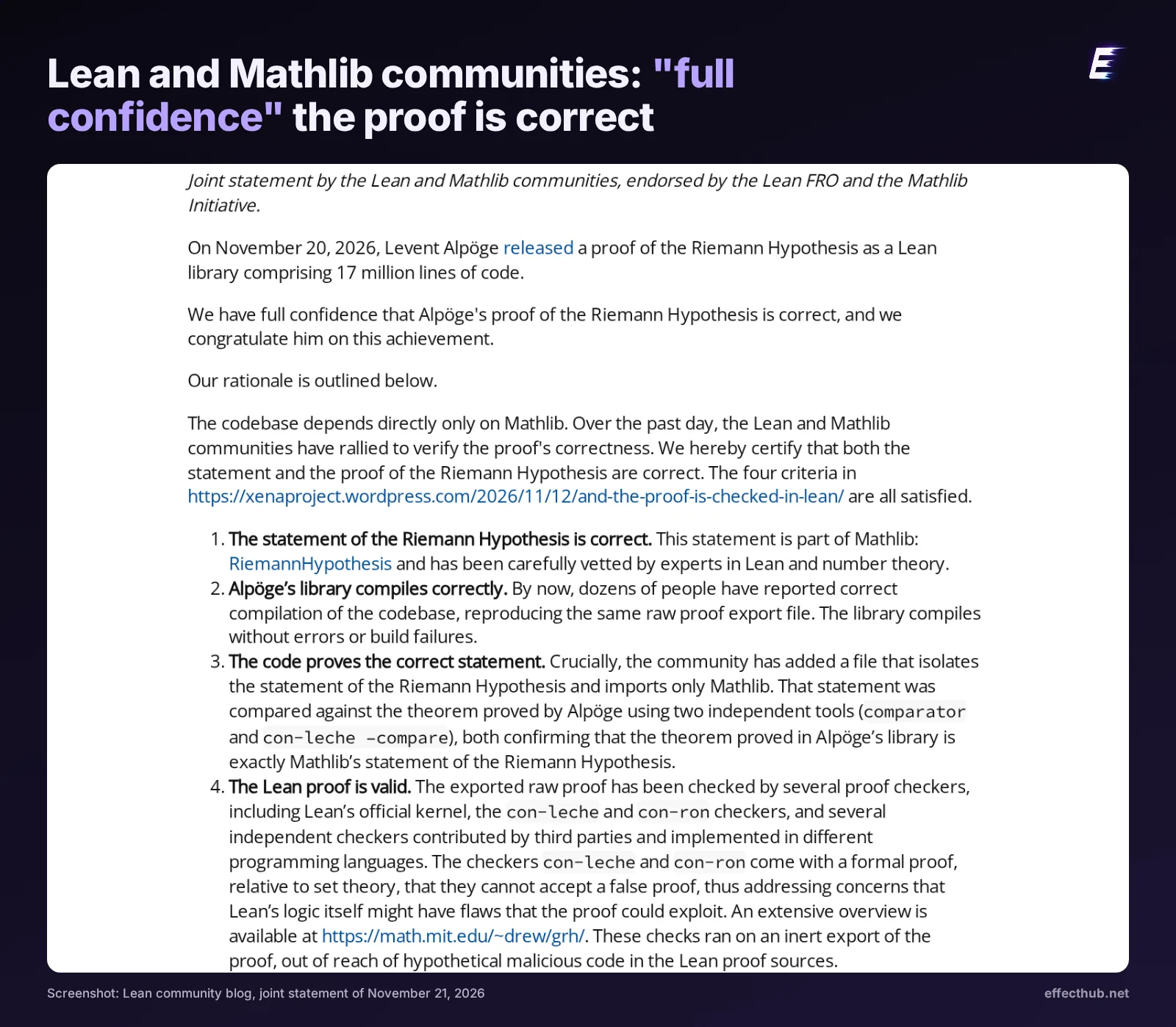
The Lean and Mathlib communities said on November 21, 2026 that Levent Alpöge's Riemann Hypothesis proof, a 17-million-line Lean library built with Anthropic's Claude, is correct. Their joint statement says: "We have full confidence that Alpöge's proof of the Riemann Hypothesis is correct." That makes it a Riemann Hypothesis proof verified by machine for Mathlib's formal statement, not a peer-reviewed paper.
Alpöge, a mathematician at Anthropic, posted the proof a day earlier with a four-page note. We covered the original claim and the first computer checks on November 21. This follow-up covers what changed since then: the community verdict, how the checks were run, and what is still open.
A joint statement from the people who build Lean
The Lean and Mathlib communities certified both the formal statement and the proof. The statement appeared on the Lean community blog on November 21. It was endorsed by the Lean FRO, which develops the Lean proof assistant, and by the Mathlib Initiative, which supports Mathlib, Lean's shared math library.
Its key line reads: "We hereby certify that both the statement and the proof of the Riemann Hypothesis are correct." The authors also congratulated Alpöge "on this achievement."
The verdict rests on four criteria from a November 12 post on the Xena Project, the blog of Imperial College London mathematician Kevin Buzzard. That post asks four questions of any proof said to be "checked in Lean":
- Does the Lean statement match the informal statement?
- Does the code compile?
- Does the code prove the theorem as stated?
- Does the code exploit a bug in Lean's official kernel?
The joint statement says all four are satisfied. It ends with a nod to the work ahead: "We look forward to all the activity in the mathematical community that will help explain the new ideas in this proof."
How was the Riemann Hypothesis proof verified?
It was checked in three layers: many people rebuilt it, two tools matched the statement, and several separate checkers replayed the proof. The joint statement describes each one.
First, compilation. "By now, dozens of people have reported correct compilation of the codebase, reproducing the same raw proof export file," the statement says. The library depends directly only on Mathlib.
Second, statement matching. The community wrote a separate file that states the Riemann Hypothesis and imports only Mathlib. Two independent tools, comparator and con-leche in its compare mode, then checked Alpöge's theorem against that file. Both confirmed it is "exactly Mathlib's statement of the Riemann Hypothesis."
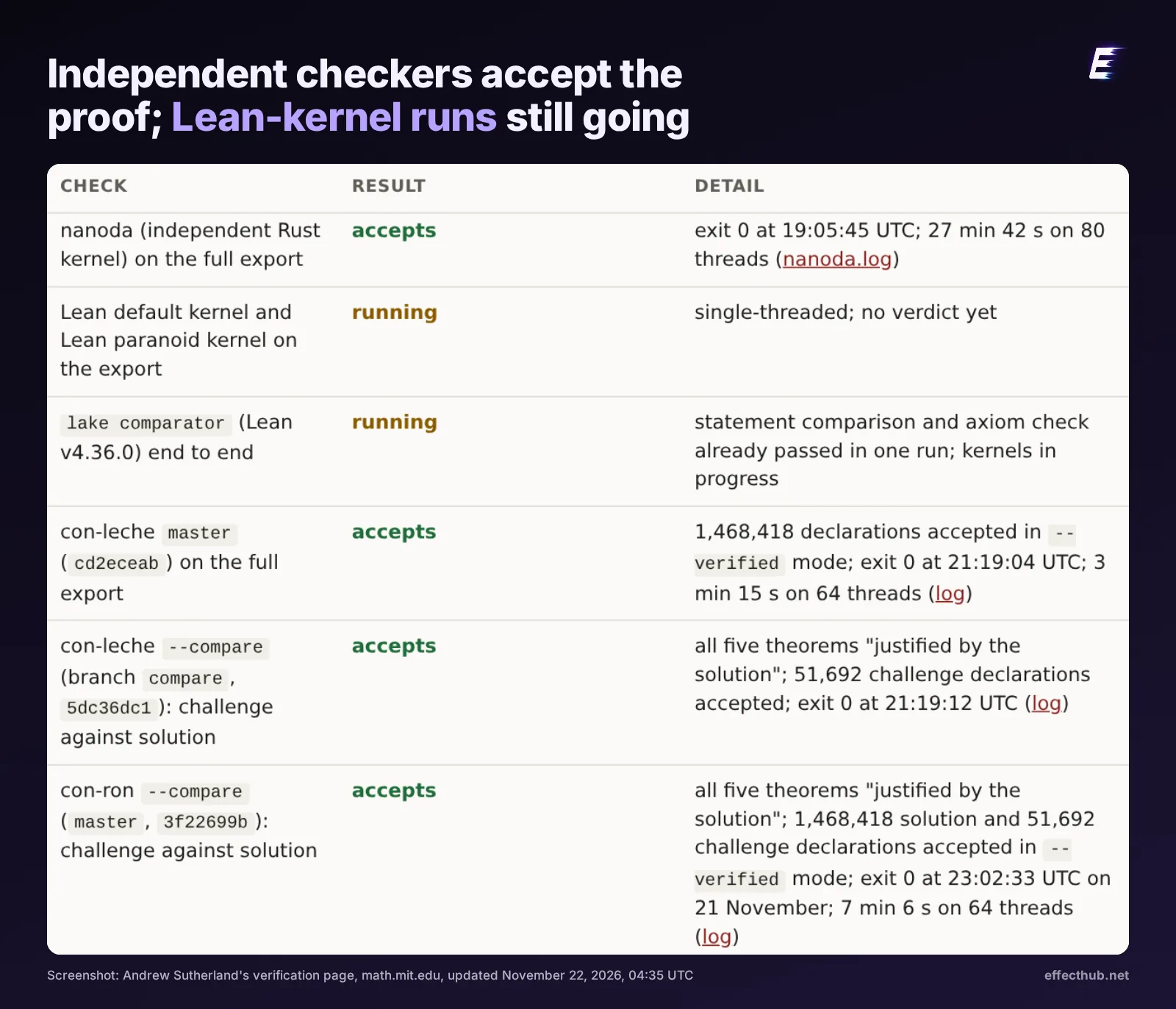
Third, proof checking. The statement says the exported proof was checked by Lean's official kernel, the con-leche and con-ron checkers, and several third-party checkers written in other languages. Sutherland's log, below, is more precise: Lean's kernel replayed every compiled module, while its run on the single exported file was still going. According to the statement, con-leche and con-ron come with a formal proof, relative to set theory, that they cannot accept a false proof. That answers the worry that a flaw in Lean itself could be exploited. The checks ran on "an inert export of the proof," so any hidden code in the sources could not interfere.
What Andrew Sutherland's log adds
MIT mathematician Andrew Sutherland keeps a public verification log, which he says he ran with Claude Code. As of its update at 04:35 UTC on November 22, it reports:
- A sandboxed rebuild on a separate machine, with no network and read-only sources, produced a byte-identical export of 61,570,595,788 bytes.
- nanoda, an independent kernel written in Rust, accepted the full export in 27 minutes 42 seconds on 80 threads.
- con-leche accepted all 1,468,418 declarations, and the compare modes of con-leche and con-ron found all five theorems "justified by the solution."
- lean4lean passed all 175,187 compiled modules; five needed a higher step limit.
Two runs had not finished. Lean's default and paranoid kernels were still replaying the export, single-threaded. The end-to-end lake comparator run was also still going, though its statement comparison and axiom check had already passed. Scientific American, in a story updated on November 21, wrote that the comparator run "has now been completed." Sutherland's later log shows the statement check done and the kernel stages still running.
There is one more cross-check. Sutherland combined the proof with Robin1984, an independent Lean formalization of Robin's and Lagarias's criteria. Together they give two inequalities about sums of divisors that never mention the zeta function. Every check on them has passed except one comparator run still in progress.
What exactly was proved, and what does "GRH" cover?
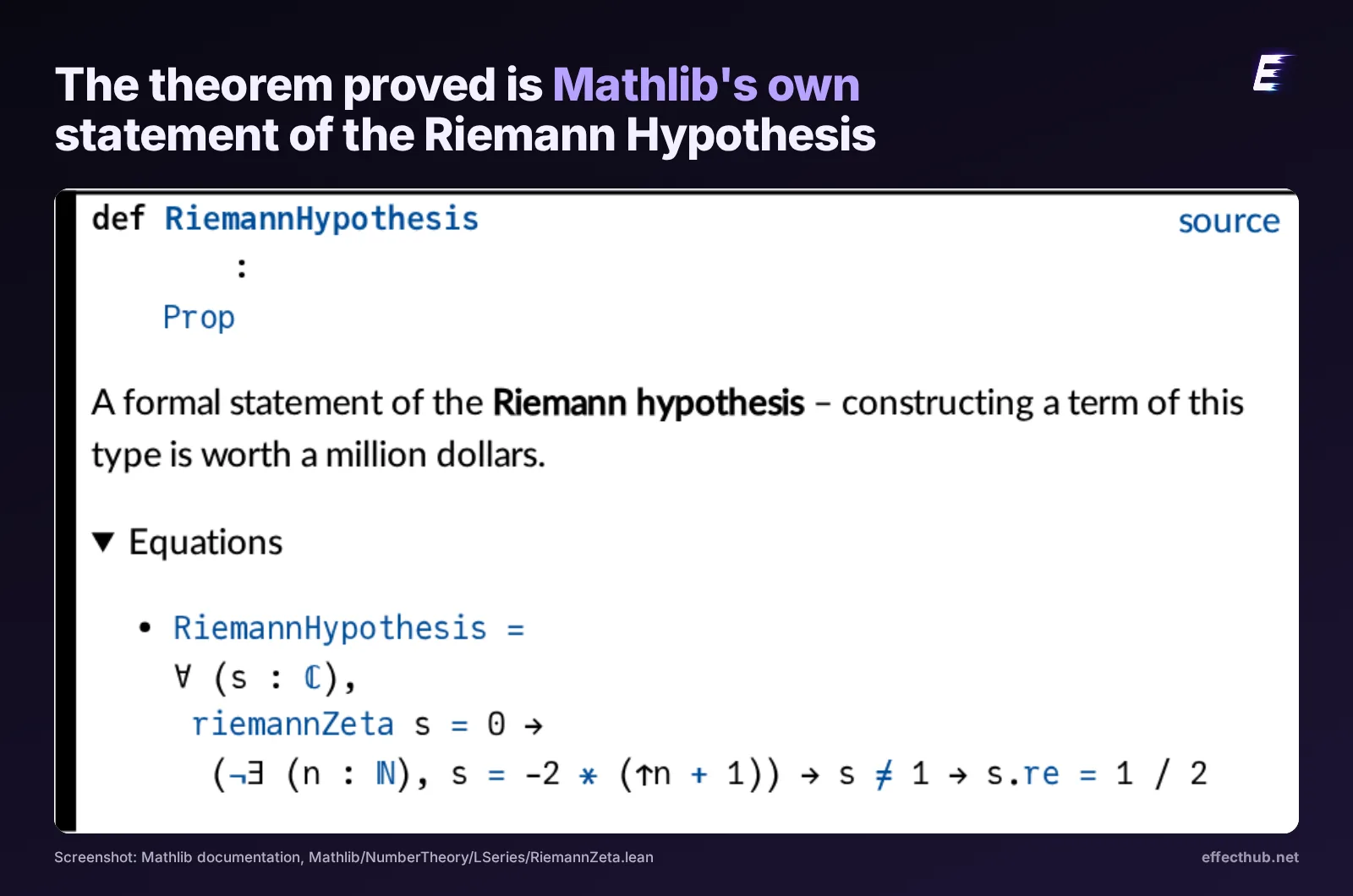
The main theorem is Mathlib's own RiemannHypothesis: every zero of the zeta function, other than the trivial zeros at −2, −4, −6 and so on, has real part 1/2. That definition lives in Mathlib's number theory library and predates Alpöge's work.
Sutherland's page lists five verified theorems in all. Two state the classic hypothesis. The other three cover Dirichlet L-functions, the family behind the "generalized" claim. For example, one says their zeros in the critical strip sit on the critical line.
That scope matters. Scientific American's Lee Billings wrote that Alpöge's proof is "technically for the 'generalized Riemann hypothesis.'" The checked files are narrower. In Sutherland's words, "'GRH' here means Dirichlet L-functions: all moduli and all characters." He adds that Dedekind zeta functions, Hecke L-functions and automorphic L-functions in general "are not among the statements that were checked."
His page also states the limit of any such check. A pass shows the formal statements follow from Lean's three standard axioms "according to the kernels used." It relies "on those kernels and on Mathlib's definitions being what they are intended to be."
How mathematicians reacted
Most of these reactions came on November 20 and 21, before the community verdict. No one quoted below disputes the formal check, but several stress what it does not give.
Sutherland told Scientific American: "The Lean proof has been compiled and independently rechecked by the Lean kernel with only the three standard axioms." Alex Kontorovich, chair of mathematics at Rutgers University, described his own position in an Associated Press report carried by CNN. "Does that mean I understand it? Not yet," he said. "But the computer is extraordinarily picky, way pickier than I am and so if you can satisfy the computer, there's a very, very good chance you're going to satisfy me too." He added: "But I have to do the work."
In Nature, Fields medallist James Maynard of the University of Oxford said "assuming we do get the corresponding understanding, this will surely be viewed as one of the absolute pinnacles of mathematical results." Tristan Buckmaster of New York University, who has worked with Alpöge on a separate problem, said: "At the moment, it apparently is crazily complicated. It's going to take a long time for mathematicians to digest."
Not everyone was gentle. Andrew Granville of the University of Montreal told Nature that Alpöge should have prepared a clearer write-up first. "What he released is garbled," Granville said of the four-page note.
Riemann Hypothesis proof verified, but not yet understood
Three things are open, and none of them is the formal check. The first is understanding. No full human-readable proof exists yet; Alpöge's four-page note gives only a sketch, as Nature reports. The joint statement itself frames explaining "the new ideas in this proof" as the next job. In his note, Alpöge says he plans to study the argument and "write it properly."
The second is peer review. There is no paper in a journal, so no referee has read an argument. A separate, fully human proof claim by Alessandro Masullo, posted by Stanford's Ravi Vakil the same day, also awaits checking. Nature reports that scholars say both claims will need rigorous checking.
Does the proof win the $1 million Clay prize?
Not yet, and not soon. The Clay Mathematics Institute's rules for its Millennium Prize Problems require publication in a qualifying outlet, two years after publication and general acceptance, as we explained in our first report. Nothing qualifying has been published, so the clock has not started. Martin Bridson, the institute's president, called it "an announcement of historic significance" in a statement quoted by CNN. "But the journey from today's announcement to a place of real understanding will be long and difficult," he said.
Mathlib's own documentation jokes that "constructing a term of this type is worth a million dollars." The Clay rules say otherwise, at least until a published proof has stood for two years.
What we make of it
We compared the joint statement line by line with Sutherland's log and the expert quotes. The formal result now has broad, independent support, from rebuilt exports to checkers written by different people in different languages. Still, we would call this a Riemann Hypothesis proof verified in Lean, for Mathlib's statement, not a settled chapter of mathematics. For anyone using Claude or other models in research work, the useful lesson is how the trust was built: separate the statement, rebuild the code, and check it with tools the author did not write.
Claude
49Assistant focused on long documents and code work
Anthropic's coding agent that reads a repository, edits files and runs commands from the terminal, IDE, desktop app, browser or Slack
What to watch next
Watch Sutherland's page for the last Lean kernel runs and the end-to-end comparator verdict. Then watch for Alpöge's human-readable write-up, which is the only route to peer review and, two years after publication, to the Clay prize.
Sources
- Andrew Sutherland, MIT — Verification files for the Lean proof of the Riemann Hypothesismath.mit.edu
- Nature — Mathematicians astounded by AI and human-written proofs of iconic Riemann hypothesisnature.com
- CNN — Anthropic worker claims to have solved a Holy Grail of math problems with the help of AIcnn.com
First posted on our Telegram channel — read and discuss it there.
ResearchAnthropic
Related news
All stories →
Anthropic launches Claude Fable 5.2 and says it formalized Fermat's Last Theorem in 30 hours
Claude Fable 5.2 is out at $8/$40 per million tokens. Anthropic says 1,000 of its agents formalized Fermat's Last Theorem in Lean in 30 hours.

Anthropic's Project EVE: Claude teammates almost never caught a secret saboteur
Anthropic's Project EVE hid a secret Claude saboteur in four-agent teams in EVE Frontier. Teammates almost never caught it. What it does and doesn't show.

METR estimates Anthropic's AI progress has roughly doubled, mostly due to AI
The METR Anthropic report estimates Anthropic now improves its models about twice as fast as in 2024–25, mostly due to AI. Much evidence was redacted.