
Unitree teleoperation mode lets a mocap suit drive a humanoid in 80 ms
Unitree's teleoperation mode, Embodied Avatar V3.0, lets a person in a mocap suit drive a humanoid live. What Unitree claims, and why the data matters.

Unitree teleoperation took a new step on November 27, 2026, when the Chinese robot maker posted Embodied Avatar V3.0 Guardian on X. The mode lets a person in a motion-capture suit and gloves drive a humanoid's whole body in real time. Unitree claims a synchronization rate of up to 99.8% and end-to-end latency as low as 80 milliseconds, but it has not said how it measured either figure.
What did Unitree show?
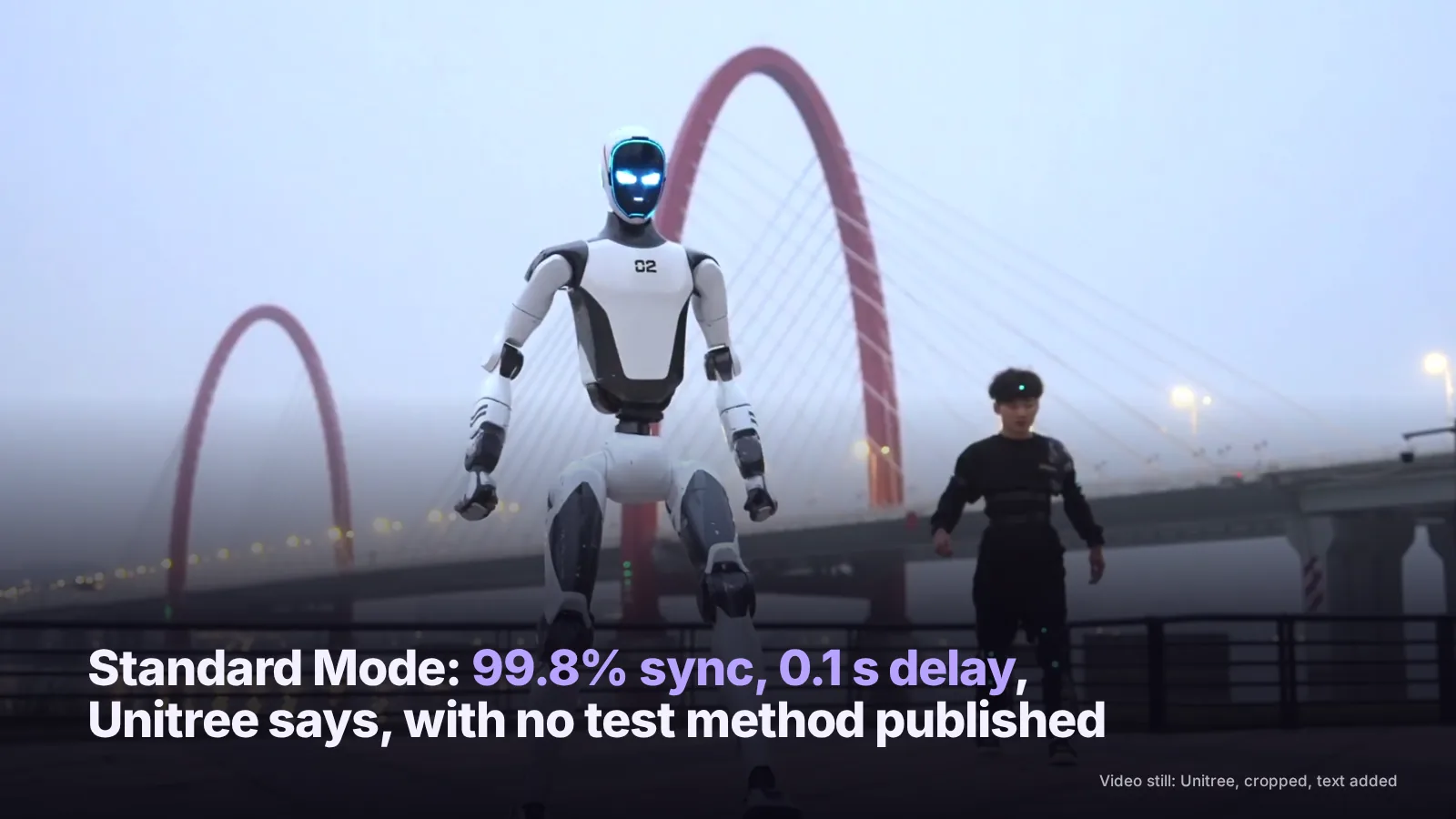
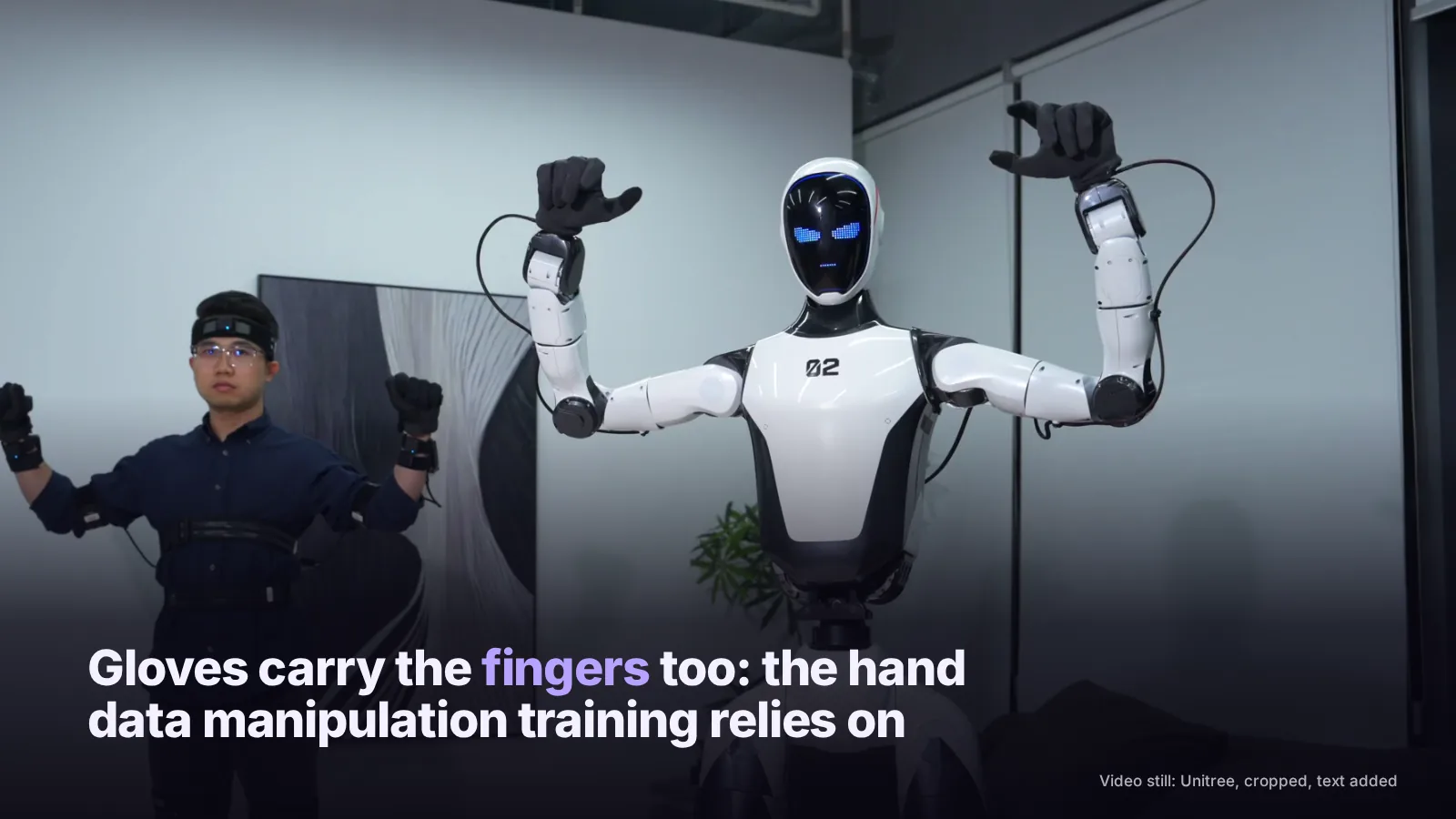
Unitree showed several humanoids, each copying its operator move for move, in a 58-second video. The operators wear motion-capture suits, head straps and, indoors, gloves. The robots repeat their punches, kicks, a backflip and finger movements, outdoors and indoors.
In one scene, the robot spars with a person in an orange bear costume on a lawn. In another, operator and robot kick in sync on a riverside promenade. An on-screen line reads "Real Footage Throughout No Speed-Up". Another reads "Deactivation of Full Autonomous Mode to Subsequent Use", which suggests the autonomous mode is off while a human drives.
The post says the mode works "in addition to fully autonomous mode". It names two uses: "complex remote operations, data collection". Then it closes with a request: "Please use this function safely and in a friendly manner."
This is not Unitree's first try. It showed an Embodied Avatar platform for "full-body teleoperation and full-body data acquisition" on X in November 2025. At least three different robot bodies appear in the video, but neither the post nor the video names a model, so we don't either. The closing card only says that "Features vary by models and versions".
How fast is Unitree teleoperation, by its own numbers?
Unitree gives one pair of numbers per mode, and the post's headline mixes them. The X post claims a "Maximum synchronization rate 99.8%, minimum end-to-end latency 80 ms". However, the captions in the video split them:
- Standard Mode: 99.8% synchronization rate, 0.1 seconds end-to-end latency.
- Motion Mode: 99.5% synchronization rate, 80 milliseconds end-to-end latency.
So the best sync and the lowest lag come from different modes. Unitree does not define "synchronization rate". It has not published a test method, the hardware setup or the network it used. All four figures are Unitree's claims.
For scale, research groups report figures in the same range. The ExtremControl paper says existing systems "consistently hover around 200ms" end to end. Its own system reaches "as low as 50ms", with optical motion capture or VR tracking. The setups differ, so this is context, not a head-to-head test.
Why robot makers want people in mocap suits
Teleoperation is one of the main ways humanoid makers collect training data. A person drives the robot through a task, and the robot logs what it sees and how its joints move. Those recordings then become demonstrations for a learned policy.
Simulation can teach robots acrobatics. But it still struggles with the physics of grasping and moving objects, MIT Technology Review reported in April. Some teams also test robot scenes in world models, such as Google DeepMind's Genie 4. Real demonstrations are still the core.
That is why Unitree's post lists "data collection" as a main use, not just sparring. The same idea runs through recent research:
- ALOHA (Stanford, 2023): a low-cost two-arm teleoperation rig. With 10 minutes of demonstrations, its robot learned six fine tasks, such as slotting a battery, with 80-90% success.
- HumanPlus (Stanford, 2024): a humanoid "shadows" a person seen by a single RGB camera. It then learns skills from up to 40 demonstrations, according to the paper.
- OmniH2O (Carnegie Mellon, 2024): whole-body control through a VR headset, voice or a camera. The robot also reaches "full autonomy by learning from teleoperated demonstrations", the authors write.
Hands matter most for that data, because hands do the useful work. In the indoor scenes, Unitree's gloves pass the operator's finger movements to the robot.
How other humanoid makers use teleoperation
Teleoperation is common across the field, but companies use it in different ways. For example, some use it for demos, some to train, and some to cover gaps in autonomy.
- Tesla: At the We, Robot event on October 10, 2024, Optimus robots mingled with guests and worked as bartenders. Employees elsewhere oversaw many of those interactions, TechCrunch reported, citing Bloomberg. Morgan Stanley analyst Adam Jonas wrote that the bots "relied on tele-ops (human intervention)."
- 1X: Its NEO home robot costs $20,000 in early access, or $499 a month. Remote operators take over complex chores, but only with the owner's approval, Engadget reported. "If we don't have your data, we can't make the product better," CEO Bernt Børnich said.
- Figure: It leans on video more than remote control. Human "pilots" in VR headsets film themselves doing chores. Its Helix model learned to fold towels from about 80 hours of video, TIME reported.
Unitree differs in one way. It sells its robots to outside buyers, and since 2025 it has offered teleoperation to them as a feature, not only as an in-house tool.
Unitree: from dancing robots to a Shanghai listing
Unitree is one of the largest humanoid makers by volume, and it is now a public company. Wang Xingxing founded it in Hangzhou in 2016. It shipped more than 5,500 humanoids in 2025, over a quarter of the global market, the magazine reported.
Unitree listed on Shanghai's STAR Market on August 19, 2026. It raised about 6.1 billion yuan ($905 million), and its shares closed more than 460% higher on day one, CNBC reported. That lifted its value to about $66 billion, Fortune reported. By early September, the stock had fallen about 50% from its peak, according to Bloomberg.
- 2025 revenue: 1.7 billion yuan (about $252 million), almost 45% from overseas, per Fortune.
- G1: pretax price cut from $16,000 to $13,500 in about 18 months, per TIME.
- H2: Nvidia picked it on June 1, 2026, for the research robot it sells with Jetson Thor and Isaac GR00T.
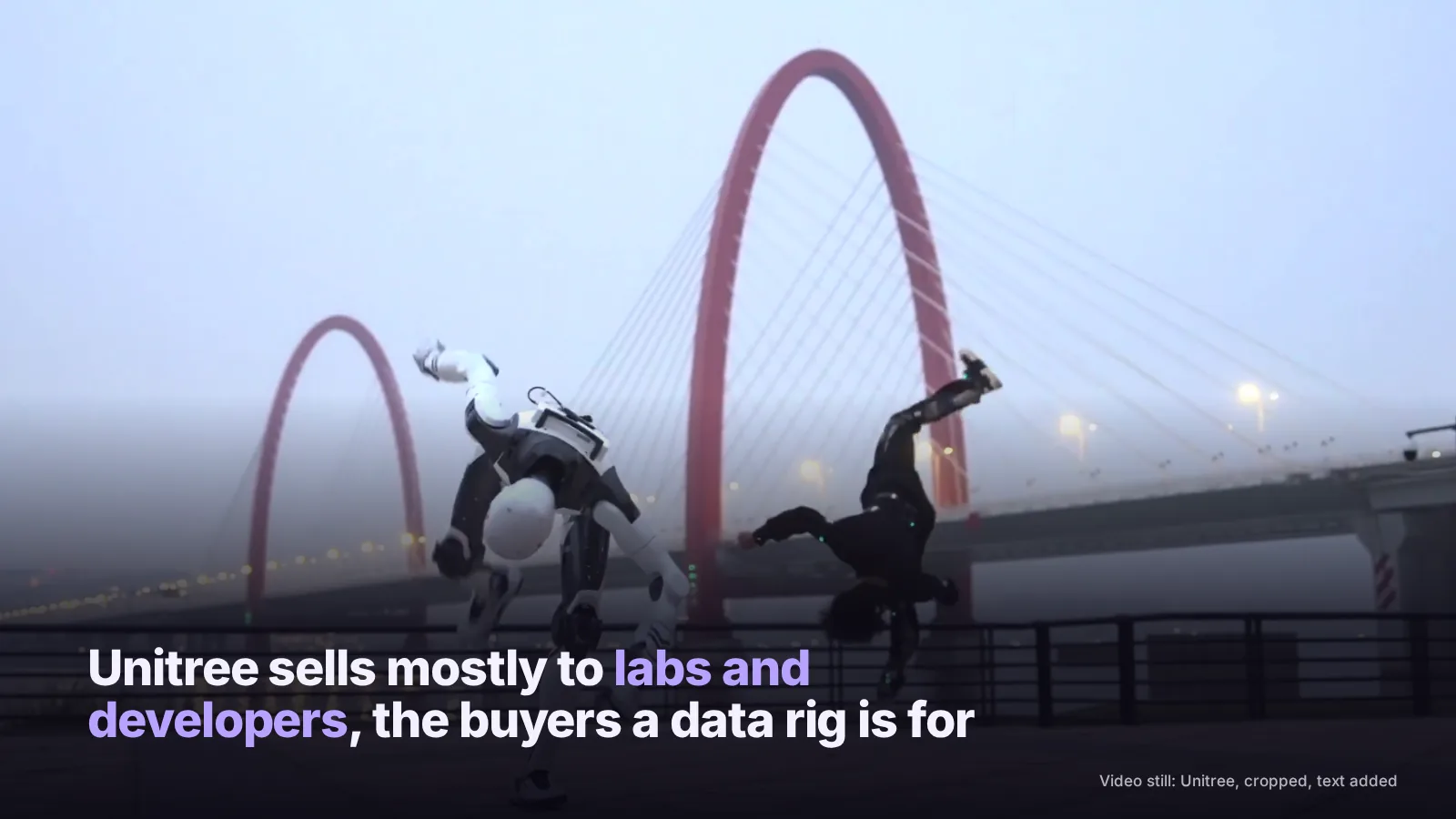
About 74% of Unitree's humanoid sales go to universities, research institutes and individual developers, TIME reported. Those are the buyers most likely to want Unitree teleoperation as a data rig. Nvidia, which just reinstated Jensen Huang as CEO, also puts its hardware in many of the same labs through the H2 deal.
What we don't know about Unitree teleoperation yet
So far, Unitree has shared a post and a video. Several basics are missing:
- Models and price: no list of supported robots, and no price for the suit, gloves or software.
- Release date: no date, and no word on whether current owners get it as an update.
- Test method: no definition of "synchronization rate" and no test conditions for the 80 ms figure.
- Range: no word on whether the operator must be nearby or can work over the internet.
- Safety: the closing card asks people and robots to keep "a safe distance of at least 2-3 meters or more". It does not say what limits apply when someone drives the robot into a sparring match.
No major outlet had tested the system when we published. Earlier, TIME described viral clips of Unitree machines striking children who wandered into their path. Wang told TIME the robots have "rigorous hardware constraints and safety protections".
We watched the full video frame by frame and checked its captions against the post. Our read: the 80 ms headline is a fair quote of Unitree, but it belongs to Motion Mode, which has the lower sync rate. If you only need human motion for a character, not a robot, markerless animation tools like Move AI already capture it from plain video.
Move AI
68Markerless motion capture from ordinary video, phone to studio
Physics-aware 3D character animation with neural pose assistance
Next, watch for a supported-models list and a price for Unitree teleoperation. After that, look for the first independent tests of the 80 ms claim, most likely from the university labs that already own its robots.
Sources
RoboticsUnitreeResearch
Related news
All stories →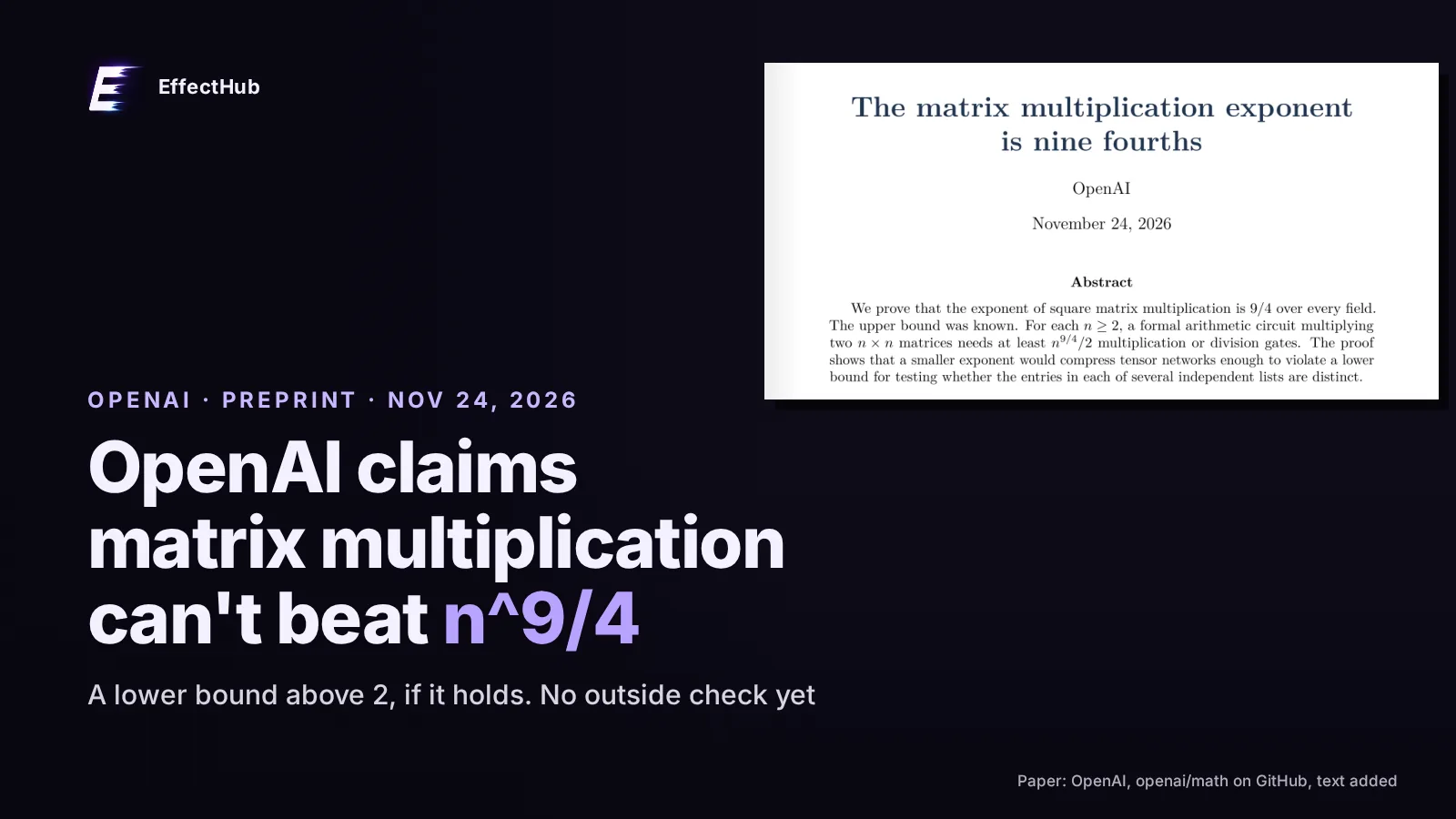
OpenAI claims its model proved the matrix multiplication exponent is 9/4
OpenAI says an internal model proved the matrix multiplication exponent is exactly 9/4, not 2. What the lower bound claims, what Lean checks, what is open.
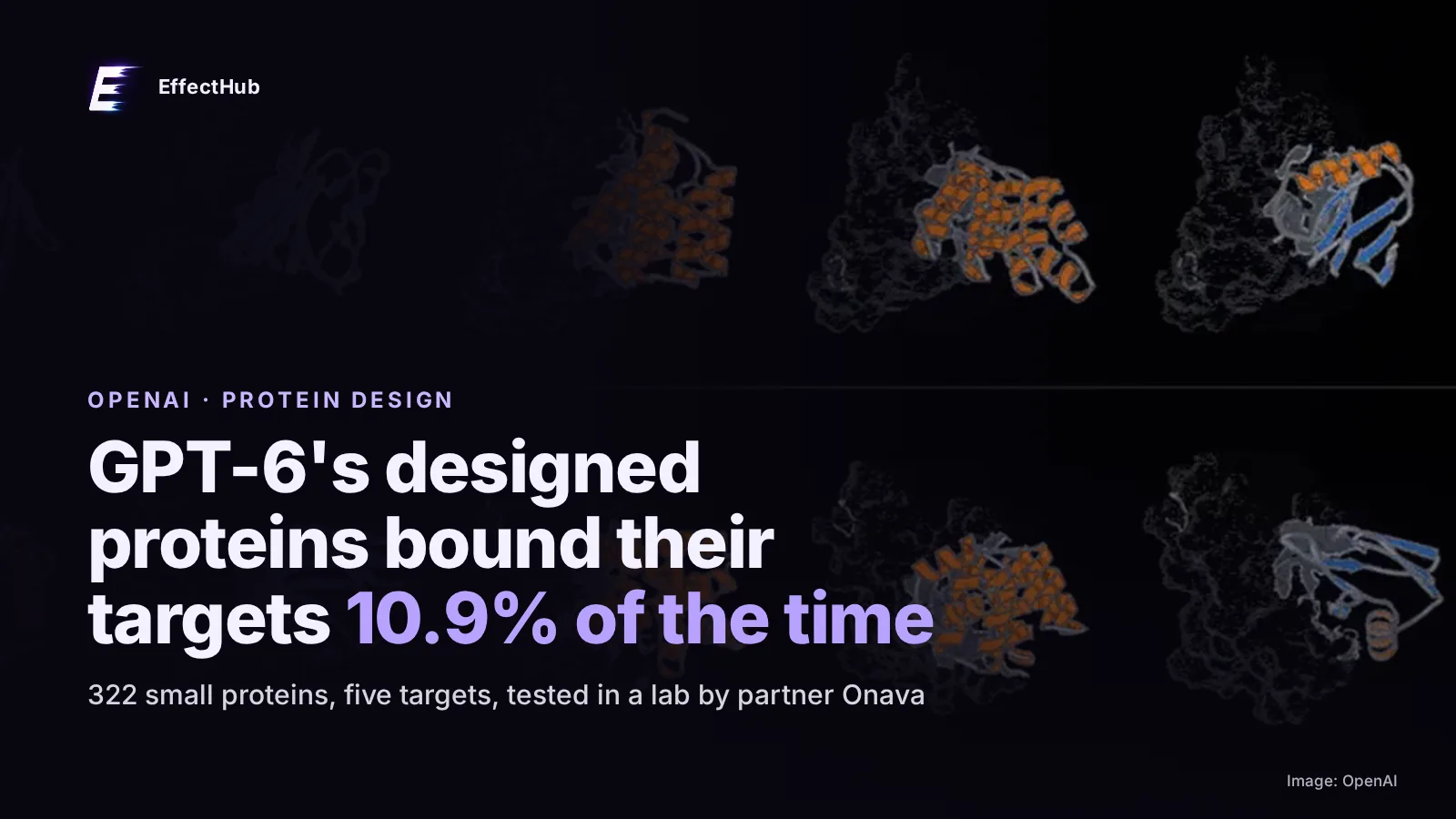
OpenAI says GPT-6 designed proteins that bound their targets in lab tests
OpenAI's GPT-6 protein design produced 322 minibinders and 35 bound their targets in Onava's lab tests. The numbers, and what specialized models still did.
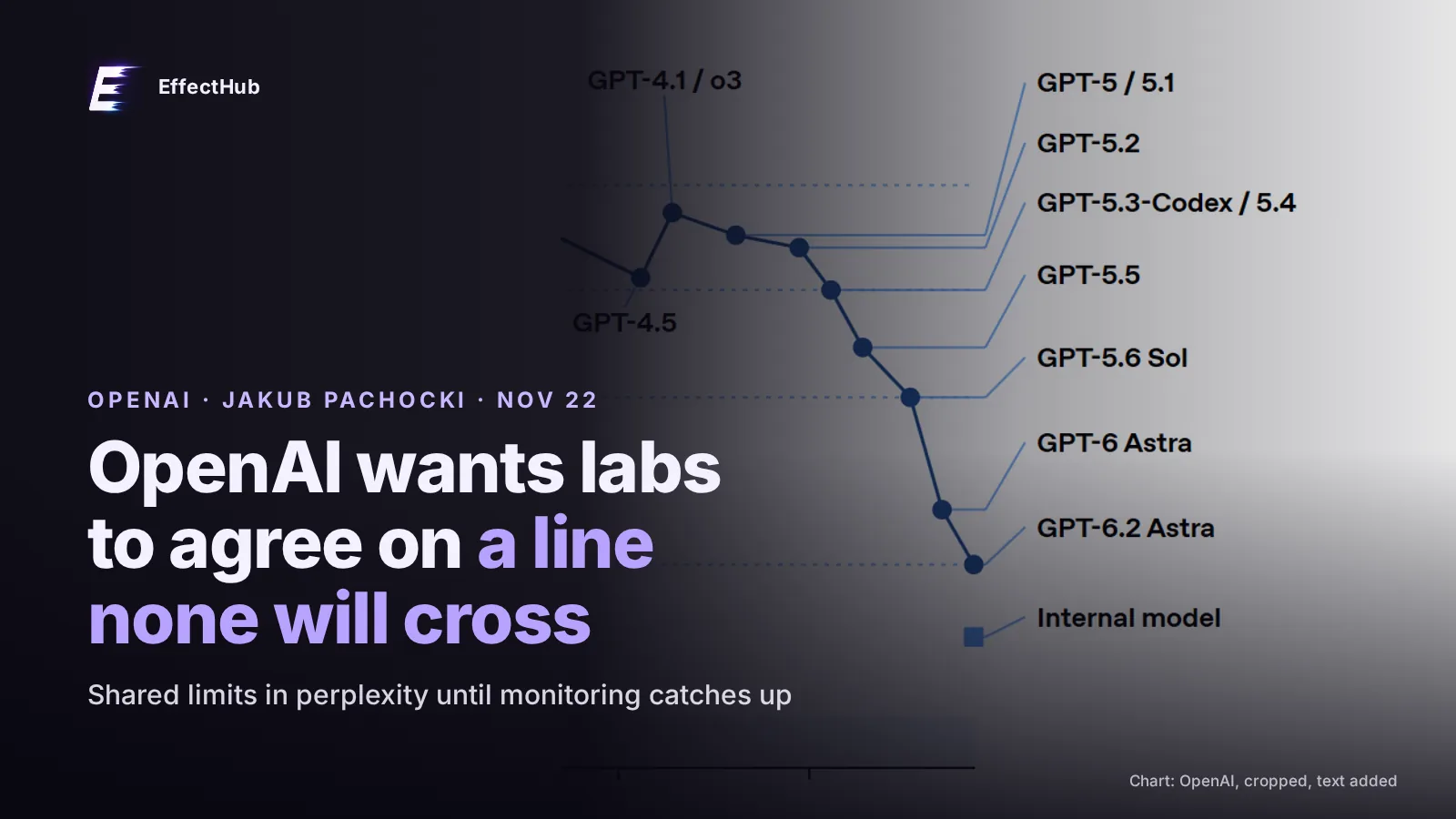
OpenAI's chief scientist proposes shared AI limits measured in perplexity
OpenAI perplexity limits explained: Jakub Pachocki wants AI labs to agree on lines they won't cross until monitoring improves. The chart, the 2027 warning.