
Terence Tao says AI labs treat their math proofs as a byproduct of training
Terence Tao told Hard Fork that AI labs see math proofs as a training byproduct, cite sources poorly and disclose little. He also expects "big math".
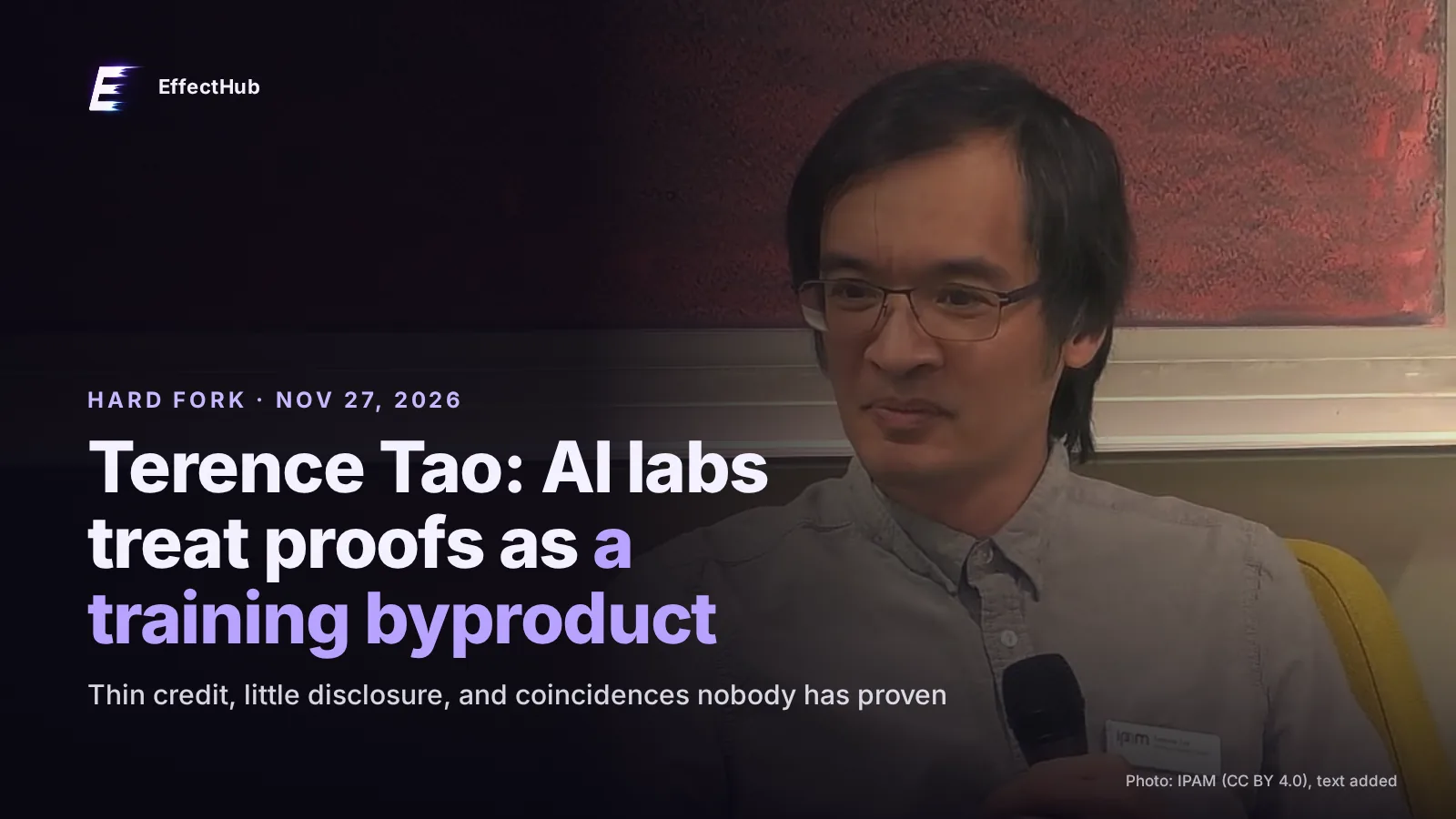
Terence Tao, the UCLA mathematician and 2006 Fields Medal winner, says AI labs now treat the math proofs their models produce as a side product of training. In a 41-minute Hard Fork interview with Max Read, published by The New York Times on November 27, 2026, he calls that output "this pile of toxic waste" that the labs give only "minimal cleanup." He also says the companies disclose little about how the proofs were made.
What did Terence Tao say about AI labs on Hard Fork?
Terence Tao's main point is that the labs stopped working with mathematicians once their models could solve problems alone. Until about last year, he said, the companies worked with academics "on a fairly even basis," because the tools needed outside experts to pick problems and check the output.
That changed in 2026, in his account. Now the labs find it more convenient to "work completely internally." He listed what that means in practice:
- "They're not collaborating with external academics anymore."
- They do not submit results to journals for peer review.
- There is usually no attempt to polish AI-written papers, or the labs say "we'll leave to the community to deal with."
His explanation is about motives, not malice. For the labs, he said, the proofs are "almost generated as a waste byproduct of their training." Their main focus is building better models. Tao added that many big tech companies have closed, cut or reassigned their science teams, because each one wants to ship a model before its rival does.
Tao described the labs as "this 800-lb gorilla in our midst now," and "much better funded." They can solve open problems well, he said, but at least for now "they can't explain them to us."
Why math problems make such good training data
Math is useful to the labs because it can be scored. Terence Tao said the problems mathematicians work on turned out to be "excellent training problems to train AI models to get better," since each answer is objectively right or wrong. Models tuned on math also tend to improve at other tasks, he added, such as coding.
That is why, in his view, labs feed their models huge numbers of math problems. Every so often a model spits out a proof of something open. But the proof "wasn't somehow their main objective," he said.
The scoreboard has moved fast. Google DeepMind's AlphaProof and AlphaGeometry 2 reached silver-medal standard at the 2024 International Mathematical Olympiad with 28 of 42 points. A year later an advanced Gemini Deep Think model scored 35 points, which DeepMind said the IMO officially graded as gold-medal standard. OpenAI said an experimental model also reached 35, graded by three former IMO medalists rather than by the IMO. Harder tests appeared too, such as Epoch AI's FrontierMath, a set of unpublished problems written by expert mathematicians.
- AlphaProof, IMO 202428
- Gemini Deep Think, IMO 202535
- OpenAI model, IMO 202535
By 2026 the labs had moved from contest problems to open research questions. On October 7, Fortune reported that OpenAI had published full or partial solutions to more than 370 open problems. Within days it had withdrawn at least three, presumably over errors.
"Toxic waste" and the minimal cleanup
Terence Tao's sharpest line came when he described what the labs do with the proofs afterward. His words: "they're sitting on this pile of toxic waste that they need to deal with and so they do some minimal cleanup."
Credit is the first problem he named. Early AI papers often built on prior work "which often was not mentioned at all," he said. The labs have since done "a somewhat better job of citing references," but suspicions remain.
Outside advisory groups have published best practices for this kind of research. According to Tao, the labs "are sort of fulfilling some of these a little bit." Fortune described one such group, hosted at the Institute for Advanced Study. It asked labs to disclose, for each solution, the model, prompts, reasoning steps, time taken and approximate compute cost. OpenAI followed some of those steps but not all, Fortune reported.
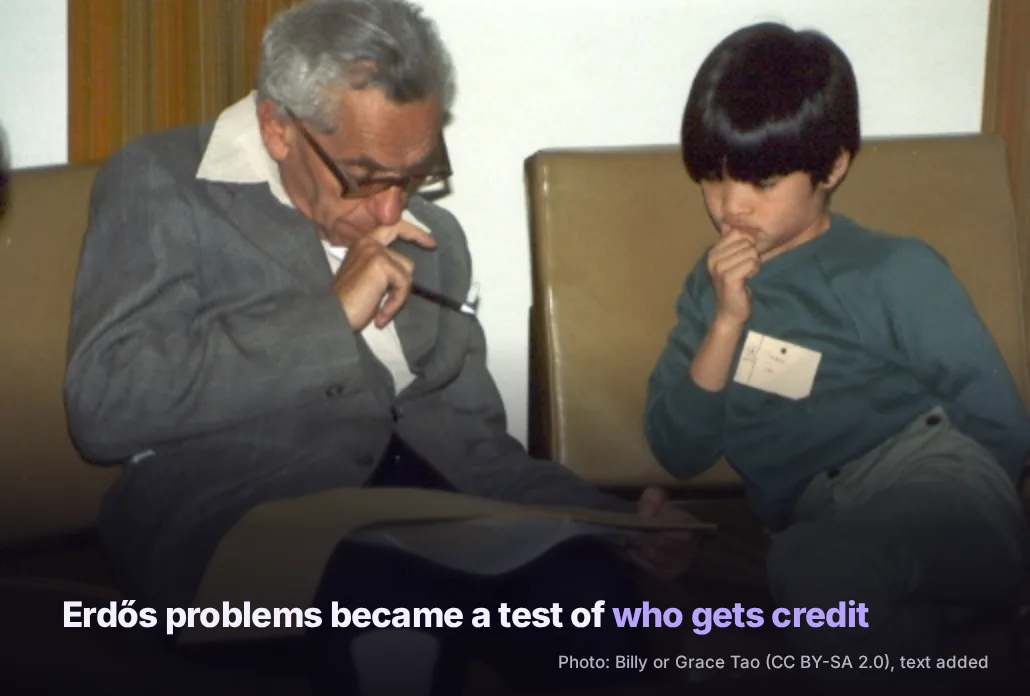
Citation problems in AI math go back further. In October 2025, an OpenAI executive posted that GPT-5 had found solutions to 10 "previously unsolved" Erdős problems. Thomas Bloom, who runs the Erdős Problems website, called it "a dramatic misrepresentation": the model had found existing papers that already solved them, TechCrunch reported. Google DeepMind CEO Demis Hassabis replied: "This is embarrassing."
What are the "weird coincidences" Terence Tao mentioned?
Terence Tao raised a suspicion that some researchers have, and he was careful to say it is unproven. "Nothing's been proven," he said, "but there are these weird coincidences."
The scenario he described goes like this. Researchers working on a problem use "say ChatGPT or some other available model" and upload part of their work for help. Then, "a month or so later," a lab's press release says it solved that same problem. His verdict was open: "that could be a coincidence it could not be." Tao did not say which company, cited no specific incident and said there was no proof. His complaint is that outsiders cannot check: "we don't have much transparency as to what actually happens."
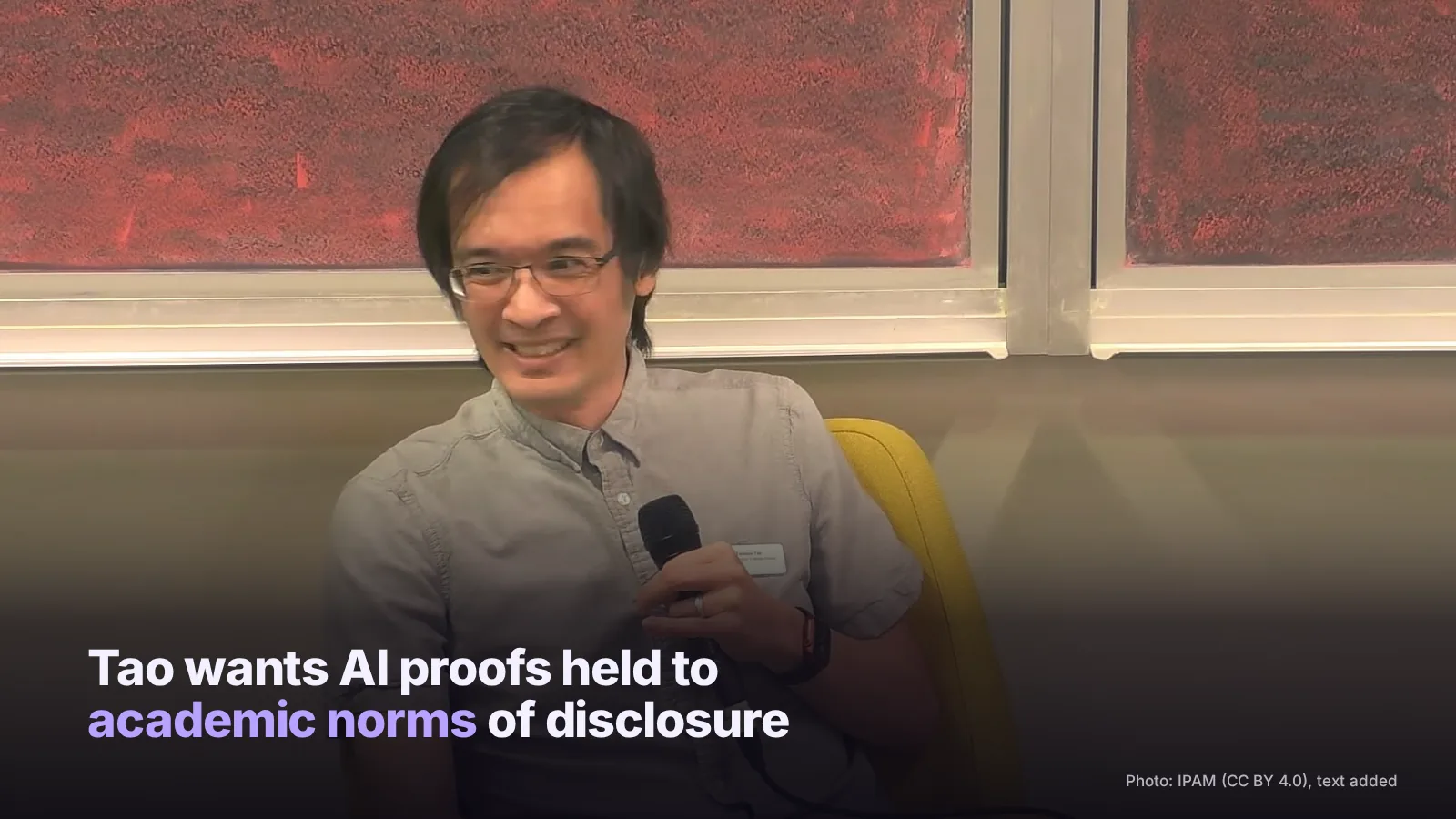
That links to his broader point about disclosure. The companies are often reluctant to say how they produced a proof, how much compute it took or how much data was used. That is "very different from academic norms," Tao said, where you can question the authors about method and ask for the data.
Even his friends in industry are worried
Terence Tao says many of his friends in tech share some of his worry. They have "very balanced views," he said, and many are "a little bit concerned that maybe the industry has become too competitive." In their view, the race for the most powerful models comes at the expense of working with scientists.
He is not against the technology. "I still believe AI is a wonderful tool," he said, and he remains positive about AI broadly. But he called the current way of churning out output "reckless," and said "the pace is more fast than it's safe."
He has company at the top of the field. On September 11, 2026, Tao published a joint declaration on his blog, "A Severe Misalignment of AI in Mathematics." It was signed by 25 Fields medallists and argues that using open problems as AI benchmarks harms the field. In October, Tao told The New York Times he was "on a war footing." He also set out his case in a Nature column calling for a "Maths 2.0" world.
"Big math": what Terence Tao expects next
Terence Tao expects mathematics to reorganize, not disappear. "I can see big math emerging just like big science," he said. He still uses blackboards and meets most of his students one-on-one, but he thinks mathematicians will work in much larger groups.
AI could also hand junior researchers bigger roles. Managing a complex project used to need a senior professor. Now, he said, "a bright postdoc or even a grad student could run a very ambitious project," for example by "mapping out thousands of problems" with AI systems and people exploring them systematically.
The incentives have to change first, in his view. Hiring still rewards paper counts, and AI is "very good at generating paper products." So journals are flooded with technically new work that is badly cited and hard to follow. He wants credit to go to clear writing, good talks and outreach. AI could find the first rough solution, and humans would organize it properly. "Maybe we will become more chefs," he said, "than sort of raw hunters of mathematics."
His closing warning was Goodhart's law. Solving problems used to be a good measure of understanding a field. Machines have now optimized that measure, he said, without advancing understanding.
What it means if you use AI for math
For a student or researcher, Terence Tao's critique is about how labs publish, not about whether the models work. The same chatbots can still help you check a calculation, find a reference or explain a step. We put the main general assistants side by side:
ChatGPT
70General assistant with tools, memory, files and voice
Claude
49Assistant focused on long documents and code work
Gemini
70Google assistant wired into Workspace and Android
Tools built for step-by-step problems are in our math solvers category. If you need sources rather than answers, the academic search tools are the better start. Tao's own advice applies here too: if a tool hands you an answer, check that you understand why it is right.
We listened to the full episode and checked every quote above against it. Most of Terence Tao's claims about the labs are his opinion and his account, not documented findings. He offers no evidence for the coincidences, and we found no documented case. What is documented is narrower. In the claimed bound for the matrix multiplication exponent and the Riemann Hypothesis proof that Lean checked, the proof arrived before human understanding did.
What to watch next
The AI news site The Decoder picked up the interview on November 28, leading with Terence Tao's "big math" forecast. The next test is practical. Watch whether labs start publishing the compute, prompts and data behind each proof, as the IAS advisory group asked. Also watch whether any AI-made solution goes through a journal's peer review. Tao expects the profession to find what he called a "new equilibrium" within about a year.
Sources
ResearchModels
Related news
All stories →
Anthropic launches Claude Fable 5.2 and says it formalized Fermat's Last Theorem in 30 hours
Claude Fable 5.2 is out at $8/$40 per million tokens. Anthropic says 1,000 of its agents formalized Fermat's Last Theorem in Lean in 30 hours.
Google releases Gemini 4 Neon, a middle model priced at $3 per million tokens
Gemini 4 Neon is Google's new middle model at $3/$15 per million tokens. Its benchmarks, how it compares with Carbon and Opus 5.5, and where to use it.
Google releases Gemini 4 Hydrogen, a fast everyday model for agentic work
Google's Gemini 4 Hydrogen is a fast everyday model at $1.50 per million input tokens. Its speed, benchmarks, price and where it is rolling out.