
Google releases Gemini 4 Neon, a middle model priced at $3 per million tokens
Gemini 4 Neon is Google's new middle model at $3/$15 per million tokens. Its benchmarks, how it compares with Carbon and Opus 5.5, and where to use it.

Gemini 4 Neon is Google's new middle model, released on November 18, 2026, at $3 per million input tokens and $15 per million output tokens. Google says it scores 61 on the Artificial Analysis Intelligence Index at its top setting, third overall. It is rolling out in the Gemini API, Gemini for business, Google Antigravity and the Gemini app.
What is Gemini 4 Neon?
Neon is the third Gemini 4 model, and it sits between the other two. Gemini 4 Carbon handles the hardest long-horizon projects, while Gemini 4 Hydrogen covers fast everyday work. Neon, Google says, "balances depth and efficiency."
The launch post comes from Koray Kavukcuoglu, SVP of Google DeepMind and Google's Chief AI Architect. He describes Neon as "bringing frontier-level intelligence with fast end-to-end task completion across complex software engineering, knowledge work, and science workflows."
So the pitch is not a new top model. Instead, Google offers Carbon-level results at a lower cost per task and a higher speed. Neon reads text, spreadsheets, PDFs, charts, audio and video in one 1 million-token context window.
Like Hydrogen, it has four thinking levels: low, medium, high and xhigh. High is the default. Carbon, by contrast, stops at high.
How does Neon score on benchmarks?
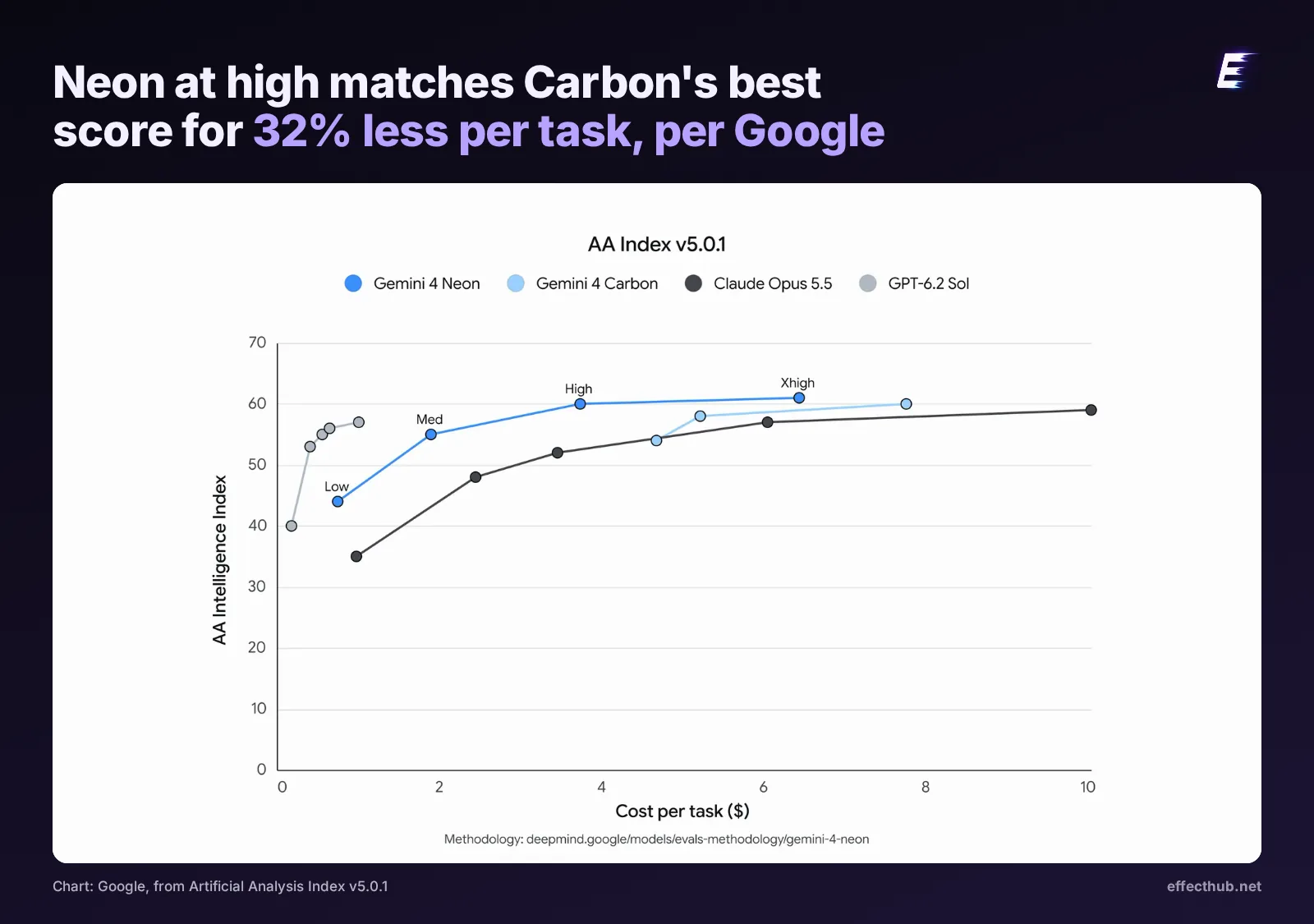
On Google's numbers, Neon edges Carbon on the Artificial Analysis Index (61 to 60) and leads Claude Opus 5.5 and GPT-6.2 Sol on most rows of its benchmark table. Most of these are Google's own runs, so treat them as company claims.
The broad indexes come first. These are the scores Google reports:
- Artificial Analysis Intelligence Index: 61 at xhigh, #3 overall, "just behind larger, slower models."
- Artificial Analysis Coding Agent Index: 58.6, #1 overall.
- Vals Index: 70.9%, #2.
- Agent Arena Index: 1336 across more than 4,200 real agent sessions, #2.
Some of this has outside backing. VentureBeat reports that Artificial Analysis confirmed the index result on X. But VentureBeat also notes that the public Vals snapshot predates Neon, so the Vals score still comes from Google.
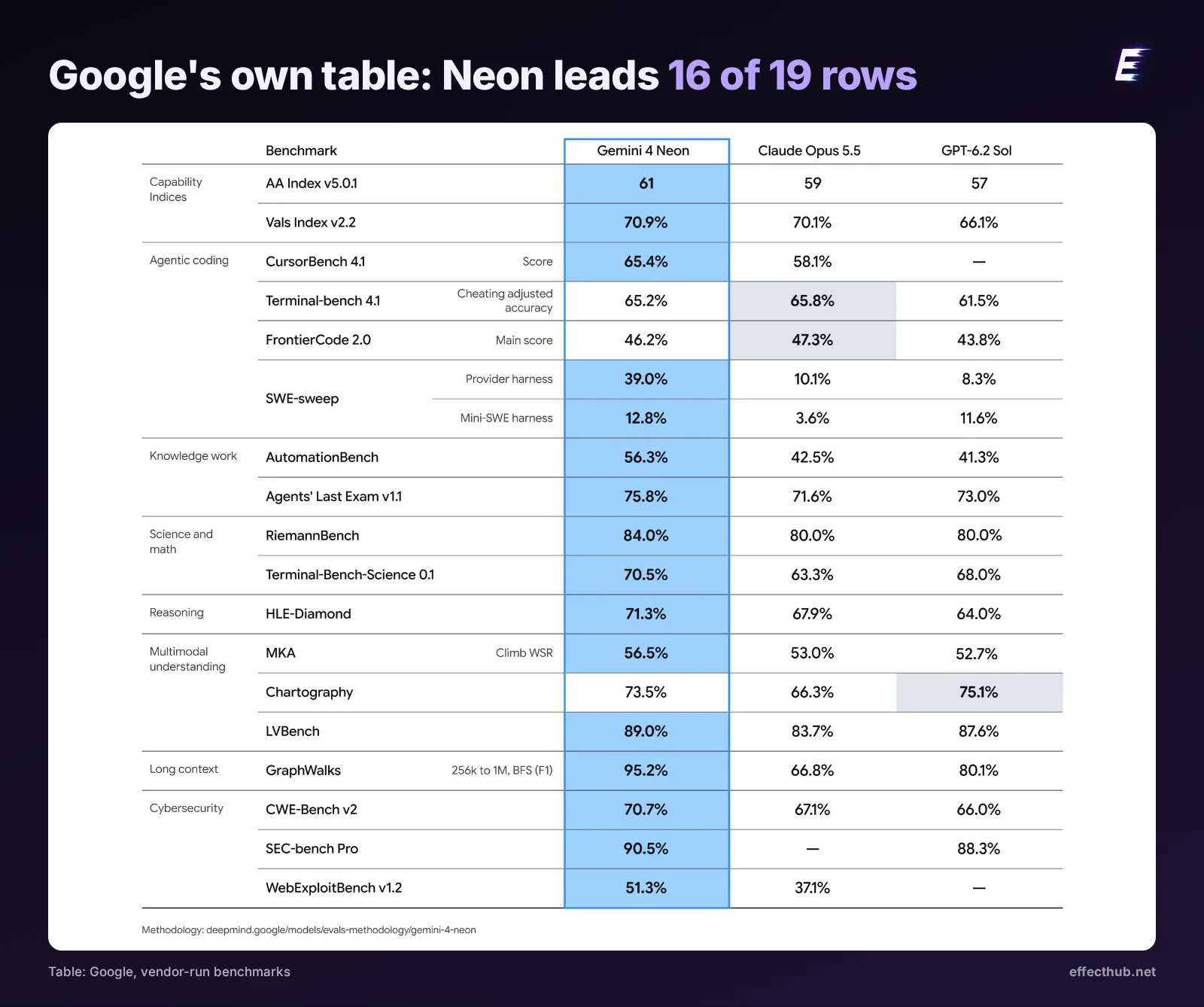
Google's head-to-head table is more mixed than the headline. Neon leads 16 of 19 rows. However, Opus 5.5 wins Terminal-Bench 4.1 (65.8% against 65.2%) and FrontierCode 2.0 (47.3% against 46.2%). GPT-6.2 Sol wins Chartography (75.1% against 73.5%).
The widest gaps are in knowledge work and long context. Neon scores 56.3% on AutomationBench, against 42.5% for Opus 5.5. On GraphWalks, a long-context test from 256K to 1M tokens, it scores 95.2% against 66.8%.
How much does Gemini 4 Neon cost?
Gemini 4 Neon costs $3 per million input tokens and $15 per million output tokens. Cached input costs $0.15 per million, a 95% discount. The price is flat across the 1 million-token window, per Google's comparison table.
| Model | Input, per 1M | Output, per 1M |
|---|---|---|
| Gemini 4 Hydrogen | $1.50 | $7.50 |
| Gemini 4 Neon | $3 | $15 |
| Gemini 4 Carbon, through Nov 30 | $2 | $10 |
| Gemini 4 Carbon, list price | $4 | $20 |
| Claude Opus 5.5, per VentureBeat | $4 | $20 |
There is a catch for the next two weeks. Carbon runs a $2 and $10 promo through November 30, so per token it is cheaper than Neon until then. From December 1, Neon costs 25% less than Carbon per token.
Per task, Google says Neon is 32% cheaper than Carbon at the default high setting. VentureBeat adds a caveat from Artificial Analysis: at xhigh, that gap narrows to about 17% against Carbon at high. Google also claims 50% to 80% lower cost per task than top rival models on Vals and Agent Arena.
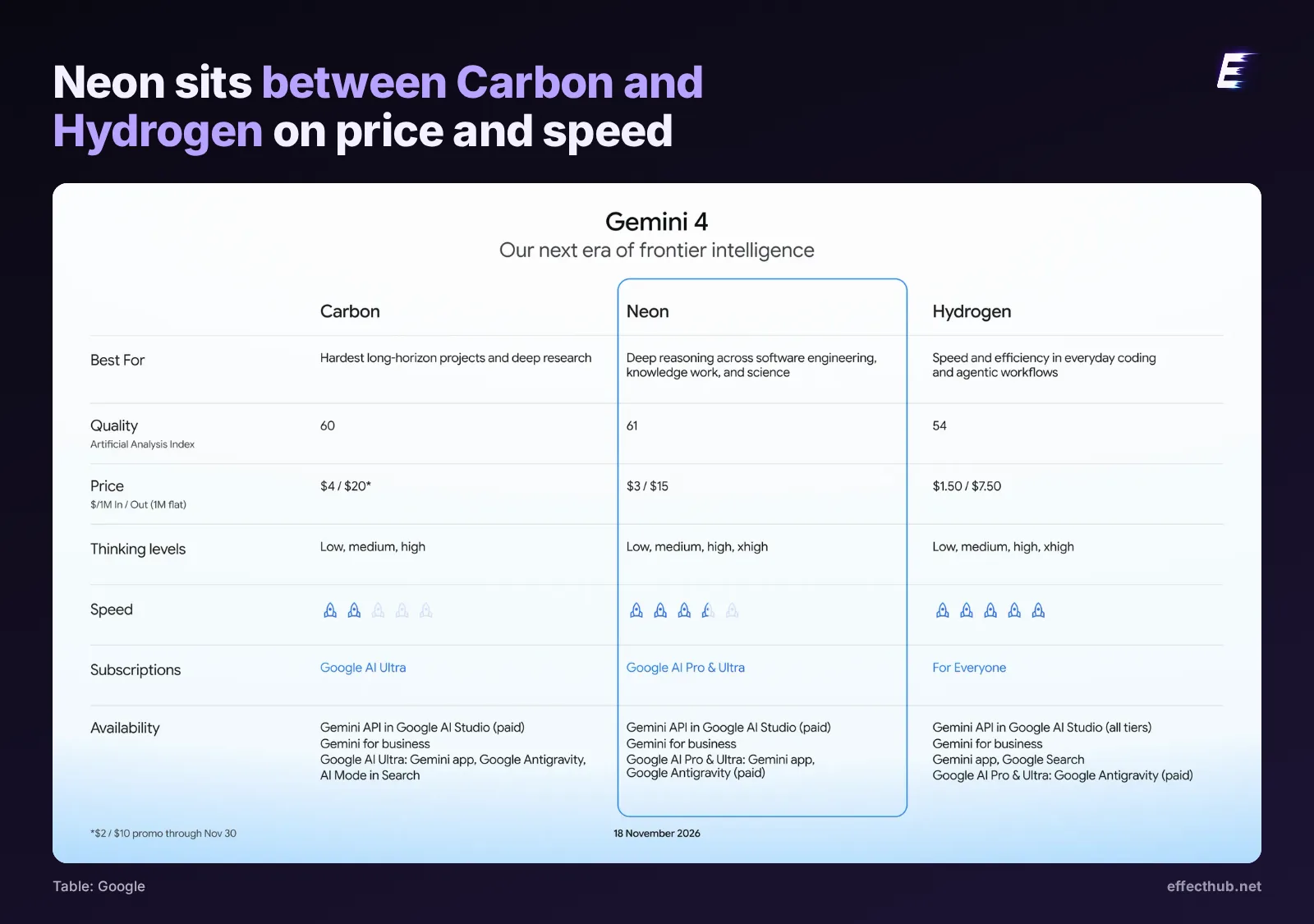
Speed is the other half of the pitch. The tracker Priors measured about 110 tokens per second for Neon at xhigh on launch day, VentureBeat reports. Artificial Analysis lists Carbon at 59 tokens per second on high. Still, Priors also shows about 57 seconds to the first token at xhigh, so long thinking still means a wait.
A coding model built around Antigravity
Google aims Neon at long agent sessions, either alone or as an orchestrator that directs parallel Hydrogen subagents in Google Antigravity. It says the model cuts redundant file reads and handles context compaction in long sessions.
The tooling around the model matters a lot here. On SWE-sweep, Neon scores 12.8% with the plain mini-SWE agent setup. In Antigravity, the same model reaches 39.0%. That is a threefold jump from tooling alone, so compare models inside the tool you actually use.
The demo in the video above shows the idea. In Antigravity, Neon wrote a first-person freeride ski simulator from scratch, Google says. The build includes:
- 10,200 lines of custom shaders in WebGL2;
- real Mont Blanc and Chamonix elevation terrain;
- 120 Hz ski physics across six alpine lines, with slab avalanches;
- spatial Web Audio and zero pre-made assets.
Early testers sound positive. "In our early evaluations, it matched or exceeded Gemini 4 Carbon on overall quality at 3x the speed and 60% of the cost," Glean AI product lead Thai Tran told VentureBeat.
Gemini
71Google assistant wired into Workspace and Android
Google's agent-first coding platform: a desktop agent manager, terminal CLI, Python SDK and IDE built around Gemini models.
Safety numbers and a cyber version
Google says Neon keeps Carbon-level protections against severe misuse and prompt injection while refusing less legitimate work. For example, it refused just 1.98% of tasks on Terminal-Bench 4.0.
Google lists several safety results:
- 0.0% cheating on Terminal-Bench 4.0, matching Carbon;
- shortcuts on 2.45% of tasks in its coding cheating test, the lowest of any Gemini 4 model;
- a 99.2% pass rate on its agent honesty evaluation;
- a 0.0% attack success rate on Gray Swan's indirect prompt injection benchmark, at the highest thinking level with real-time safeguards.
A separate Gemini 4 Neon for cyber goes to trusted defenders in Google's Fairwind Program over the coming days. Google reports 90.5% on SEC-bench Pro for finding vulnerabilities and 70.7% on CWE-bench v2 for patching them. Our Gemini 4 Carbon story covers how that program started.
Where can you use Gemini 4 Neon?
Neon started rolling out on November 18 across developer, business and consumer products.
- Developers: the paid tier of the Gemini API in Google AI Studio and Android Studio. Paid Google AI Pro and Ultra subscribers can also use it in Google Antigravity, and all Pro and Ultra subscribers can try it in AI Studio.
- Enterprises: Gemini for business, through the API or the model drop-down, plus Antigravity.
- Consumers: Google AI Pro and Ultra subscribers can pick Neon from the model drop-down in the Gemini app.
Neon has no free API tier at launch. Hydrogen, by contrast, is open to everyone and on every API tier, and our Gemini 4 Hydrogen story covers it.
What Gemini 4 Neon means, and what to watch
We checked every number here against Google's launch post, its benchmark table and its family chart, and the VentureBeat figures against that report. Our read: Neon looks like the sensible default for paid Gemini work, because Carbon only wins on per-token price until November 30. Against Claude, the case is narrower, since Opus 5.5 still leads Google's own table on two coding tests. If you choose among AI coding assistants, run your real tasks in your own setup, and see our Claude and Gemini comparison for the products around the models.
Claude
49Assistant focused on long documents and code work
ChatGPT
70General assistant with tools, memory, files and voice
Watch three things next. First, independent reruns of Google's Vals, Terminal-Bench and SWE-sweep results. Second, December 1, when Carbon moves to $4 and $20 and Neon's price edge becomes real. Third, how the cyber version performs once Fairwind Program members start using it.
Sources
- Google — Introducing Gemini 4 Neonblog.google
- VentureBeat — Google launches Gemini 4 Neon with Opus 5.5-level coding performance at 25% lower API token pricesventurebeat.com
First posted on our Telegram channel — read and discuss it there.
GoogleModelsPricingCoding
Related news
All stories →
Google releases Gemini 4 Hydrogen, a fast everyday model for agentic work
Google's Gemini 4 Hydrogen is a fast everyday model at $1.50 per million input tokens. Its speed, benchmarks, price and where it is rolling out.
Google's Gemini 4 Carbon tops the leaderboards, but cyber defenders get it first
Gemini 4 Carbon leads the Artificial Analysis index at 59 and posts record cyber scores, but only vetted defenders can use it. Benchmarks, price, timing.
Anthropic launches Claude Fable 5.2 and says it formalized Fermat's Last Theorem in 30 hours
Claude Fable 5.2 is out at $8/$40 per million tokens. Anthropic says 1,000 of its agents formalized Fermat's Last Theorem in Lean in 30 hours.