
Google AI for students goes off by default on K-12 accounts, and Google Search goes with it
Google AI for students will be off by default on K-12 accounts until a school admin turns it on, and Google Search is on the list. What changes and when.
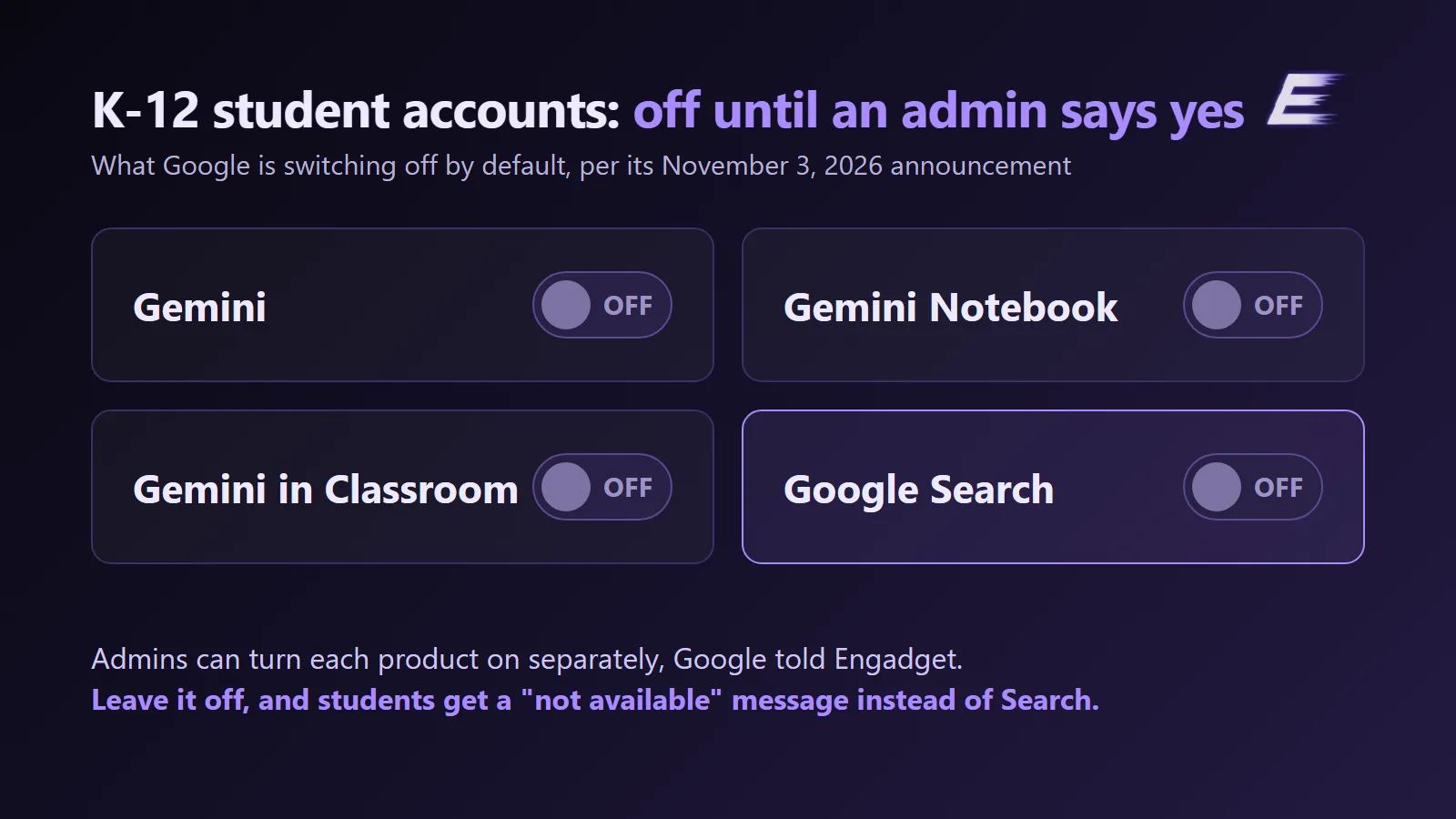
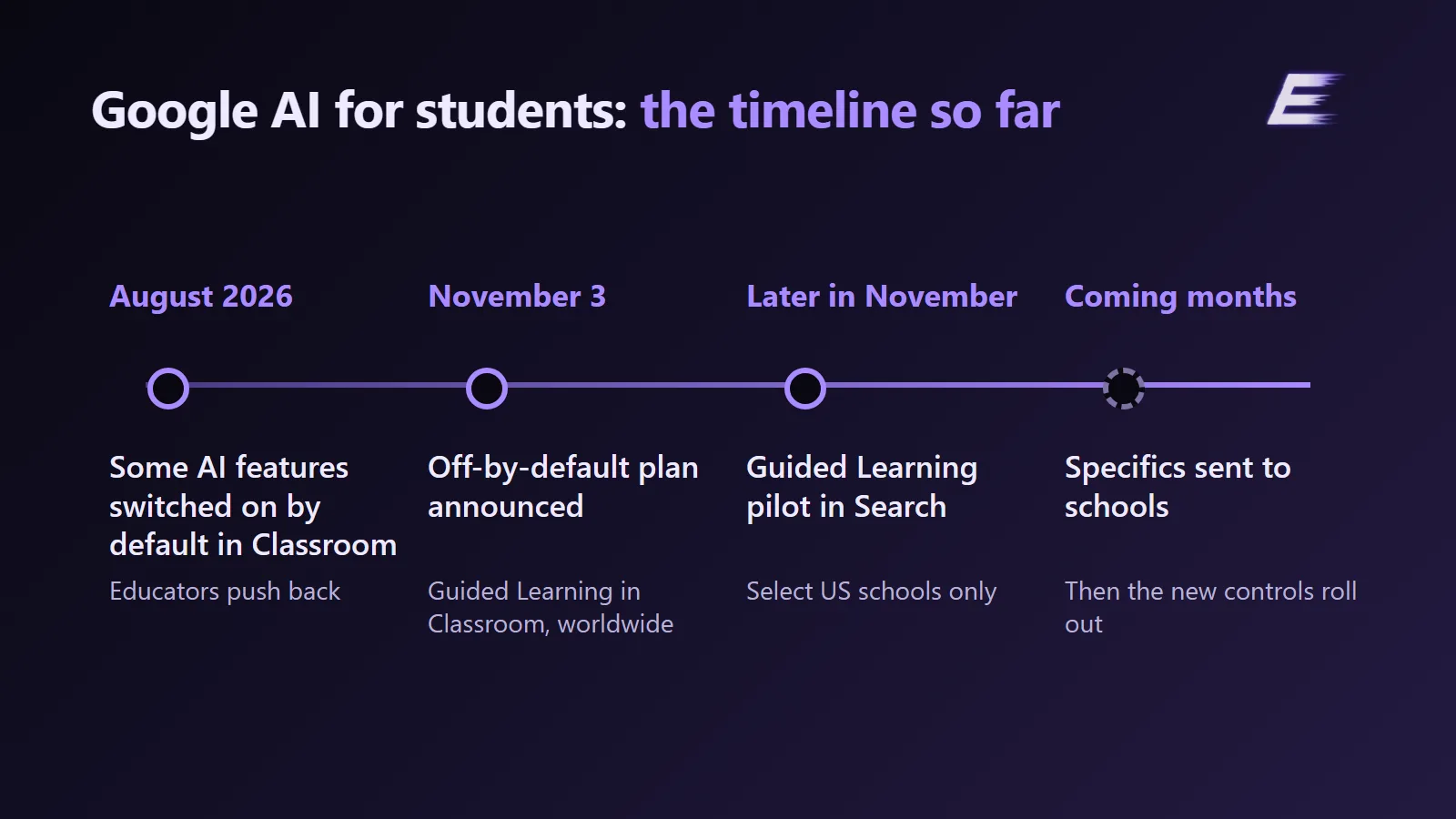
Google AI for students is going off by default. On November 3, 2026, Google said that Gemini, Gemini Notebook, Gemini in Classroom and Google Search will stay off for K-12 student accounts until a school administrator turns them on. Google gave no date for the switch and promised schools the details "in the coming months."
What is Google turning off for K-12 students?
Four products, on school-managed accounts for students from kindergarten through 12th grade. In Google's announcement, Chris Phillips, vice president and general manager of education, lists them: Gemini, Gemini Notebook, Gemini in Classroom and Google Search.
"Access to these products will be entirely off for K-12 student accounts until school administrators explicitly turn them on," Phillips writes. So the decision moves to the school.
It is not one master switch, either. Google told Engadget that administrators can enable each product on its own, and that the change is not an all-or-nothing deal. For example, a school could turn on Search and leave the Gemini app off.
The post covers K-12 student accounts only. It says nothing about teacher accounts, and nothing about students who use a personal Google account at home.
Why is Google Search on the list?
Because Google counts Search among its AI products for students. Google's own post does not explain why Search sits next to Gemini. The explanation comes from Phillips's interview with The New York Times, as Engadget reports it.
According to Engadget, Phillips told the Times that "Search and AI are deeply integrated." If a school bans AI tools, students "will not have access to Search, and they'll see a message from their school that indicates it's not available."
So a school that wants no AI for its students loses Google Search too. We could not read the Times interview itself, which sits behind a paywall. So Google's fuller reasoning reaches us only through the quotes Engadget carries, and we can't say whether Google calls the AI in Search impossible to separate.
Either way, the result for schools is the same. Neither Google's post nor its comments to Engadget describe a way to keep plain web search for students while turning off the AI answers on top of it.
What is Guided Learning, and where does it launch?
Guided Learning is Google's answer to the cheating worry. It coaches a student through a problem with questions and step-by-step hints instead of handing over the final answer. Phillips calls the goal "productive struggle": students get challenged, but not so much that they give up.
The mode already exists in the Gemini app. Now it is spreading to two more places:
- Google Classroom, worldwide, from November 3. A teacher assigns a Guided Learning activity, and it works like a one-on-one study tool anchored in class material. Teachers also get real-time insights into where the class needs extra help.
- Google Search, as a pilot. Google says it starts "in select U.S. schools later this month," then expands to other districts in the coming months.
In Search, Google says the mode kicks in "when our systems understand a student is looking for certain types of homework help." Its examples are a pasted physics problem and a request for help with a book report. In both cases, the student sees prompts to think the problem through rather than the answer.
Engadget adds that teachers will be able to see transcripts of chatbot conversations on student accounts in the school version. Google's post does not mention transcripts.
Why is Google switching AI for students off now?
Because its last move went badly. In August, Google turned on some AI features by default in Classroom, Engadget writes, and educators pushed back, as the Times reported. The new plan reverses that summer change.
Phillips frames it as listening. Google updated its approach "after listening to schools, teachers, leading researchers, and policymakers," he writes. The stated goal is to give school leaders "the control and confidence to use AI products in classrooms as they see fit."
The catch is in the bundle. Schools now get a real off switch for Gemini. But the same kind of switch decides whether students can use Google's search engine at school at all. For a district that runs on Chromebooks and Google's education apps, that is a hard choice to make.
How does Gemini compare with other AI tutors?
Google is not alone in selling a tutor that holds back the answer. Several tools in our AI tutors category work the same way, and the choice for a school is now partly about defaults and controls.
Gemini
71Google assistant wired into Workspace and Android
Google's source-grounded notebook: ask questions of your own PDFs, docs and videos with citations
Khanmigo
69Khan Academy's tutor that guides learners with questions instead of answers, free for teachers and $4 a month for families.
Browser extension and web app giving K-12 teachers feedback, reading-level, quiz and lesson tools inside Google and Microsoft classrooms
Khanmigo, from Khan Academy, also guides students with questions instead of answers. Brisk Teaching sits on the teacher's side, inside the browser. Gemini and Gemini Notebook are Google's own picks, and for K-12 students both now need an admin to say yes. You can browse more options in education and learning tools.
What we don't know yet about Google AI for students
Quite a lot, since Google promised the specifics later. The open questions:
- The date. The post says only "in the coming months," with no month or quarter.
- What "Search on" includes. If an admin enables Search, it is not clear whether AI Overviews and AI Mode come with it, or whether a school can keep them off.
- Countries. Guided Learning in Classroom is global, and the Search pilot is US-only. The post does not say if the off-by-default change applies in every country.
- Existing settings. Google has not said what happens to schools that already turned Gemini on for students.
- The research. Google says Guided Learning "leads to measurable learning gains," but the post itself gives no figures, only a link to Google's research.
We read the Google post line by line against the coverage. The off switch is real, and schools asked for it. Tying it to Search, though, means the honest default for many schools will still be "AI on," because few can run a school day without a search engine. That makes Guided Learning the part to judge, and the pilot will be the first real test.
Next, watch the Search pilot in select US schools later in November: it will show whether step-by-step hints hold up against real homework. Then watch for the admin details, which should say what "Search on" means for students.
Sources
GoogleEducationSearchGemini
Related news
All stories →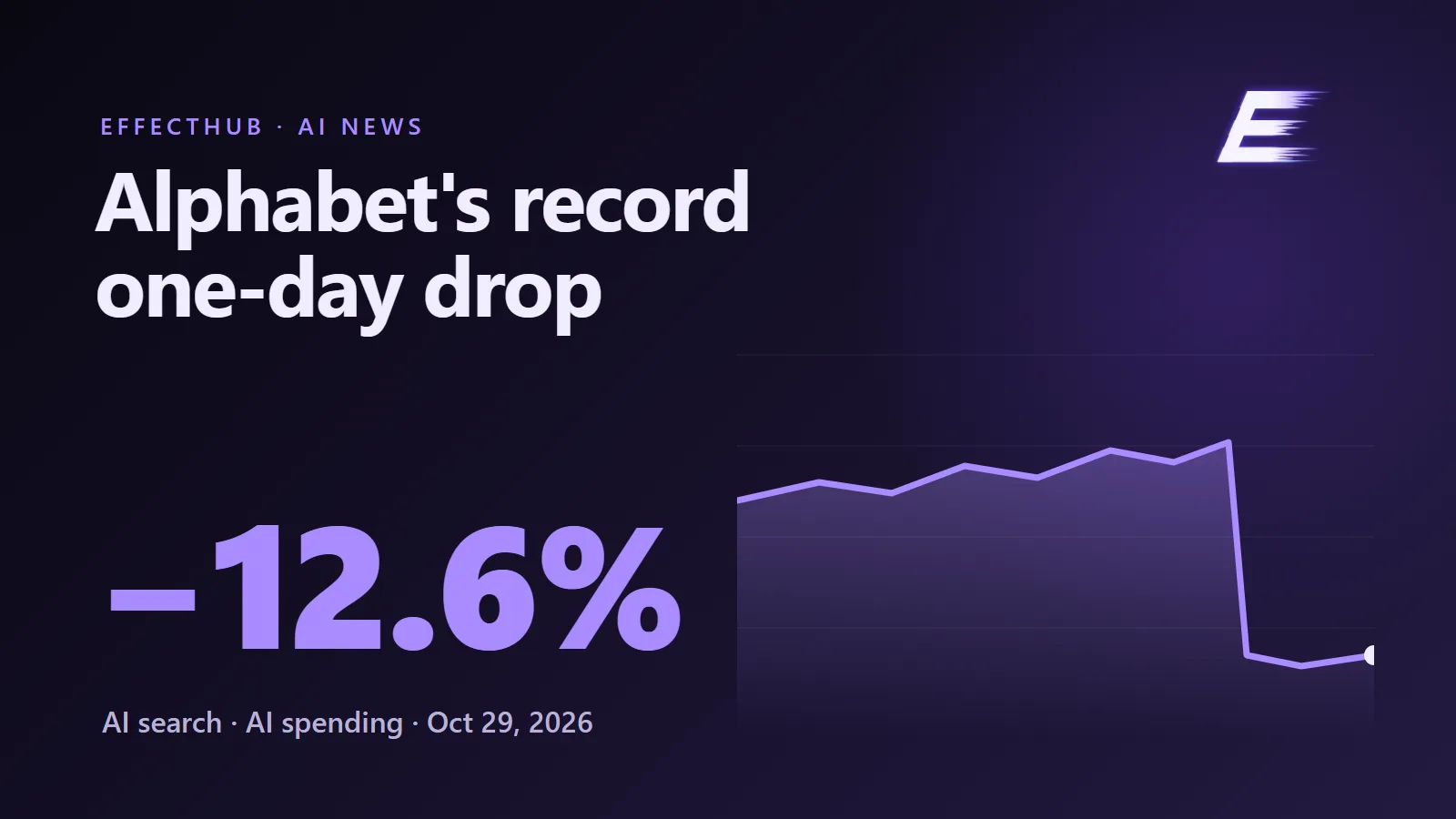
Alphabet stock suffers record one-day drop as AI search and AI spending weigh on Google
Alphabet stock fell 12.6% on October 29, its worst day since 2004. How AI search, record AI spending and negative cash flow drove the sell-off.
Google's Project Suncatcher satellite is online and sends its first AI response from orbit
Project Suncatcher, Google's data center satellite, sent its first AI reply from orbit. What the haiku proved and when orbital AI could pay off.

Google's Gemini 4 Carbon tops the leaderboards, but cyber defenders get it first
Gemini 4 Carbon leads the Artificial Analysis index at 59 and posts record cyber scores, but only vetted defenders can use it. Benchmarks, price, timing.