
Google's Project Suncatcher satellite is online and sends its first AI response from orbit
Project Suncatcher, Google's data center satellite, sent its first AI reply from orbit. What the haiku proved and when orbital AI could pay off.
Project Suncatcher, Google's research effort to run AI in orbit, has sent its first answer back from space. On October 30, 2026, Google said its prototype satellite, launched on October 1, had answered a prompt with the Gemma 4 open model. Google calls it "the first-ever AI response from a data center class TPU in orbit." The answer was a haiku.
What did the Project Suncatcher satellite actually do?
It ran a language model on a Google AI chip in orbit and sent the output to the ground. In Google's update, project lead Travis Beals says the team uplinked a prompt during a ground-station pass. It asked Gemma 4 for a haiku about being in space. The reply came down as the satellite passed Svalbard, Norway:
Blue marble below / Data streams in silent grace / Starlight feeds my core.
The team then tried space-themed limericks, plus prompts that report the technical status of the payload. Before any of that came commissioning, which meant powering up the host and TPU trays and running early machine learning tests. TechCrunch puts that phase at about three weeks, and a spokesperson told the outlet the satellite was operating nominally.
So the poem is a smoke test. It shows that the power, the chip, the model and the radio link all work together. It says little yet about whether the hardware will last.
Is this really the first AI in orbit?
No, and Google's wording is careful. The claim covers a "data center class TPU," which means Google's own chip family. By contrast, CNBC reported in December 2025 that the startup Starcloud had an Nvidia H100 in orbit, launched that November and running Gemma. So the same model family had already answered from space, on a rival's chip.
Nor was Project Suncatcher alone on its rocket. TechCrunch's launch report says the same flight carried AI payloads from Satlyt and Cowboy Space. We can't verify Google's "first" independently, so read it as Google's claim about its own class of hardware.
How small is the Project Suncatcher prototype?
Very small, and Google's team says so. Google built it in partnership with Planet and flew it on SpaceX's Transporter-18 rideshare mission. TechCrunch says that was a Falcon 9 carrying more than 100 other spacecraft. NPR describes a refrigerator-sized machine, and quotes Beals calling it "a very minimal test."
Most of the hard numbers come from reporters rather than Google:
- Power: up to 1 kW, TechCrunch reports.
- Chips: four TPUs, but only one can run at a time, according to a TechCrunch correction.
- Run time: about 20 minutes per burst, per TechCrunch on October 30. NPR and TechCrunch's own launch story said 15 minutes.
- Orbit: a standard orbit with batteries, NPR says. A sun-synchronous orbit without batteries is the plan for later satellites.
- Lifetime: the goal is a year of operation, according to NPR.
The design isn't final, either. TechCrunch reports this satellite uses a standard Planet platform, while the 2027 pair will be more purpose-built, with higher power generation. Google says the job of this mission is to gather data on how TPUs handle spaceflight stress, radiation and thermal extremes.
Why would anyone put data centers in space?
Because the energy is there. Google's facts page says satellites in low Earth orbit can generate up to eight times more solar power than panels on Earth. Meanwhile, demand keeps climbing. CNBC reports that Alphabet kept its 2026 capital spending guidance at $195 billion to $205 billion, in the same results that preceded a record drop in Alphabet stock. NPR adds that opposition to data centers is growing on the ground.
Cooling is the catch. A vacuum has no airflow, so heat can only leave through radiators, and Beals told NPR those are among the heaviest parts of this mission. Weight costs money at launch. Repairs are another problem. Carnegie Mellon professor Brandon Lucia told NPR that upkeep costs get "amplified by a factor of 10, maybe a factor of 100."
How does Google's plan differ from its rivals?
Google wants satellites to work as one machine. TechCrunch says Project Suncatcher is largely alone in planning high-speed links for coherent distributed workloads. SpaceX is also expected to use laser links, but with satellites too far apart to share processing well. Starcloud and Cowboy Space expect to run inference on individual satellites.
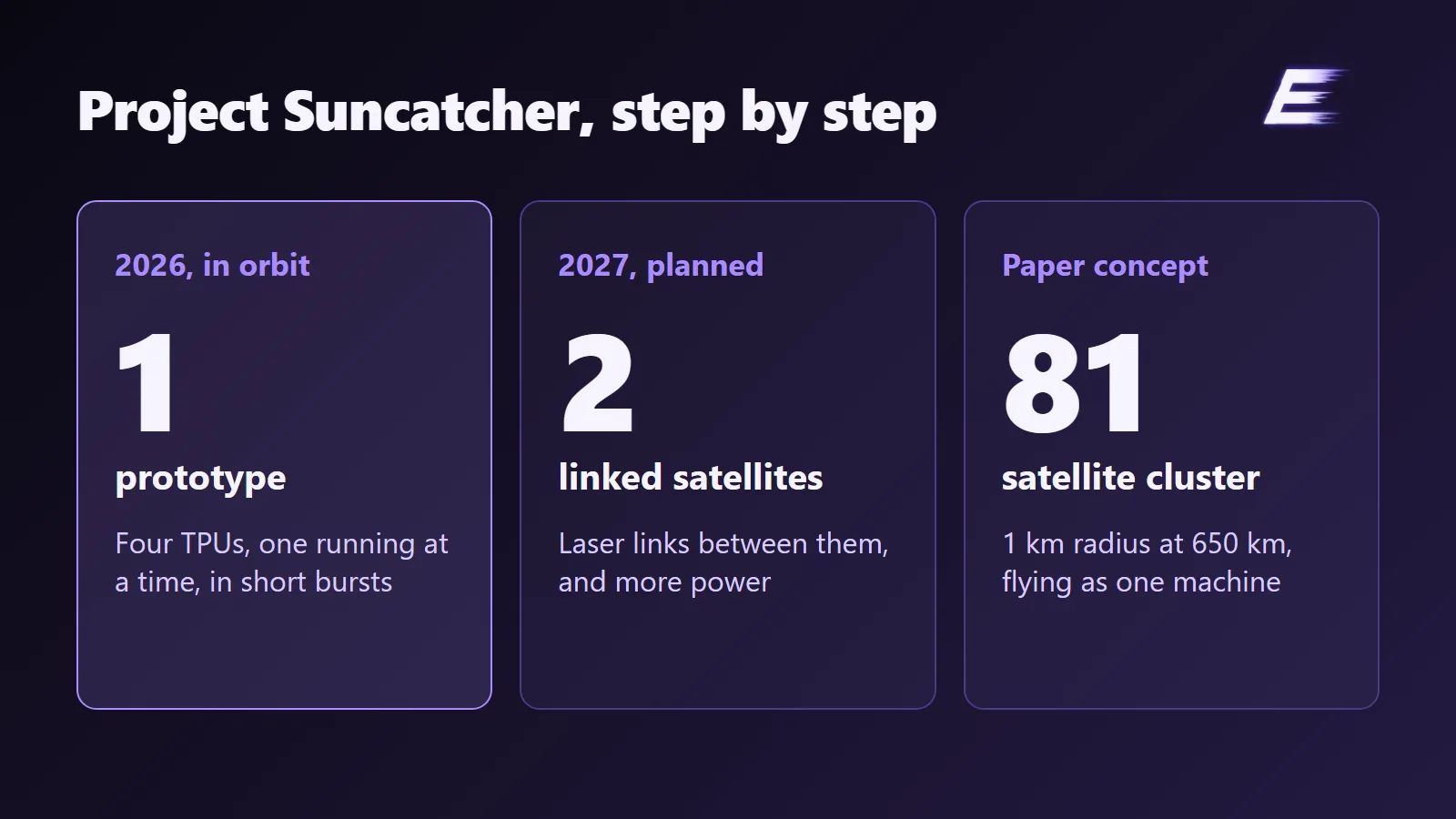
That design demands extreme formation flying. Google's paper sketches an illustrative cluster of 81 satellites within a 1 km radius at 650 km altitude. A bench demo has reached 800 Gbps each way over a short free-space path. Future satellites would each carry dozens of TPU chips, Google says. For competition on timing, NPR notes that SpaceX expects to start deploying "orbital AI compute satellites" as early as 2028.
What will the next Project Suncatcher tests measure?
Heat and radiation, which Google names as the next phase. On the ground, the team ran TPUs in a proton beam at UC Davis while they handled AI workloads. The Project Suncatcher paper reports no permanent failures from cumulative dose, well above what a five-year mission should deliver.
- Expected over a 5-year mission750
- First memory irregularities2000
- Highest dose tested on one chip15000
Those results come with an asterisk. TechCrunch reports that Google had to repeat the tests after realizing the chip's setup gave more shielding than it would get in orbit, and the rerun produced slightly more logic errors.
Silent errors matter most, because a bit flip can corrupt data without tripping any alarm. For inference, the paper estimates about one such failure per 3 million inferences, assuming one inference per second. Beals told TechCrunch it is "like one in a million." Training is more exposed, since thousands of chips would run for months, and he called that case "already problematic." So orbit looks more plausible for answering queries than for building the next frontier model.
When could Project Suncatcher pay off?
Not soon, and it leans on Starship-class rockets. Beals told NPR: "I don't see this being something where it's cheaper to do this in the next five years." TechCrunch describes the focus as infrastructure that is economical in the 2030s.
The arithmetic is in Google's paper. It assumes prices fall 20% for every doubling of cumulative mass launched, starting from Falcon Heavy at about $1,800 per kilogram. On that path, prices could drop below $200 by 2035. Getting there takes the equivalent of 1,800 Starship launches at 200 tons each, or 180 a year. An earlier TechCrunch headline said 1,600, and the outlet has corrected it to 1,800, which matches the paper.
- Most flown in any year, per TechCrunch on October 15
- Needed on Google's price path180
The authors note that rate sits well below SpaceX's stated targets, and that the result is "highly sensitive to chosen initial conditions." They also offer a lower case: about 72% less mass could still bring prices near $300 per kilogram.
So what does cheap launch buy? For a Starlink v2-style satellite, the paper estimates launch at $14,700 per kilowatt per year at today's $3,600 per kilogram on Falcon 9. That falls to $810 at $200, and to about $1,200 at $300. The authors call that comparable to terrestrial power prices, but stress this is "not intended as a comprehensive economic feasibility study." Alphabet also has a stake in the outcome, since TechCrunch reports it holds a significant investment in SpaceX.
What we don't know yet
Google's posts leave several gaps. They don't state the power budget or the run time, and the outlets give different figures. They don't say which size of Gemma 4 is aboard, or how fast it answered. And they include no in-orbit thermal or radiation data.
We also took the paper's figures from its June 2026 arXiv version, because we couldn't open the peer-reviewed version in the journal Joule. Numbers there may differ slightly.
What this means if you use AI tools today
Nothing changes in your stack. Gemma, the model behind the haiku, is an open model, and our list of open-source models shows its alternatives. Compute shortages are still solved on the ground, through a GPU cloud or wider AI infrastructure.
Gemma
87Google DeepMind's family of open-weight language and multimodal models, from phone-sized to workstation-sized, free to download and run.
Gemini
71Google assistant wired into Workspace and Android
We read Google's posts and paper against the press reports, and the result is real but small: one chip, short bursts, a poem. That earns respect as engineering, but it isn't evidence that orbit beats the ground on cost.
What to watch next
Three things will tell us more about Project Suncatcher than the haiku did. First, any published thermal and radiation results from this satellite. Next, the twin interconnected satellites due in 2027, which will test the laser links that make Google's plan different. Finally, watch Starship's flight rate, because 180 launches a year is what the paper's $200 target assumes.
Sources
- Google — We've received our first response from the Project Suncatcher prototype satelliteblog.google
- Google — Our Project Suncatcher prototype satellite is in orbitblog.google
- Google — Behind Project Suncatcher, our moonshot to put AI in spaceblog.google
- arXiv — Towards a future space-based, highly scalable AI infrastructure system designarxiv.org
- TechCrunch — Google's first data center satellite is online and writing poetrytechcrunch.com
- TechCrunch — Google thinks SpaceX's Starship has to launch 1,800 times before space data centers get off the groundtechcrunch.com
- NPR — Google launches Project Suncatcher, a step towards AI data centers in spacenpr.org
- CNBC — Nvidia-backed Starcloud trains first AI model in space, orbital data centerscnbc.com
- CNBC — Alphabet tanks nearly 13% for worst day ever losing $500 billion valuecnbc.com
GoogleResearchInfrastructure
Related news
All stories →
Google DeepMind's Genie 4 world model adds sound, speech and live steering
Google DeepMind's Genie 4 generates playable worlds with native sound and dialogue. What's new since Genie 3, who gets it first, and what it can't do yet.
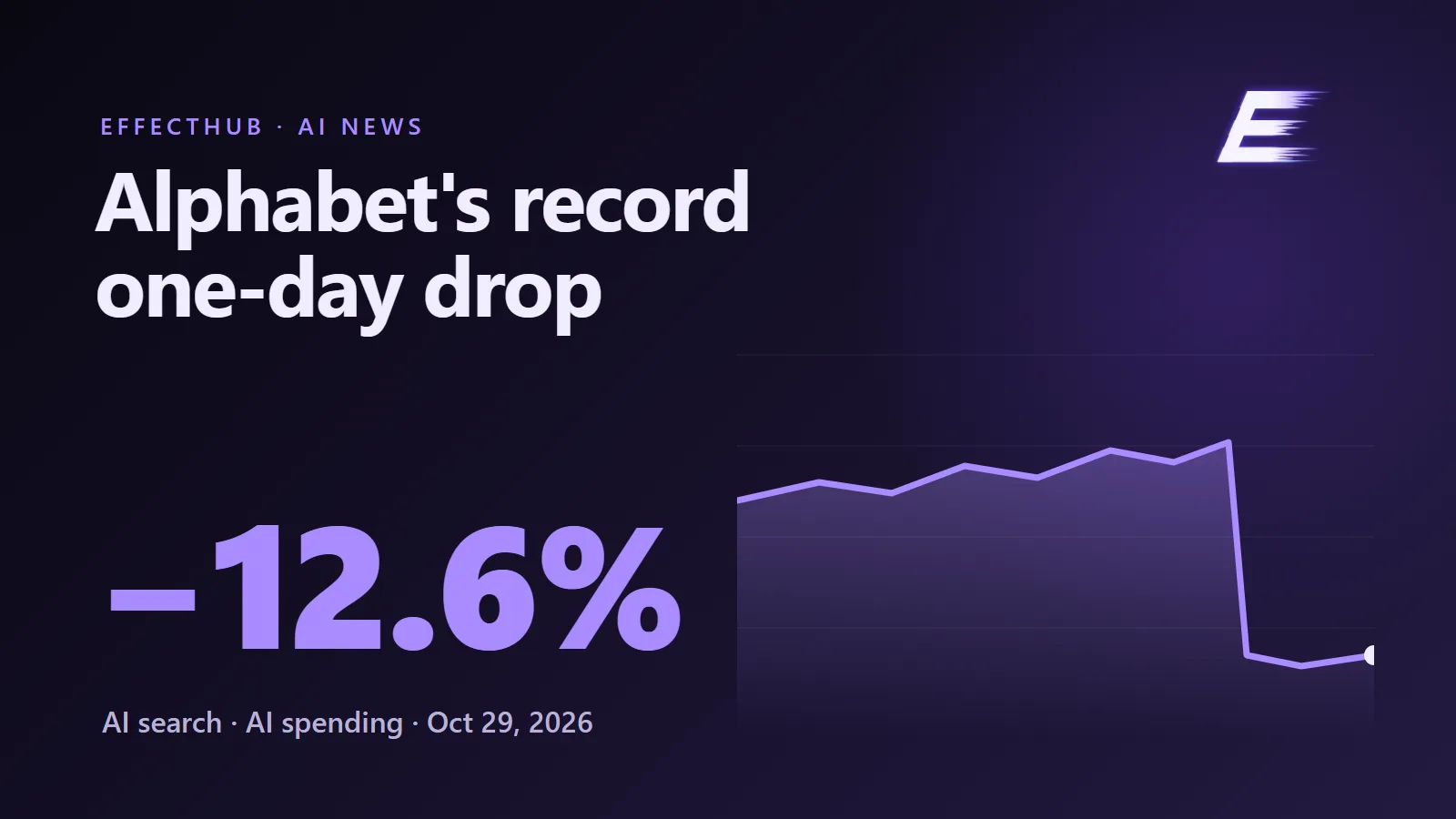
Alphabet stock suffers record one-day drop as AI search and AI spending weigh on Google
Alphabet stock fell 12.6% on October 29, its worst day since 2004. How AI search, record AI spending and negative cash flow drove the sell-off.
Google's Gemini 4 Carbon tops the leaderboards, but cyber defenders get it first
Gemini 4 Carbon leads the Artificial Analysis index at 59 and posts record cyber scores, but only vetted defenders can use it. Benchmarks, price, timing.