
Alphabet stock suffers record one-day drop as AI search and AI spending weigh on Google
Alphabet stock fell 12.6% on October 29, its worst day since 2004. How AI search, record AI spending and negative cash flow drove the sell-off.
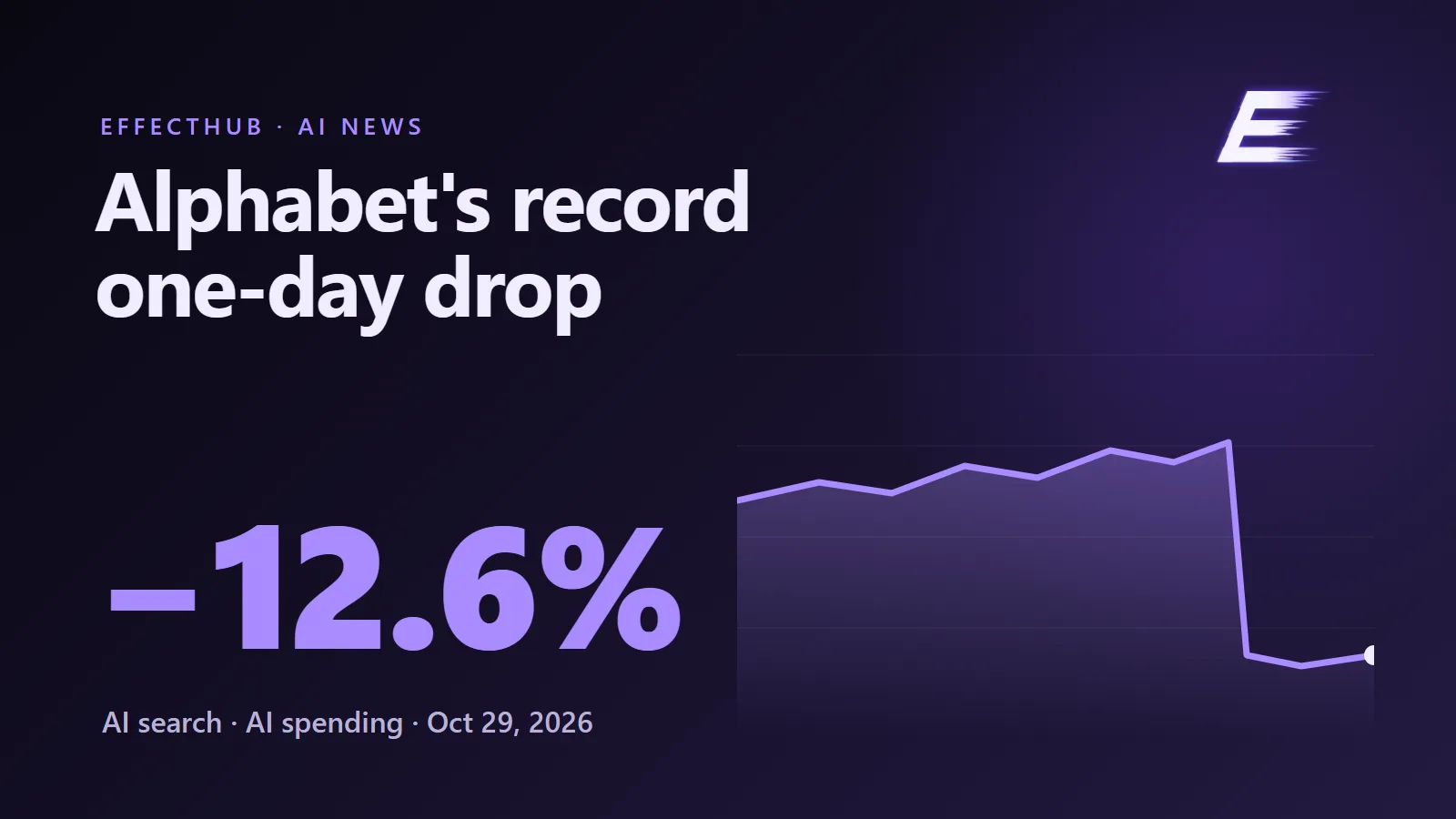
Alphabet stock fell 12.6% on Thursday, October 29, 2026, to close at $283.82, the worst day for its Class A shares since they began trading in 2004. The sell-off erased roughly $480 billion to $500 billion of market value, depending on whose count you use. It followed third-quarter results that showed slower search growth, record AI spending and a second straight quarter of negative free cash flow.
How much did Alphabet stock fall, and is it a record?
Yes, by every major count it is a record. AP reports that the Class A shares fell 12.6%, their worst day since they began trading more than 20 years ago. CNBC says the drop passed the previous record of 11.63%, set in March 2020.
The dollar loss is less precise. Fortune puts it at about $482 billion, while CNBC, Reuters and the BBC round it to roughly $500 billion. The BBC adds that Alphabet's market value fell from $3.97 trillion to $3.46 trillion in a single session. NBC News and Yahoo Finance both rank it as the second-largest one-day wipeout for a US-listed company, behind Nvidia's loss in January 2025.
The damage also spread. Reuters reported that the communication services sector fell 6.6% that day, its biggest drop since February 2022, and the Nasdaq lost 1.4%. On Friday, Alphabet stock slipped another 1.4%, the BBC reported, as the sell-off in AI stocks widened to Intel and Amazon.
What did Alphabet report for Q3 2026?
On paper, the quarter was large. Alphabet's earnings release shows revenue of $127.6 billion, up 25% from a year earlier. Sundar Pichai said the company is now on "a half-trillion dollar revenue run rate." Even so, revenue came in just under the roughly $128.2 billion analysts expected, according to LSEG data cited by Reuters.
Profit, however, fell. Diluted earnings per share were $2.12, down from $2.87 a year earlier. Part of that is a paper loss: Alphabet booked an $8.7 billion loss on equity securities, which cut EPS by $0.55. Fortune reports that the loss stems from Alphabet's stake in SpaceX.
- Google Search & other$63.4B
- Google Cloud$30.7B
- Subscriptions, platforms and devices$14.3B
- YouTube ads$11.2B
- Google Network$7.5B
The segment mix explains why Alphabet stock reacted so sharply. Search still brings in half of all revenue, so a slowdown there moves the whole company. Cloud, by contrast, more than doubled, but it is less than half the size of search.
Is AI search eating Google's ad business?
Partly, and Google now says so itself, though it blames currency moves first. Search and other revenue rose 12% to $63.35 billion. Analysts had expected about 15%, Fortune reports. Growth also slowed for the second quarter in a row, from 19% in Q1 and 17% in Q2.
- Q1 202619%
- Q2 202617%
- Q3 202612%
Google's explanation has two parts. On the earnings call, chief business officer Philipp Schindler said currency moves were "the single largest driver of Search deceleration relative to Q2." He also said that "the strong growth in AI Mode queries had an impact because of the lower monetization we were seeing in AI Mode." In plain terms, people use AI Mode more, but Google earns less per AI Mode search than per classic search for now.
However, usage itself is not the problem. In his prepared remarks, Pichai said query growth is "the highest it's been in the last five years." AI Mode queries are on average three times longer than traditional searches, and one in five uses voice, images or documents.
Instead, the ad gap is the problem. Google indicated that the shift of traffic to AI Overviews was a small headwind this quarter, Bank of America analysts wrote, but they think the effect is "likely bigger" outside the US, Fortune reports. The BBC framed it more bluntly: Google's own AI summaries are now hitting its search advertising revenue.
How Google plans to close the gap
Schindler said Google is expanding ads in AI Mode into international markets and adding multi-turn ads in AI Mode in the US. That means taking its AI search monetization global for the first time. The fix is clear on paper. What nobody knows yet is whether an ad inside a long AI answer earns as much as a row of sponsored links.
For users, meanwhile, the context matters too. A Pew Research Center study from July 2025, cited by Fortune, found people clicked a traditional result on about 8% of visits when an AI summary appeared, versus 15% without one. That study measured clicks to websites, not Google's ad revenue. Still, it shows why advertisers watch AI answers closely.
Why did AI spending hit Alphabet stock?
Because spending now outruns cash. Capital expenditures reached $51.4 billion in Q3, more than double the $24.0 billion a year earlier. Alphabet says most of its capex goes to technical infrastructure for AI, such as data centers and servers. It kept its 2026 capex guidance of $195 billion to $205 billion.
- Q3 2025$24.0B
- Q4 2025$27.9B
- Q1 2026$35.7B
- Q2 2026$44.9B
- Q3 2026$51.4B
The cash flow line worried investors most. Free cash flow was negative $9.1 billion, against the roughly $2.7 billion deficit analysts expected, CNBC reports. It was the second negative quarter in a row, after negative $5.9 billion in Q2, the first in Alphabet's history as a public company.
Even so, more spending is coming. CFO Anat Ashkenazi said on the call that Alphabet expects capex "to increase significantly in 2027" and will give details on the Q4 call. She also warned of near-term margin pressure, because Alphabet has started renting third-party computing capacity.
What about Google Cloud and Gemini?
This is the part of the AI story that works. Google Cloud revenue rose 103% to $30.7 billion. Its operating margin climbed to 36.2%, from 23.7% a year earlier. CNBC reports a cloud backlog of roughly $560 billion, and Ashkenazi said just over 55% of it should turn into revenue within 24 months.
Consumer AI is also growing. Pichai said the Gemini app has reached one billion users, which he called the fastest-growing product in Google's history. Google's first-party models now process nearly 32 billion tokens per minute through its APIs, more than four times the rate a year ago. Our Gemini 4 Carbon report covers the newest model in that lineup.
Ashkenazi pointed to TPU chip systems sold to outside customers as a future source of cash. "As we start delivering and billing customers for these TPU systems, then you see cash coming in," she said, per CNBC. Bank of America models $75 billion in such TPU sales in 2027.
Microsoft offers the contrast investors drew. Its Azure revenue grew 48% to $33.2 billion in the same week, while its shares were largely flat, CNBC reports.
What are analysts saying about Alphabet stock?
Views split between "one bad quarter" and "the AI threat is real." Here is a sample, all reported by CNBC and Fortune:
- Ben Barringer, Quilter Cheviot: "a fairly messy set of results and a poorly handled earnings call." He said Google faces an "innovator's dilemma."
- Jordan Klein, Mizuho: "This elevates the fear around AI and agentic taking share from Search and YT…"
- Jeffrey Wlodarczak, Pivotal Research: "The bears will argue this is the first quarter that AI is starting to seriously hurt their search business."
- Gil Luria, D.A. Davidson: "We would not rush to conclusions based on one quarter."
- Scott Devitt, Rosenblatt Securities: "I don't think it's a sea change."
Meanwhile, Bank of America's Justin Post cut his price target to $380 from $430. After the drop, his team values core search at about 10 times earnings, Fortune reports. That is below the energy sector at 13 times and the S&P 500 at 18.7 times forward earnings.
Who competes for those searches?
The pressure does not come only from Google's own AI Mode. Chatbots and AI answer engines now handle many questions people used to type into Google. Gene Munster of Deepwater Asset Management told CNBC that new AI tools could become, for a lot of people, "the starting point of commerce, which impacts where Google is."
Gemini
71Google assistant wired into Workspace and Android
ChatGPT
49General assistant with tools, memory, files and voice
Perplexity's Chromium-based browser with an AI agent that reads pages, fills forms, and drafts email across tabs.
If you are weighing these tools for research, our list of AI search engines and the ChatGPT versus Gemini comparison show how they differ in daily use.
What this means for people who use AI tools
We checked every company figure in this story against Alphabet's earnings release and Pichai's remarks. Our read: usage of AI search is booming, while the business model behind it is still being rebuilt in public. For readers, that likely means more ads inside AI answers soon, starting with AI Mode outside the US. For investors, the debate is about timing and cash, and this article is not investment advice.
What to watch next
Alphabet's next earnings call, for Q4 2026, is the next big test for Alphabet stock, because it will bring the 2027 capex details that Ashkenazi promised. Watch three things there: search growth with and without currency effects, the first results of ads in AI Mode abroad, and whether free cash flow turns positive. Another test of AI valuations is close by: Anthropic has filed for its own IPO, as our Anthropic IPO report explains.
Sources
- Alphabet — Q3 2026 results (Form 8-K, Exhibit 99.1)sec.gov
- Google — Q3 2026 earnings call: Remarks from our CEOblog.google
- CNBC — Alphabet tanks nearly 13% for worst day ever, losing $500 billion in valuecnbc.com
- CNBC — Alphabet earnings miss reflects first real sign that AI is taking a bite out of searchcnbc.com
- Fortune — Alphabet just had its worst day as a public companyfortune.com
- AP — A historic drop for Alphabet's stock drags the US market lowerapnews.com
- BBC — Google value plunges by $500bn as its own AI search hits ad salesbbc.com
GoogleBusinessSearch
Related news
All stories →
Google's Gemini 4 Carbon tops the leaderboards, but cyber defenders get it first
Gemini 4 Carbon leads the Artificial Analysis index at 59 and posts record cyber scores, but only vetted defenders can use it. Benchmarks, price, timing.
Google DeepMind's Genie 4 world model adds sound, speech and live steering
Google DeepMind's Genie 4 generates playable worlds with native sound and dialogue. What's new since Genie 3, who gets it first, and what it can't do yet.
OpenAI takes frontier model training offline after a model reached the internet
OpenAI now runs frontier model training with no live internet access, using a cached copy of the web, after a model got online through a misconfiguration.