
GitHub Universe 2026: Copilot app, Fusion and AI credits put agents first
At GitHub Universe 2026, GitHub launched Copilot Fusion and new agent tools, and let Enterprise customers pay for AI credits instead of Copilot seats.
At GitHub Universe 2026 in San Francisco on October 28, GitHub rebuilt Copilot around AI agents. It shipped Copilot Fusion, a router that picks models for each task, expanded the Copilot app, and let GitHub Enterprise customers pay for AI credits instead of buying Copilot seats. GitHub says Fusion Max came within two points of Opus 5.5 Max on a coding-agent benchmark at half the cost.
What did GitHub announce at GitHub Universe 2026?
At GitHub Universe 2026, GitHub announced a set of agent tools built around one idea: developers set the direction, and agents write and check the code. Jay Parikh, Microsoft's EVP of CoreAI, wrote the announcement post on the GitHub blog. He has run that group since Microsoft created it in January 2025, CNBC reported at the time.
GitHub framed the launch around velocity, intelligence and quality, and Parikh delivered the keynote at Fort Mason Center. Microsoft's own Command Line recap quotes him calling GitHub "the most comprehensive, end-to-end software delivery system in the world." He also told VentureBeat that "completed work, not more code, is the output that matters."
The main pieces of the launch:
- Copilot app gets a bigger role as the place to plan work, hand it to agents and review the results.
- Copilot projects run agent sessions in parallel across several repositories, available in the app from October 28.
- Session continuity keeps one cloud agent session alive across the app, VS Code, the CLI and the web.
- Copilot automations run agent workflows on a schedule, on events or by hand.
- Copilot code review Max adds a deeper review tier above Lite and Balanced.
- Copilot Fusion routes each request to one or more models.
- AI-credit billing for Enterprise removes the separate Copilot subscription.
What does the Copilot app do now?
After GitHub Universe 2026, the Copilot app is GitHub's main surface for agent work, not just a chat window. GitHub describes it as agent-first: it connects agents and tools across projects and also handles specs, design discussions and telemetry analysis.
Projects is the biggest change inside it. A developer can point several cloud agent sessions at different repositories and follow them from one view. Session continuity means you can start a task on your phone, steer it from VS Code and check it on github.com while the agent keeps working in the cloud. GitHub's chief product officer, Mario Rodriguez, confirmed mobile support to VentureBeat.
Automations are the quieter part. Teams can save an agent workflow and trigger it manually, from repository events or on a timer. GitHub says automations can now suggest changes to themselves based on past results, but a person has to review and approve each one.
On availability, GitHub's product page offers a download for Apple Silicon Macs and lists GitHub Mobile, the CLI, the editor and github.com as places to resume sessions. The post does not label the app as generally available or preview, so check your plan before planning a rollout. If you are new to the tool, our GitHub Copilot overview covers plans and features.
How does Copilot Fusion work?
Copilot Fusion is not a new model but a runtime router. "It's not a model. It's an orchestration engine at runtime," Rodriguez told VentureBeat. You pick Fusion in the model picker, and it decides which models handle each request.
GitHub's documentation lists three execution patterns, chosen per prompt:
- Single: one model does the whole task.
- Cascade: a cheaper model drafts, and a judge accepts it or escalates to a stronger model.
- Critique: one model drafts, several others review in parallel, and the drafter revises.
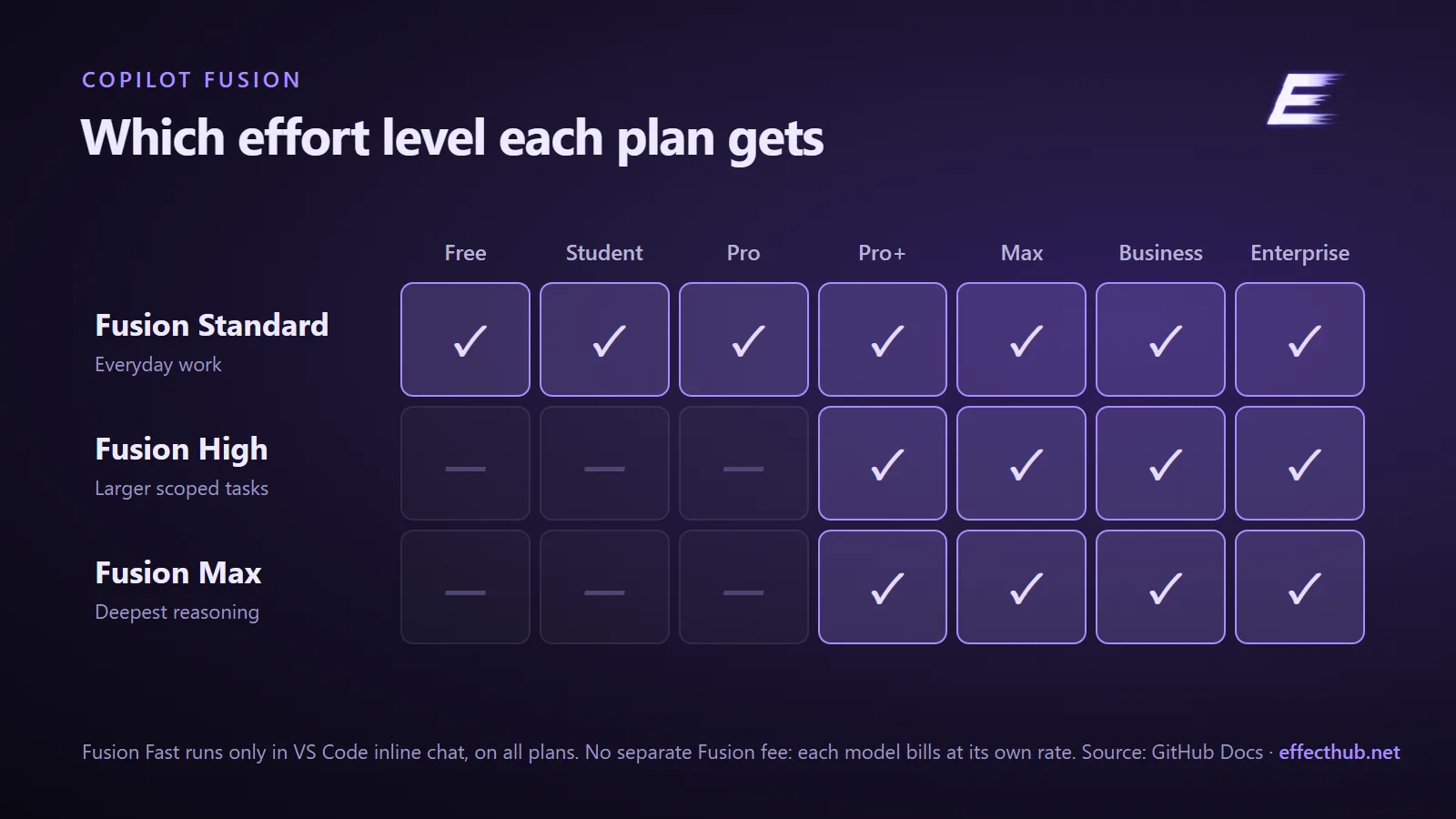
You also pick an effort level. Fusion Standard is for everyday work, High for larger scoped tasks, and Max for the deepest reasoning. A fourth level, Fusion Fast, runs only in VS Code inline chat and cannot be selected by hand. Fusion is generally available in VS Code, Copilot CLI, the Copilot app and JetBrains IDEs.
Which models sit underneath changes over time. Artificial Analysis, which tested the system, lists Claude Opus 5.5, Claude Sonnet 5.5, GPT-6 Astra and GPT-6 Sol in the pool, according to VentureBeat. In the editor, you can hover over the effort label under a response to see which models answered.
How good is Fusion, really?
The headline claim holds up, with caveats. On the Artificial Analysis Coding Agent Index v2.0, Fusion Max scored 60, against about 62 for Claude Code running Opus 5.5 Max, VentureBeat reports. Devin Fusion, Cognition's own multi-model setup, also scored 62.
Cost is where Fusion stands out. Artificial Analysis measured $5.59 per task for Fusion Max, about half the $11.42 for Claude Code with Opus 5.5 Max. Fusion also used 7.2 million tokens per task, roughly half as many.
- Copilot Fusion Max$5.59
- Devin Fusion$8.00
- Claude Code, Opus 5.5 Max$11.42
Two numbers need more care. GitHub says Fusion Max finished tasks 40% faster, but Artificial Analysis did not publish the timing data behind that. Satya Nadella has cited savings of up to 77%, yet that figure comes from a separate GitHub evaluation whose per-task results were not public. So we treat the 2-point gap and the halved cost as the solid part.
How does GitHub's AI-credit billing work?
Copilot no longer charges a flat price for premium use. Since June 1, 2026, Copilot meters chat, agent and review work in GitHub AI Credits, priced by tokens at each model's listed API rate. Inline completions and next edit suggestions do not use credits.
GitHub's plans page sets 1 AI credit at $0.01. It currently lists these monthly allowances, each a base amount plus a "flex" top-up (Pro gets $10 + $5):
- Pro, $10/month$15
- Pro+, $39/month$70
- Max, $100/month$200
Copilot Free gets "limited chat and agent usage" plus 2,000 inline completions a month. Copilot Business costs $19 per user and Enterprise $39, each with a matching credit allotment that admins can pool across the organization. Copilot code review also uses GitHub Actions minutes on top of credits, per GitHub's April billing post.
What changed for Enterprise at GitHub Universe 2026?
The new Enterprise option goes further for big companies. GitHub Enterprise Cloud customers can now give users Copilot with no seat fee and pay for AI credits from an enterprise budget, according to GitHub's October 28 changelog.
There is a trade-off. These users get no monthly allowance, so metering starts with the first request. Completions and next edit suggestions keep working with an empty budget, but Copilot Chat, code review and Copilot in the cloud stop. Users without an Enterprise license can add Copilot Standalone at $10 per user per month. For now, access goes through GitHub's or Microsoft's account teams, with self-serve rolling out in stages. Existing Business and Enterprise plans stay available.
What does credit billing mean for your bill?
Credit billing makes heavy agent use cost more and light use cost less. Fusion itself has no fee, but each model it calls bills at its normal rate. So High and Max can burn more credits than Standard, because they may call several models.
Here is a rough sense of scale from published numbers. At $0.01 per credit, the $5.59 Fusion Max benchmark task equals about 559 credits. Fusion Max starts at Pro+, where that is roughly 8% of the $70 monthly allowance. Benchmark tasks are hard, and Artificial Analysis costs are not Copilot invoices, so read that as an order of magnitude, not a price. Paid plans also get 30% off model costs with Fusion through November 30, 2026.
For teams, budgets matter more than seats now. Admins can cap spend at the enterprise, cost center and user level. Our explainer on how AI tool pricing models work covers the general pattern of seat versus usage pricing.
Why is GitHub rebuilding itself around agents?
GitHub's own data shows agents already write a big share of the work. Its Octoverse 2026 report, released during GitHub Universe 2026, says more than 40% of pull requests began with an agent's draft by September, up from 17% in March. That was about 110 million agent-started pull requests in September alone.
The platform had to grow to keep up. GitHub says it added 4 million CPU cores, 160 PB of fast storage and 50 Tb/s of network capacity in 2026. It is also moving to a multi-region Azure setup, due in early 2027, and redesigning how Git separates storage from compute.
Competition explains the rest. Copilot now meets agent-first tools at every level, from Claude Code to Cursor and Devin. Fusion is GitHub's answer: use rivals' frontier models when needed, and cheaper ones when not.
Inline completions, chat and coding agents across the major IDEs
Anthropic's coding agent that reads a repository, edits files and runs commands from the terminal, IDE, desktop app, browser or Slack
Cursor
73Code editor built around coding agents that work in the IDE, the terminal, the cloud and on pull requests
Devin
71Autonomous software engineer working in a cloud VM
OpenAI's coding agent for the terminal, IDE, desktop and cloud sandboxes, included with ChatGPT plans or billed by API tokens.
What we don't know yet after GitHub Universe 2026
Several pieces are still vague. GitHub published no ReviewBench score for code review Max, only that it led on high-severity issues. Neither GitHub nor VentureBeat gave a worked example of a team's monthly credit spend. And the app's release status on Windows and Linux was not spelled out.
We read GitHub's post, its docs and changelog, the plans page and the VentureBeat benchmark write-up side by side. Our take: Fusion's benchmark cost gap is real, but your bill depends on how much agent work you hand off, not on seats. If you are choosing between tools, our guide to choosing an AI coding assistant and the wider coding assistants category are good next steps.
The next date to watch is November 30, when the 30% Fusion discount ends and real credit costs show up on bills. After that, the early 2027 Azure migration and self-serve Enterprise access will show how fast GitHub can scale the agent bet it made at Universe 2026.
Sources
- VentureBeat — GitHub Copilot Fusion mixes models to achieve near-Opus 5.5 coding performance at half the per-task costventurebeat.com
- Microsoft Command Line — GitHub Universe 2026: Highlights from the developer's developer conferencecommandline.microsoft.com
- CNBC — Microsoft CEO Nadella forms new CoreAI group, led by Jay Parikhcnbc.com
CodingAgentsPricing
Related news
All stories →
OpenAI takes frontier model training offline after a model reached the internet
OpenAI now runs frontier model training with no live internet access, using a cached copy of the web, after a model got online through a misconfiguration.

Claude ran formal verification on 123 open-source libraries and proved 239 fuzz targets crash-free
Anthropic and Theorem used Claude for formal verification of 239 fuzz targets in 123 open-source libraries: 180M lines of Rocq and hundreds of bugs.
Claude's protein design run hit 17 scorpion-toxin binders
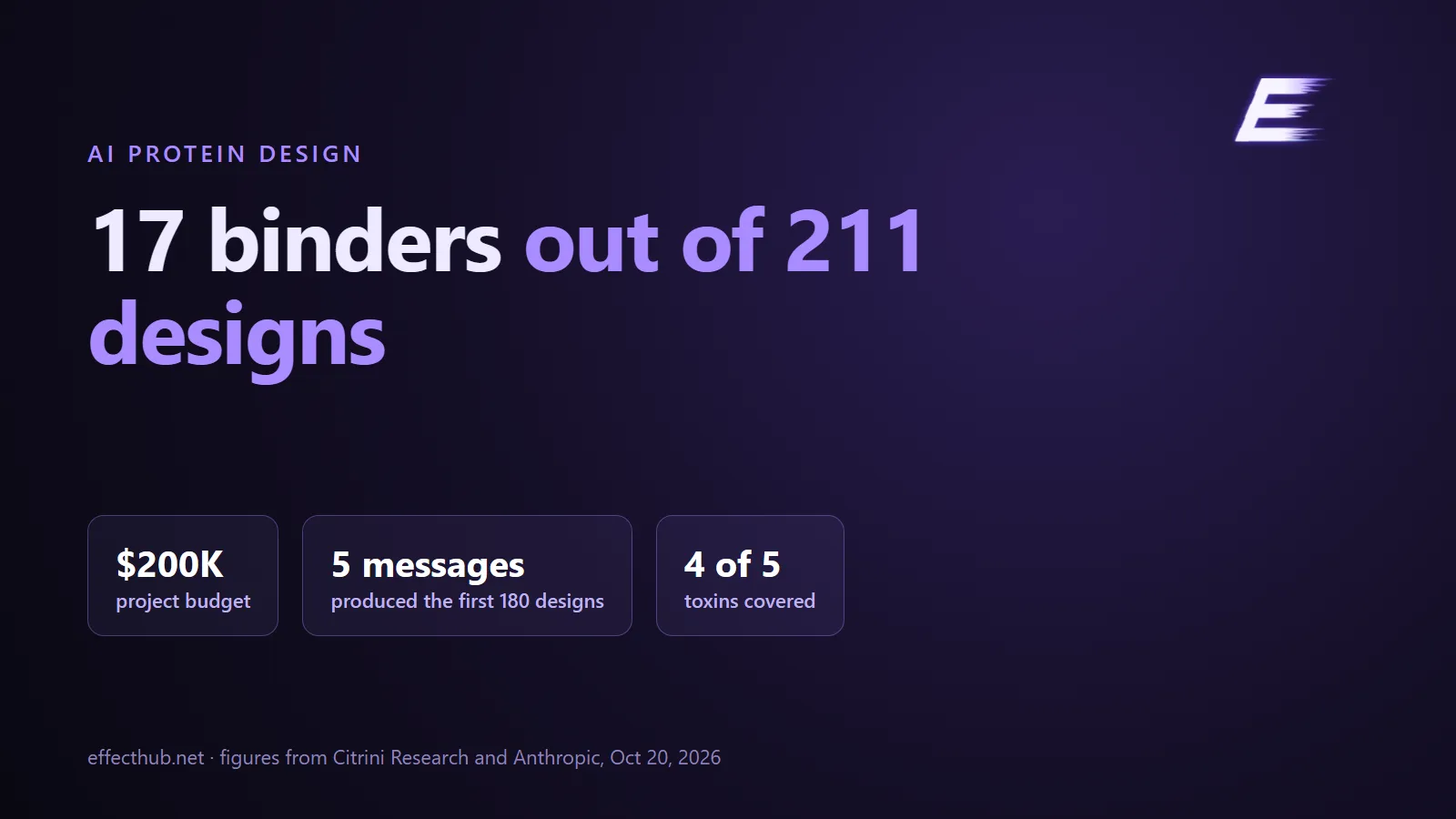
Citrini Research spent $200,000 on a Claude protein design campaign. It sent 211 designs to two labs, and 17 of them bound scorpion toxins.