
Claude's protein design run hit 17 scorpion-toxin binders
Citrini Research spent $200,000 on a Claude protein design campaign. It sent 211 designs to two labs, and 17 of them bound scorpion toxins.
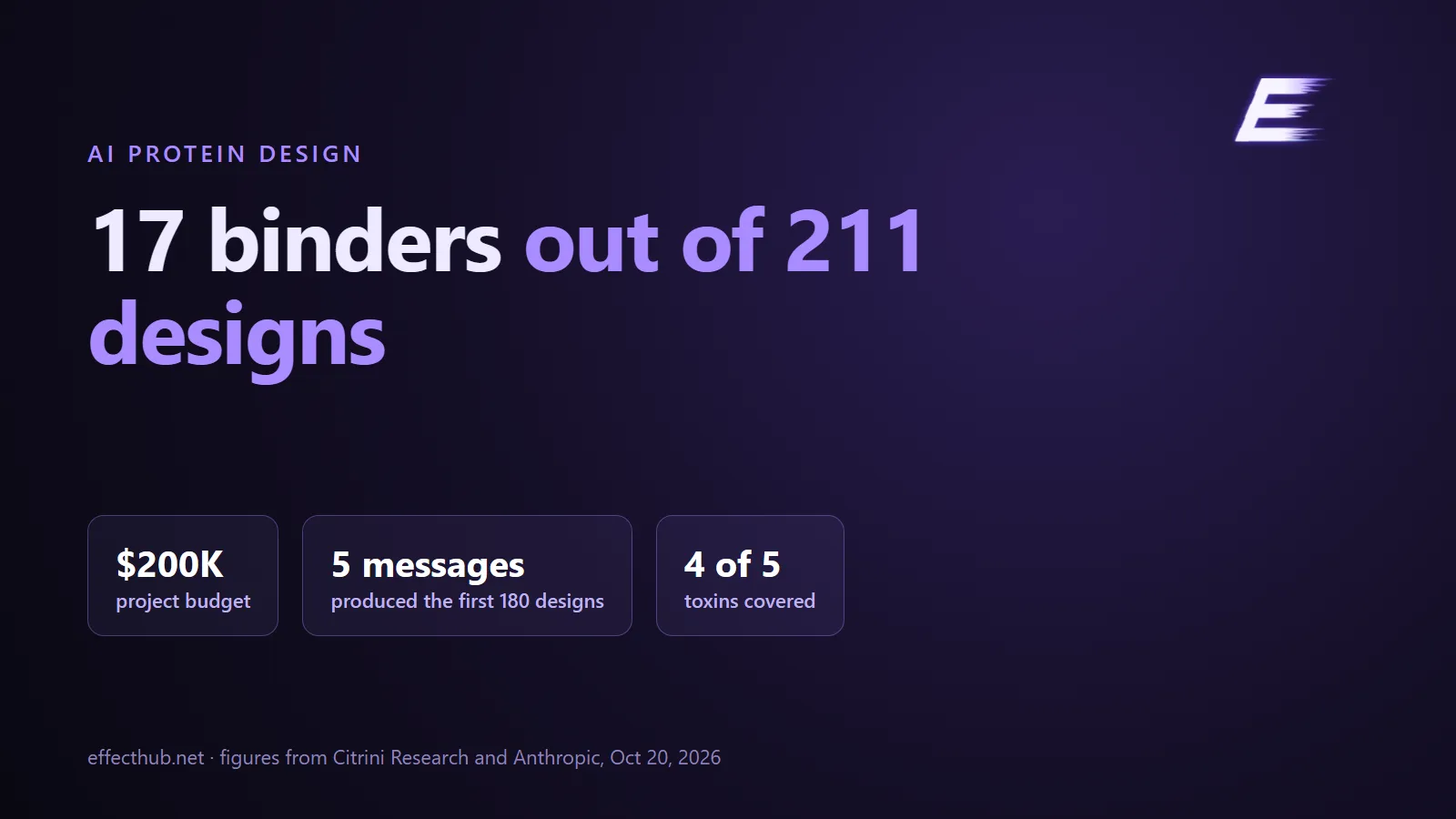
An investment newsletter spent $200,000 to see whether Claude could run a protein design project. On October 20, 2026, Citrini Research published what came back from the lab: of 211 designs sent to two contract labs, 17 bound their target scorpion toxins, across four of the five toxins picked. Anthropic published the technical write-up the same day, and it says plainly that the work does not amount to an antivenom.
Why an investment newsletter picked a protein design problem
Citrini Research is an investment research firm, not a biotech. Five people took on the project, and three of them have no science background at all. Their stated goal was modest: get as far as an in vitro study package, and find out first-hand what "AI drug discovery" actually involves.
They settled on minibinders, which are small proteins that latch onto a target protein such as a toxin. Snakebite had already been worked on with AI by the Baker lab, so the team turned to scorpion toxins instead. Today's scorpion antivenoms come from horses that are injected with venom, and whose purified antibodies are then collected, a process Citrini calls laborious. US prices run to thousands of dollars a dose, it says, though doses are much cheaper in Mexico.
Large molecules are the easier target for AI right now. Citrini says AI protein design is much further along than the equivalent work on small molecules, because a protein is a structured design problem with an evolutionary alphabet. A toxin is also a clearly identifiable protein, so a lab can answer a simple question about any protein design: did the binder stick?
The team added a moonshot as well, asking for one molecule that would bind all five toxins at once. Claude warned them it was very likely to fail, and it did.
What stopped them, and how did Anthropic respond?
Their very first prompt was blocked. Citrini had forgotten about biosecurity filtering, and the request to rank candidates hit the classifier immediately. After an introduction to Anthropic's life sciences team, the company sent a questionnaire with more than 60 questions about security measures the newsletter did not have.
So the work moved inside Anthropic. The team did the prompting in person at Anthropic's offices, on the company's own network and machines, using an internal research model that is more capable than the public releases. That detail matters more than the binders, because the access path here was a badge and a supervised room, not an API key.
What did the $200,000 buy?
The budget split two ways. Lab work across two contract research organisations, Adaptyv Bio and Twist Bioscience, came to just shy of $150,000. That covered DNA synthesis, expression and purification, binding measurements and a developability assay. Compute came to $49,997, which bought a little more than 10,000 H100 GPU-hours.
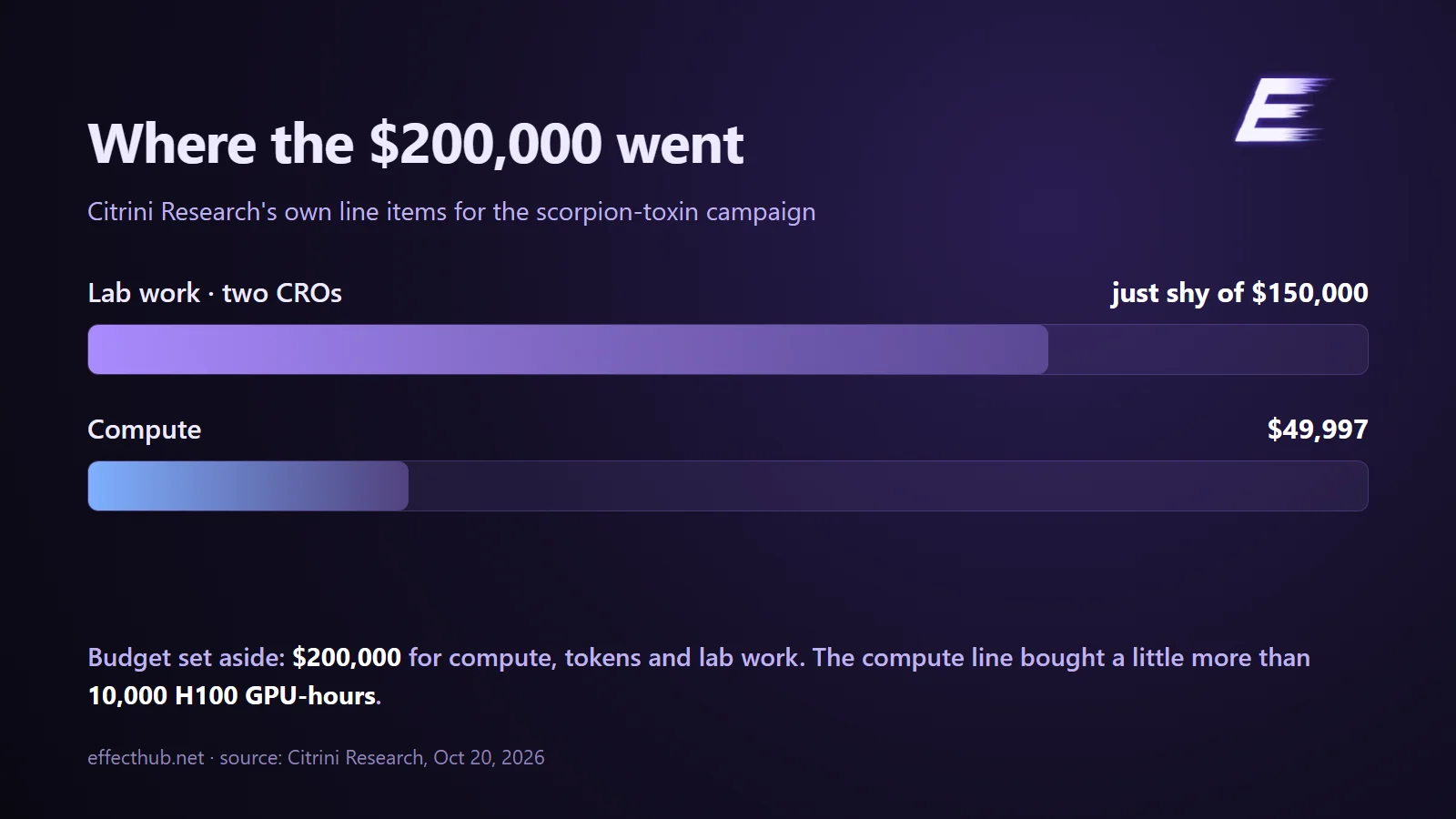
Wet-lab work, in other words, cost three times the compute. That ratio is the quiet lesson of the project, because the cheap part is the part people write headlines about.
How did the protein design campaign run?
Five human messages produced the first 180 designs. The team wrote a roughly 35-page prompt with Claude's help, hit enter, and sent four follow-ups during the run. Claude worked autonomously for the first 24 hours, spawning more than 300 sub-agents across more than 300 concurrent GPUs.
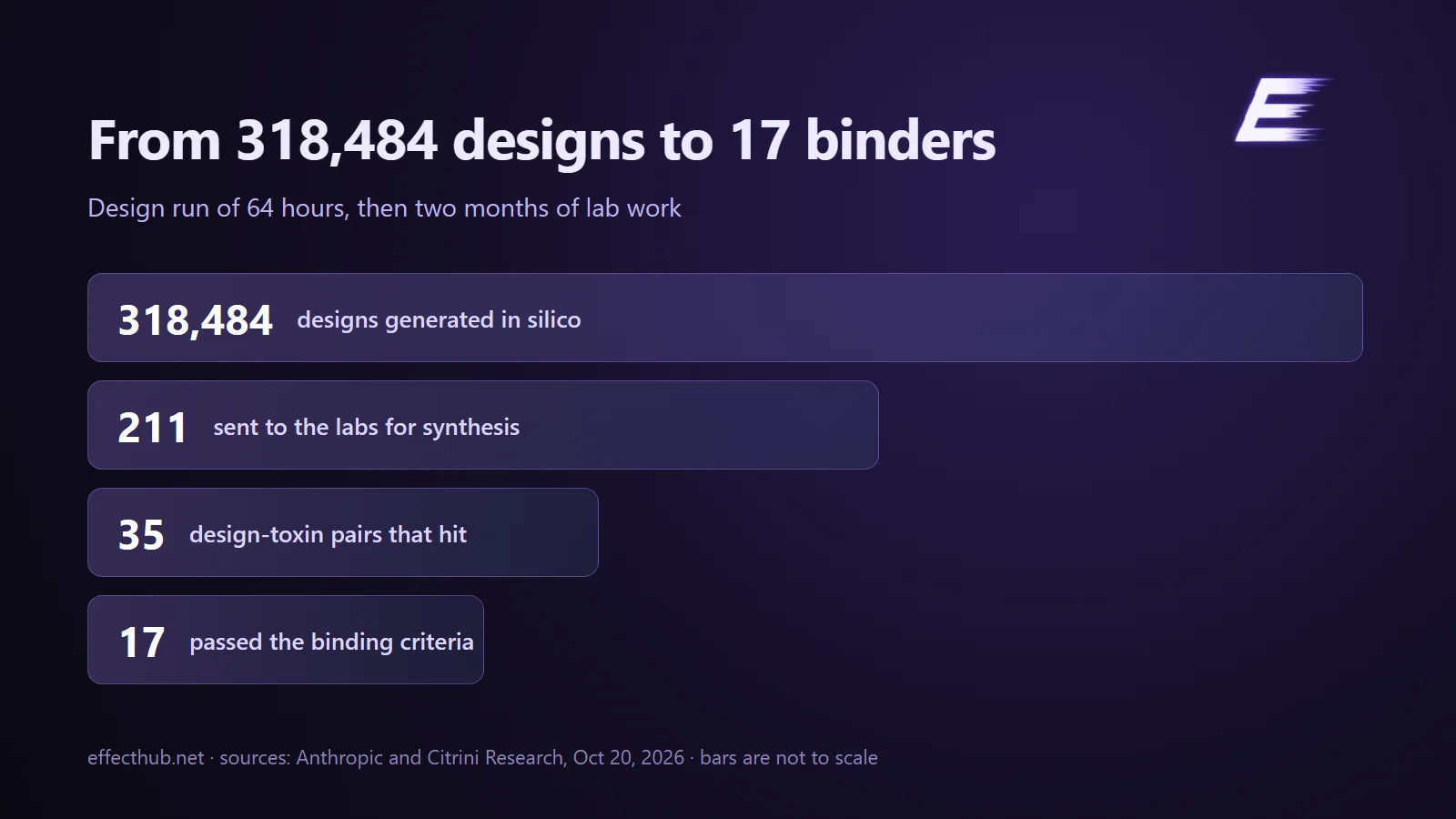
By Anthropic's count, Claude drove 12 specialist protein design tools, generated 318,484 candidate designs and screened 553,052 design-toxin pairs. The whole campaign ran 64 hours from the first prompt to a final list of 180 designs, the four follow-ups included. Anthropic counts 31 further designs added afterwards with Claude's help, which brings the total to the 211 that went for synthesis. The best design, Cn2-B1, came out of the third follow-up.
One step stands out. Claude drafted an email to a procurement scientist at Twist, asking which fusion formats the vendor could actually build. It paused that branch of the work, then picked it back up hours later when the answer arrived.
What did the lab actually measure?
Binding, and nothing more. The labs used surface plasmon resonance, with one or several known antibodies per toxin as positive controls. Thirty-five design-toxin pairs hit, but only 17 met the criteria the team had set in advance, and none of those protein design candidates had been improved using lab feedback.
- Cn27
- AaH II4
- AaH I4
- LqhIII2
- Ts10
Cn2, a toxin from the Mexican scorpion Centruroides noxius, gave the strongest leads. Two designs, Cn2-B1 and Cn2-B2, bound with affinities in the low-nanomolar range, and a known antibody blocked them in every scorable competition test. The moonshot went as predicted: of 91 designs aimed at all five toxins, exactly one qualified, and only against AaH I. Anthropic has released all 211 designs and their data on Hugging Face.
Hosting hub for models, datasets and demo apps
What does this protein design result not prove?
It does not prove that anything neutralises venom. Binding was tested against recombinant toxins rather than toxins purified from venom, no neutralisation test was run in cells, and no animal study was run at all. "A good binding measurement does not establish that a binder actually blocks the toxin," Citrini writes, and Anthropic states that it does not claim to have produced an antivenom.
The next step both groups name is a patch-clamp assay, which measures whether a binder stops a toxin from disrupting the electrical signalling of a cell. Animal protection studies, formulation and manufacturing would follow, and each of those stages kills candidates.
What it means if you are not a biologist
We read both write-ups against each other before posting this, and the numbers line up. What we find notable is not the chemistry but the shape of the work: five messages, one supervised room, and a vendor email the model drafted and sent under supervision. That is the same pattern we see in far less exotic places, where agents now sit between a person and a dozen tools they never learned to drive.
Claude
50Assistant focused on long documents and code work
Anthropic's coding agent that reads a repository, edits files and runs commands from the terminal, IDE, desktop app, browser or Slack
Our survey of where AI tools stood this month covers the lighter version of that pattern. The same wiring shows up in searching the literature and across the agent tools in our catalogue. The gating story is worth keeping in view too, because capability that exists only behind a badge is not capability you can buy.
What to watch next
Two things. First, whether a patch-clamp result arrives showing any of the 17 binders stops toxin activity, because without it the protein design headline stays a lab curiosity. Second, whether Anthropic widens access to the internal model it used here, or keeps protein design of this kind inside its own offices.
Sources
ResearchAnthropicAgents