
State of AI tools, October 2026: 3,264 tools, by the numbers
3,264 AI tools counted on October 13, 2026: domain ages, .ai against .com, how they charge, median prices by category, platforms, countries and shutdowns.
On this page11 sections
On October 13, 2026 we counted every published listing in the EffectHub catalog: 3,264 AI tools in 23 categories. Each listing records how the tool charges and what its first paid plan costs, the platforms it runs on and the company behind it, plus two facts we collect ourselves: when the tool's domain was registered, read from the registry, and whether its site still answers our checks. This report is what those fields say when you count all of them. No field is filled for every tool, so every number below comes with its denominator.
- Two in three tools run on a domain registered after ChatGPT launched. 1,907 of the 2,842 tools with a registry record (67%) were registered on or after November 30, 2022; 581 (20%) are less than a year old.
- .ai has drawn level with .com. 1,135 tools use .ai and 1,226 use .com, 35% and 38% of the catalog. 78% of the .ai domains were registered after ChatGPT launched, against 51% of the .com ones.
- Freemium is the default. 1,832 of the 3,264 tools (56%) have a free plan and paid ones above it. Only 322 (10%) are free with no paid tier.
- The median first paid plan costs $16.70 a month, across the 1,876 tools that publish a monthly price. The middle half runs from $9 to $29, and $19 is the most common price.
- 18% of the tools that charge do not say how much: 540 of 2,942.
- Most AI tools are a website and nothing else. 1,718 (53%) run only in the browser; 28% offer a public API, 14% a phone app and 8% a Chrome extension.
- One shutdown confirmed since listing. Of 3,263 tools our checker has reached, one is marked shut down and nine more failed a first check. The catalog went live in August, so this is a rate over weeks, not years.
The places founders list these tools are counted in the companion report, State of AI directories, October 2026.
Two in three domains are younger than ChatGPT
For 2,842 of the 3,264 tools (87%), the registry returned a registration date for the tool's domain. The median domain is three years old. 1,907 of them (67%) were registered on or after November 30, 2022, the day OpenAI released ChatGPT; 1,027 (36%) in the last two years and 581 (20%) in the last twelve months. Only 376 (13%) were registered before 2015.
- 2018 or earlier564
- 201968
- 202078
- 202199
- 2022158
- 2023541
- 2024379
- 2025518
- 2026, January to August437
2023 is the peak, with 541 domains: more than 2019, 2020, 2021 and 2022 together (403). The 2026 bar is a floor rather than a slowdown. A tool has to be found, researched and published before it is counted here, and the newest domain in the catalog was registered in August.
A domain's age is not the product's. For 720 tools we know both the year the product launched and the year its domain was registered: 334 launched in a later year than the domain, 289 in the same year, and 97 are older than the domain they use now. An old domain with a new AI product on it is common, so domain age overstates how long many of these products have existed.
It still matters to anyone deciding whether to sign up. A domain under a year old is what disposable sites have in common, which is why domain age is one of the checks behind our Trust score. It is also true of 581 tools that cleared our publishing rules, so a young domain is a reason to look closer, not a verdict. The other checks worth running before you hand over a card are in How to check an AI tool before you sign up.
.ai has drawn level with .com
The catalog's 3,264 tools sit on 1,226 .com domains (38%), 1,135 .ai (35%), 263 .io (8%), 164 .app (5%), 67 .co (2%) and 48 .net (1%). The remaining 294 are spread across dozens of endings, led by .org (35) and .dev (32).
The two big endings are different ages. Half of the .com domains were already registered before ChatGPT; more than three quarters of the .ai ones were not. The median .ai domain is 2.6 years old and the median .com 3.8 years; 40% of .ai domains are under two years old, against 29% of .com.
- .app88% (144 of 164)
- .ai78% (886 of 1,135)
- .com51% (623 of 1,225)
One caveat on .ai: 76 .ai domains share a registration date of December 15 or 16, 2017, which looks like a date in the registry's own records rather than the day each was bought. We count them as "2017 or earlier", which changes none of the shares above.
Where the domains are registered has shifted too. Namecheap and GoDaddy hold half of all the domains we could read. Among the 1,027 registered in the last two years, Cloudflare's share is 21% against 13% overall, Spaceship's 10% against 4%, and GoDaddy's falls from 24% to 19%.
| Registrar | All domains (2,839) | Registered in the last two years (1,027) |
|---|---|---|
| Namecheap | 786 (28%) | 258 (25%) |
| GoDaddy | 694 (24%) | 190 (19%) |
| Cloudflare | 371 (13%) | 219 (21%) |
| Spaceship | 123 (4%) | 107 (10%) |
| Porkbun | 89 (3%) | 35 (3%) |
| Everyone else | 776 (27%) | 218 (21%) |
Every one of the 3,264 listed addresses uses HTTPS. Of the 3,187 certificates our checker recorded, Let's Encrypt and Google Trust Services issued exactly 1,401 each, 88% between them. Amazon issued 230 (7%), and the remaining 155 (5%) come from a long tail led by DigiCert (59) and Sectigo (30).
How AI tools charge
More than half of the catalog is freemium: a free plan you can keep using, with paid plans above it. Paid-only tools are a little over a quarter.
- Free plan plus paid plans (freemium)1,832 (56%)
- Paid plans only900 (28%)
- Free, with no paid tier322 (10%)
- Price on request only210 (6%)
The mix depends on who the buyer is. In Lifestyle & Personal, 39% of tools are free with no paid tier. In Marketing & Growth and Sales & CRM, 55% are paid-only, and not one Sales & CRM tool is free outright. In Security, Privacy & Compliance, 33 of 52 tools (63%) publish no price at all and quote on request.
Across the whole catalog, 540 of the 2,942 tools that charge (18%) give no entry price: 206 that quote on request only, and 334 freemium or paid tools for which we found no number to record. What each pricing model means in practice is in How AI tools charge, and the tools are listed by model on the freemium, paid and free pages.
What the first paid plan costs
2,402 tools publish an entry price, the price of their cheapest paid plan. 1,876 of them (78%) quote it per month, 269 (11%) as a one-time price, 92 (4%) per seat per month, 62 (3%) per year and 20 per week. Only 83 (3%) lead with a usage price: per credit, minute, request or image. To compare like with like, everything below uses the 1,876 monthly prices only.
The median is $16.70 a month, and the middle half runs from $9 to $29. Freemium tools charge less for their first paid plan than paid-only tools do: a median of $13.90 (1,279 tools, middle half $9 to $20) against $25 (595 tools, middle half $14.99 to $49). The most common prices are $19 (113 tools), $29 (98), $20 (97), $9 (89) and $9.99 (81).
- Under $10597 tools
- $10 to $19.99535 tools
- $20 to $29.99332 tools
- $30 to $49.99194 tools
- $50 to $99.99119 tools
- $100 or more99 tools
Six in ten monthly plans cost less than $20. What moves the price most is the category. Tools for making things, such as images, text, audio and design, have a median first plan of $10 to $13.50 a month; tools sold to a sales or support team, $39 to $49.
- Marketing & Growth$29
- Coding & Development$20
- Chatbots, Assistants & Agents$17.91
- Video$15
- Design & Creative$13.50
- Image Generation & Editing$10
- Text & Writing$10
- Audio, Voice & Music$10
The table adds the spread and the four business categories with at least 50 monthly prices. Every quartile is a price some tool in the category actually charges.
| Category | Tools | Monthly prices | 25th percentile | Median | 75th percentile |
|---|---|---|---|---|---|
| Marketing & Growth | 292 | 227 | $19 | $29 | $56 |
| Image Generation & Editing | 289 | 148 | $8.30 | $10 | $19 |
| Video | 273 | 186 | $9.99 | $15 | $23.25 |
| Chatbots, Assistants & Agents | 262 | 147 | $9.99 | $17.91 | $25 |
| Text & Writing | 239 | 133 | $8 | $10 | $19 |
| Design & Creative | 216 | 135 | $9 | $13.50 | $20 |
| Audio, Voice & Music | 215 | 134 | $8 | $10 | $19 |
| Coding & Development | 179 | 122 | $12.60 | $20 | $25 |
| Business, Finance & Legal | 127 | 53 | $15 | $25 | $49 |
| Customer Support & Service | 95 | 60 | $29 | $39 | $99 |
| Data & Analytics | 92 | 50 | $15 | $29 | $49 |
| Sales & CRM | 91 | 54 | $29 | $49 | $99 |
Mostly a website
3,014 of the 3,264 tools (92%) run in a browser, and 1,718 (53%) are a website and nothing else: no app, no extension, no API. 250 do not run in a browser at all.
- Public API906 (28%)
- iPhone app423 (13%)
- Android app362 (11%)
- Desktop app for Mac, Windows or Linux298 (9%)
- Chrome extension251 (8%)
- Slack app62 (2%)
- VS Code extension25 (1%)
A phone app usually means both stores: 343 of the 442 tools with one (78%) are on iOS and Android. On the desktop, 268 tools have a Mac app, 199 a Windows app and 68 run on Linux.
Each platform clusters where you would expect it. An API is close to universal among AI infrastructure tools (91 of 99) and common in automation (48 of 64) and Sales & CRM (48 of 91), but rare in Education & Learning (9 of 140). Phone apps are most common in Health, Fitness & Wellbeing (18 of 34), Productivity & Workflow (48 of 141) and Lifestyle & Personal (38 of 114), and almost absent in Marketing & Growth (4 of 292). Chrome extensions are most common in Text & Writing (56 of 239), HR & Recruiting (18 of 77) and Productivity & Workflow (30 of 141). The tools themselves are listed by platform on AI apps by platform, including the API, iPhone and Chrome extension hubs.
Where the companies are
2,745 of the 3,264 listings (84%) name the company that operates the tool; 519 (16%) name none. A country is recorded for the company behind 1,675 tools (51%), across 62 countries. Almost half of them are American.
- United States825
- United Kingdom127
- India60
- Singapore58
- Germany54
- Canada45
- China45
- France40
- Israel37
- Australia37
Two cautions. A company's recorded country can be where it is incorporated rather than where its team works. And the half of the catalog with no country recorded need not be a random half, so the ranking is a sketch, not a census. Countries with at least five tools have their own page under AI tools by country.
Shutdowns: one confirmed so far
Our checker re-requests every published tool's own website and marks a tool shut down only when failures repeat on separate runs; a bot wall or a refused request never counts. On the snapshot date it had reached 3,263 of the 3,264 tools, and one is marked shut down: Phind, whose site answers that the page no longer exists. That is under 0.1%, the same figure as on our discontinued tools page.
Technical answer engine aimed at developers
Nine more tools failed one check and are waiting for the second: three answered 404, three timed out, two returned a 502 error and one presented an invalid certificate. They are not counted as shut down unless the next check fails too. Another 137 tools (4%) block automated checks altogether, which says nothing about whether they are alive, so they are never counted.
Read the low number with the catalog's age in mind. 1,469 listings were published in August 2026 and 1,794 in September, and the checks behind these figures ran in September, the latest on September 29. A shutdown rate measured over a few weeks is a floor, and tools we found dead while researching them were never published, so they are in neither number. How shutdowns usually announce themselves is in How to tell an AI tool is about to shut down.
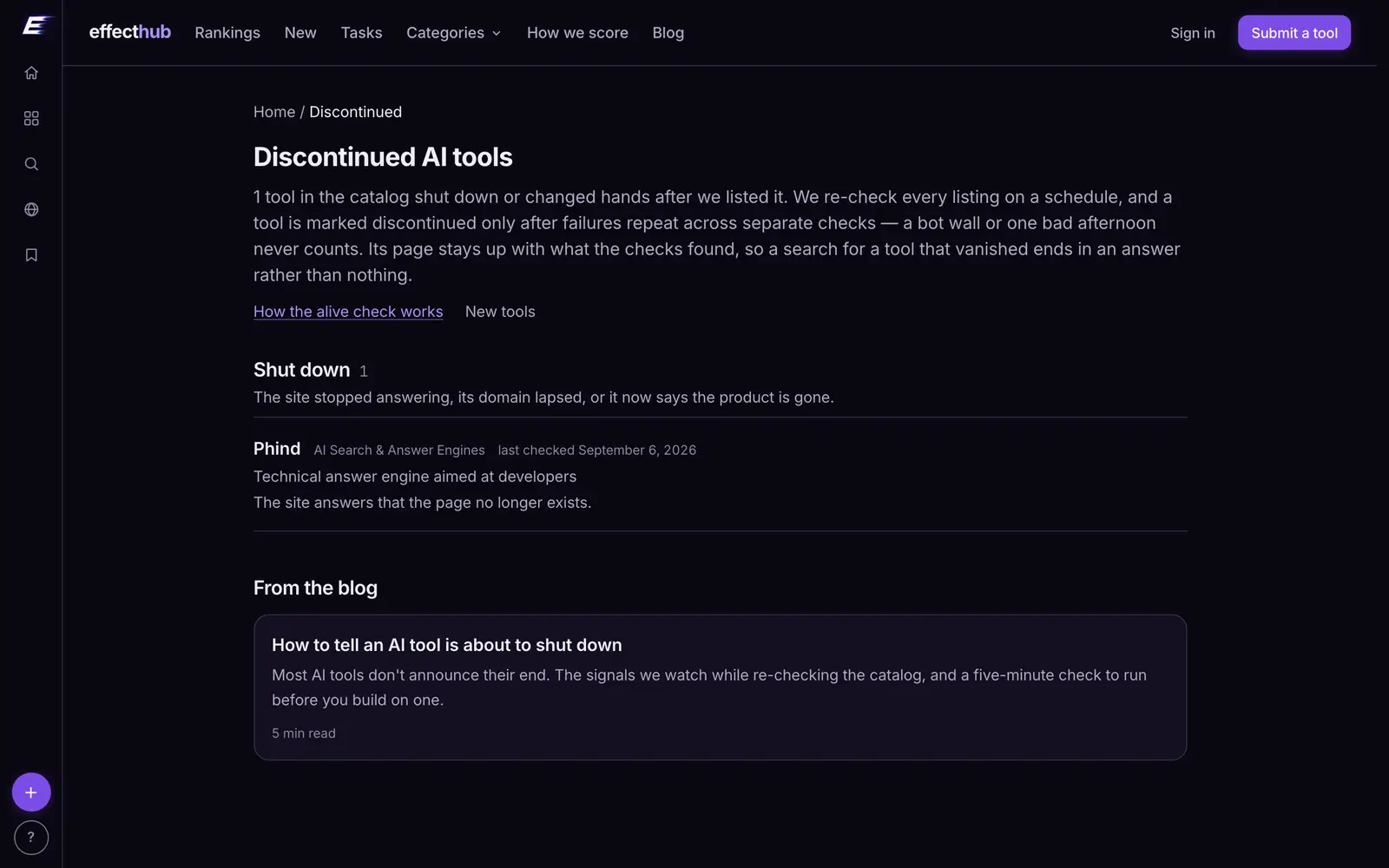
The tool-level data behind that page is open: effecthub.net/discontinued.csv, one row per discontinued tool with the reason our check found, under CC BY 4.0.
Trust and Effect: what we can and cannot score
Every listing carries two scores out of 100. Trust asks whether a site is safe to hand your email and card to; Effect asks how much a tool is used and how complete its listing is. Effect leaves out any signal it has no data for and moves its weight to the rest. Trust does the same for visitor ratings, but counts a missing company name, price or source against the tool, because not knowing who runs a site is itself the finding.
Trust could be measured for every tool on seven of its eight checks; the eighth, visitor ratings, has no data yet, since no tool has two ratings. With each certificate's expiry read as of the tool's last check (more on that below), the median Trust score is 78. 2,628 tools (81%) score 70 or more, 940 (29%) score 85 or more, 636 (19%) land between 50 and 69, and none is below 50. What holds scores down most is missing information rather than bad news: 519 listings (16%) name no operating company, 540 (17%) publish no entry price, 747 (23%) appear in only one of the public lists we build the catalog from, and 135 (4%) have no claim we can back with a source.
One detail of the Trust numbers needs saying. This report reads certificate expiry as of each tool's last check. Since those checks, 364 of the recorded certificates have passed their expiry date, 343 of them from Let's Encrypt and Google Trust Services, whose short-lived certificates are normally renewed automatically. Scored against today's date instead, those 364 count as expired and 2,431 tools (74%) reach 70.
Effect we are not publishing as a distribution. Only 69 tools (2%) have enough visits, clicks and saves on our site for the demand signal to count, and none has two ratings, so for 98% of the catalog the score rests on two of its four signals: how many independent catalogs list the tool, and how complete and alive its listing is. A distribution would describe our catalog, not the market. Both scores are explained in full on how we verify.
Methodology
- Source. Every published listing in the EffectHub catalog, read from the production database on October 13, 2026: 3,264 tools. EffectHub is an independent catalog of AI tools: each listing is researched from the vendor's own pages and published only once it clears our publishing rules, set out on how we verify.
- Categories. Each tool is counted once, under the top-level category of its main category.
- Pricing. The pricing model and the cheapest paid plan in US dollars, with its unit, as recorded in the catalog on the snapshot date. Medians and quartiles use monthly prices only, and every quartile is an observed price, not an interpolation. A freemium tool's entry price is its cheapest paid plan.
- Platforms. As recorded for each listing; "public API" counts a tool marked as having one in either field we keep.
- Domain age. The registration date of each tool's domain, read over RDAP, the registry protocol that replaced WHOIS, by our own worker; 2,842 of 3,264 (87%). Almost all of the other 422 are on .io, .co, .so, .me, .sh, .im, .gg and a few other country-code endings whose registries returned no record to our lookup; they are left out, not counted as new. Ages are measured to October 13, 2026.
- Country and company. The operating company and the country recorded for it, as researched for each listing: 2,745 and 1,675 tools.
- Shutdowns. Counted exactly as on the discontinued tools page: published tools our checker has reached at least once, and those marked shut down or acquired.
- Scores. Trust and Effect were computed with the same code the site uses, over the stored fields of every listing.
- Limits. This is a count of one catalog, not a census of the market. The catalog is built from public lists of AI tools and its publishing rules require a researchable listing, so it leans toward tools launched as AI products and toward tools that publish enough to research. Prices change; categories are our own assignment; fields we could not confirm are left empty rather than guessed, which is why most of the percentages above have their own denominator.
Cite this
On October 13, 2026, 67% of the 2,842 AI tools in the EffectHub catalog with a registry record ran on a domain registered on or after November 30, 2022, the day ChatGPT launched, and the median entry price among the 1,876 tools with a monthly plan was $16.70 a month (EffectHub, State of AI tools, October 2026).
Sources
ResearchPricingAlive checkTrust
Every tool named here has a live catalog page — price, status and when we last checked it.
Browse the catalogFollow new posts via the RSS feed.
Keep reading
All posts →
State of AI directories, October 2026: 110 places, by the numbers
110 AI directories and launch sites checked on October 10, 2026: who still lists for free, what a badge buys, median prices, queues, links and closures.
AI directory submission services: what $25–$299 actually buys
Ten bulk directory-submission services compared on what their pages and terms say: price, count, manual or not, report, refunds. Read October 10, 2026.
AI receipt scanners: how OCR expense apps compare, and what the free tiers leave out
How receipt OCR works and where it fails, what to check before paying, which free tiers cap what, and where your receipts are stored.