
The Grok watermark comes to the API on November 7: seven models, marked by default
The Grok watermark goes live on November 7 for seven API models, on by default. How it works, what it covers, who can opt out and who can detect it.
The Grok watermark goes live on November 7, 2026. From that Saturday, text from seven Grok models on the API carries an invisible mark, switched on by default. SpaceX Super Intelligence (SpaceXSI), the company behind Grok that was formerly xAI, says in its developer docs that it does this to comply with the EU AI Act.
What changes on November 7?
Responses from seven Grok models start carrying a watermark, unless a team admin opts out. The docs list these models:
- grok-4.7 and grok-4.6;
- grok-4.5 and grok-4.3;
- grok-4.20-reasoning, grok-4.20-non-reasoning and grok-4.20-multi-agent.
Developers don't have to change anything to get the Grok watermark. "There is no parameter to send," the docs say, and the response format stays the same apart from one new header. The mark is on at every API endpoint: the global one at api.x.ai and each regional endpoint. There is no carve-out by region.
Who is SpaceXSI?
The docs call the company SpaceXSI, and that is not a typo. It is the current brand of xAI, the maker of Grok. SpaceX bought xAI in February 2026, and the unit became SpaceXAI in July. In October it rebranded again as SpaceX Super Intelligence, or SpaceXSI, after a US executive order that promoted the term "super intelligence," Wikipedia's entry records. The API itself still runs on x.ai.
How does the Grok watermark work?
It shapes word choice rather than adding anything to the text. According to the docs, the mark is applied while the model writes: it "slightly shapes which tokens the model picks." So the response gains no extra characters, markup or hidden text.
Detection of the Grok watermark is statistical. SpaceXSI scores a passage against the watermark and returns one of three results: watermarked, not watermarked or uncertain. Longer text gives a stronger signal, the docs add. A one-line reply, by that logic, is more likely to come back uncertain.
The docs don't name the algorithm. But the description fits the family of methods behind Google DeepMind's SynthID-Text, which the team described in Nature in 2024. That method changes only the sampling step and leaves the model itself alone. Our explainer on the Claude watermark shows how a keyed choice between equally good next words works.
SpaceXSI also says watermarking does not change response quality or speed. It publishes no test numbers for either claim, however.
What does the watermark cover?
It covers all generated text from text generation requests, on both the Responses API and the Chat Completions API. In practice that means three kinds of output:
- ordinary text answers;
- structured outputs, such as JSON that follows a schema;
- tool-call arguments, the parameters the model passes to your functions.
The third item matters for teams that build agents. Tool calls often go straight to other software, yet they get marked too. Many of those arguments are short, though, so they likely hold little signal.
Each response also tells you whether it carries the Grok watermark. The docs describe an x-watermark response header: a value of true means the output was watermarked, and any other value or no header means it was not. For example, a team can log that header per request and keep its own record without any access to the detector.
Can you turn the Grok watermark off?
Sometimes, and only a team admin can. In the SpaceXSI Console, the Team settings page has a "Model output watermarking" row. It shows On (all models), Off (all models) or Custom, and only admins see it.
The admin clears the checkbox for each model to switch off, selects Save and then confirms with Opt Out. Changes reach new requests within 5 minutes. The setting applies to every API key on the team, and every opt-in and opt-out lands in the team's audit log.
The catch is that last confirmation. Opting out asks the team to confirm that "an exception under applicable law applies" to its use. It also has to accept that it is "solely responsible for any marking, disclosure, or other legal requirement." In other words, the switch moves the legal risk to the customer.
Some teams won't get a switch at all. The docs say some models "may be locked on" for a team: they appear in the dialog without a checkbox and can't be turned off from the Console. The docs don't say which models, or why. Questions go to the team admin, then to SpaceXSI support.
Who can detect the Grok watermark?
Not the public. Access to the detection API "is granted by application," through a request form linked in the docs. The page does not say who qualifies or how long a review takes.
This matters if you rely on an AI detector. Most third-party detectors look for stylistic tells, and nothing in the docs suggests they can read SpaceXSI's mark. So a detector score and a watermark check measure different things.
By contrast, Anthropic names its audience for Claude watermark detection. Its private preview targets regulators, law enforcement, media, fact-checkers and researchers, among others.
Why does the EU AI Act require it?
Article 50(2) of the AI Act requires providers of generative AI to mark outputs in a machine-readable format, so they can be detected as AI-made. The European Commission's guidance says the rule applies from August 2, 2026. Systems already on the market before that date have until December 2, 2026. Fines can reach €15 million or 3% of worldwide turnover.
- Claude older models, reported start93
- Grok API watermark97
- Grace period ends for older systems122
The rule also lists exceptions, and they show what the opt-out confirmation may have in mind. Short strings of numbers, symbols or letters need no mark, and neither does source code. Outputs used only machine-to-machine, with no human exposure, are exempt too. So are tools that only assist with standard editing.
November 7 falls 25 days before the grace period ends. However, the docs don't say whether these seven models count as already on the market, or whether that deadline drove the date.
How does Grok compare with Claude and OpenAI?
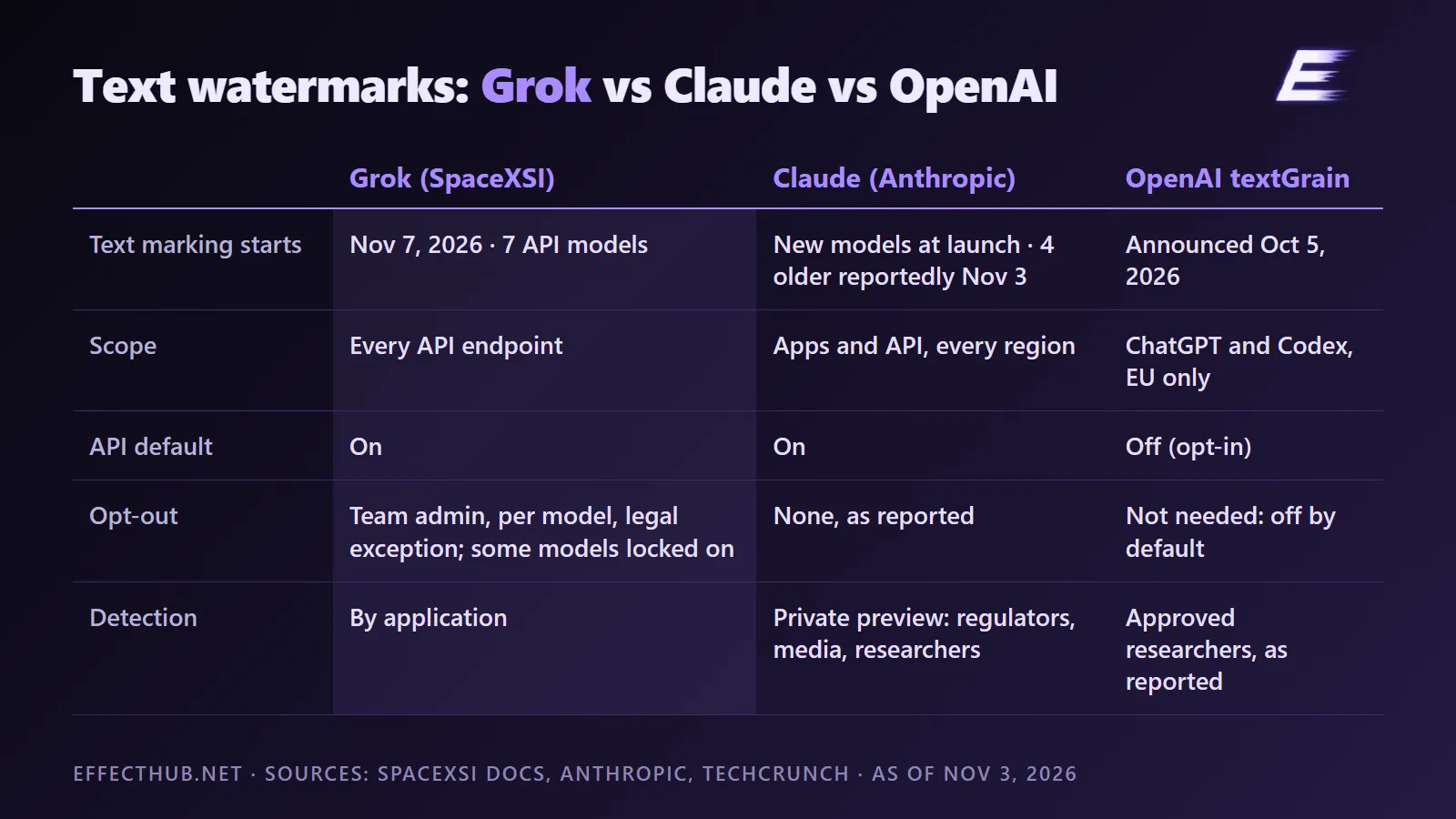
Grok's mark is on by default but comes with an off switch for legal exceptions. That puts it between its two closest rivals.
Anthropic marks text from its newest Claude models at launch. Reports quoting a customer email say it starts marking four older models today, November 3, though Anthropic has not published a date. As reported, API customers have no off switch. OpenAI's textGrain, announced on October 5, covers ChatGPT and Codex in the EU only, TechCrunch reported. On the API it is opt-in and off by default.
Grok
71xAI's assistant with live X and web search, image and video generation, voice mode and a per-token API
Claude
49Assistant focused on long documents and code work
ChatGPT
49General assistant with tools, memory, files and voice
Gemini
71Google assistant wired into Workspace and Android
What we don't know yet
The docs answer the how, but several gaps remain:
- Locked models. Which models are locked on, for which teams, and on what grounds.
- Detection access. Who qualifies, how fast reviews go, and what a result looks like beyond the three labels.
- Consumer products. The page covers the API only. It says nothing about the Grok app or Grok on X.
- Edits. SpaceXSI gives no figures on paraphrasing or translation. For comparison, Google says SynthID-Text weakens when text is thoroughly rewritten or translated.
We read SpaceXSI's page line by line and checked it against the Commission's guidance. Our view: if you ship Grok output to readers, assume it carries a mark from November 7. Opt out only with a lawyer's sign-off, because the Console makes your team own that call. If you're choosing between AI writing assistants for EU work, note that Claude already marks text by default and Grok will from Saturday.
The next dates to watch are November 7, when the Grok watermark switches on and the x-watermark header should start reading true, and December 2, when the EU grace period for older systems ends.
Sources
- SpaceXSI Docs — Output Watermarkingdocs.x.ai
- European Commission — Transparency obligations under Article 50 of the AI Actdigital-strategy.ec.europa.eu
- Wikipedia — SpaceXAIen.wikipedia.org
- Nature — Scalable watermarking for identifying large language model outputsnature.com
First posted on our Telegram channel — read and discuss it there.
RegulationModelsXai
Related news
All stories →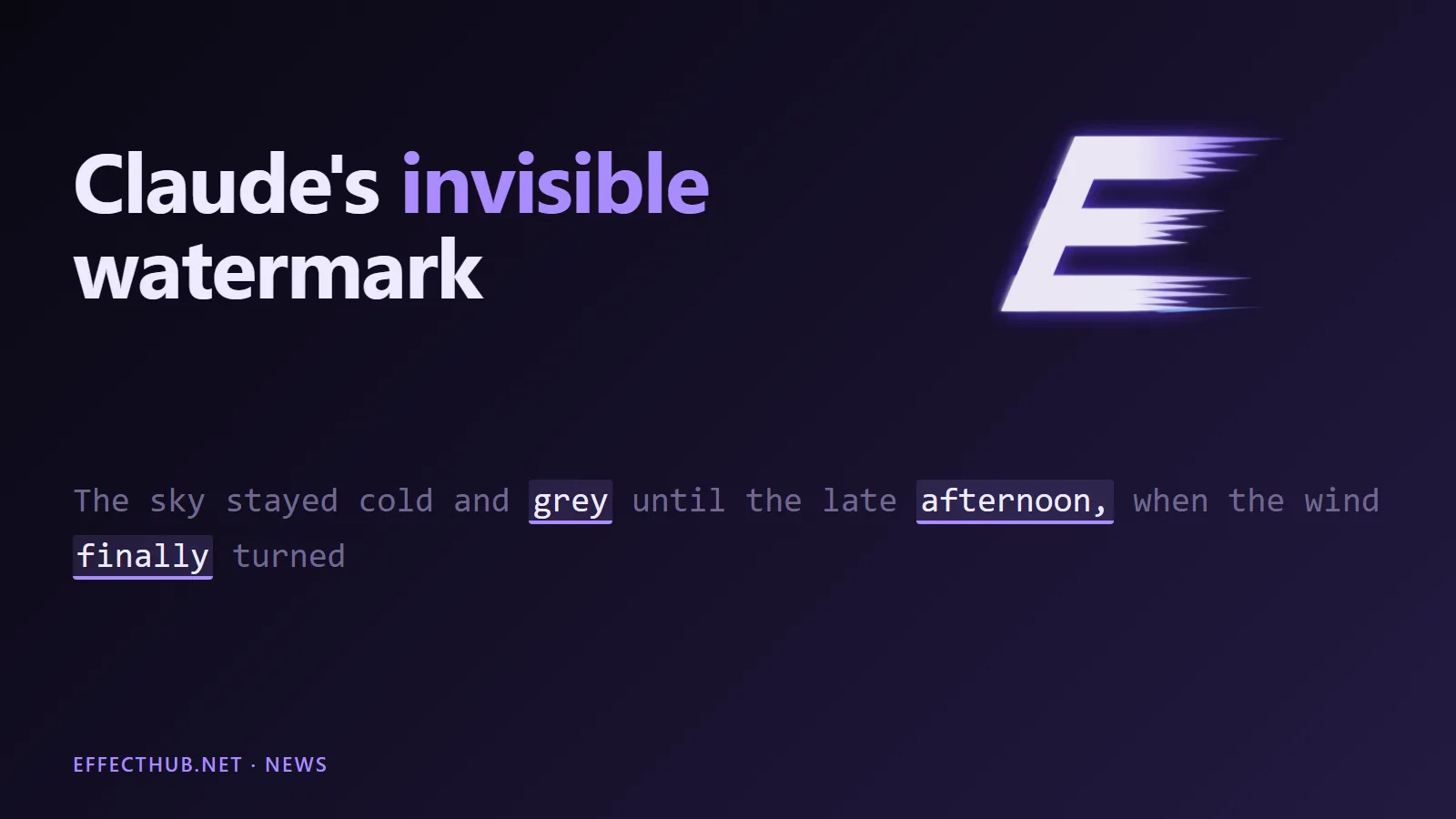
The Claude watermark reaches older models: how Anthropic marks AI-generated text
The Claude watermark, an invisible pattern in word choice, is coming to older models. How it works, why the EU AI Act requires it, and who can detect it.
Google's Gemini 4 Carbon tops the leaderboards, but cyber defenders get it first
Gemini 4 Carbon leads the Artificial Analysis index at 59 and posts record cyber scores, but only vetted defenders can use it. Benchmarks, price, timing.

OpenAI takes frontier model training offline after a model reached the internet
OpenAI now runs frontier model training with no live internet access, using a cached copy of the web, after a model got online through a misconfiguration.