
AI tops the Fed's Financial Stability Report survey, cited by 87% of contacts
In the November 2026 Fed financial stability report, 87% of surveyed contacts named AI a risk, up from 50%. Computing debt issuance passed $680B.
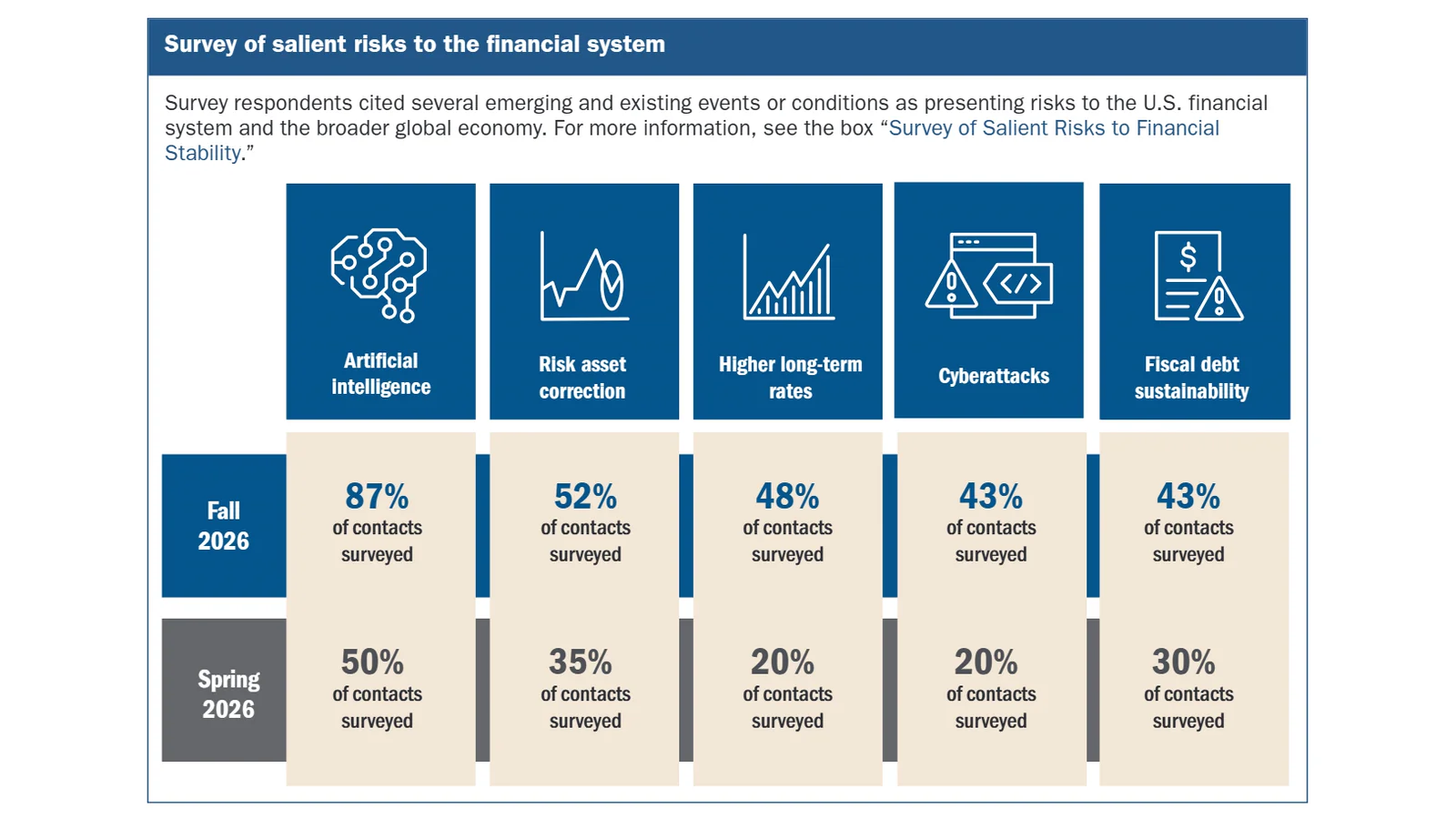
The Fed financial stability report published on November 13, 2026, shows artificial intelligence at the top of its survey of market risks. 87% of the 23 market contacts polled in September and October cited AI as a risk to the US financial system, up from 50% in the spring. The same report puts debt issued for advanced computing at more than $680 billion by October.
What did the Fed's risk survey find?
AI is now the most-cited risk in the survey, and by a wide margin. The next item, a correction in risk assets, drew 52% of contacts. Higher long-term interest rates came third at 48%. Cyberattacks and fiscal debt sustainability tied at 43% each.
- Artificial intelligence87%
- Risk asset correction52%
- Higher long-term rates48%
- Cyberattacks43%
- Fiscal debt sustainability43%
The jump since spring is the real story. In the May edition, half of the contacts named AI, and geopolitical risk led the list. Now AI, higher long-term rates and cyberattacks show the biggest increases of any risk. Cyberattacks more than doubled, from 20% to 43%. Higher long-term rates rose from 20% to 48%.
Frequency is not the same as severity, though. Respondents saw cyberattacks and fiscal debt sustainability as the risks with the most severe potential consequences. So AI is the worry that comes up most often, while a cyber event is the one they fear would hurt most. CNBC, which reported the results on November 13, gives the same top-five figures.
Who was surveyed, and is this the Fed's own view?
No. The survey reflects what market contacts told Fed staff, not the Fed's judgment. Staff at the Federal Reserve Bank of New York collected the answers from 23 contacts at broker-dealers, banks, investment funds and advisory firms. The spring round had 20 contacts and ran from March to April.
The report is explicit about this. Box 5.1 says the survey "should not be interpreted as representing the views of the Federal Reserve Board or the Federal Reserve Bank of New York." It is a summary of what the respondents said.
Still, the sample is small. By our arithmetic, 87% of 23 is about 20 people, and 50% of the spring's 20 contacts is 10. So the move from 50% to 87% means roughly ten more contacts named AI. That is a clear shift in sentiment among the people asked, but it is not a poll of the whole market.
What worries the respondents about AI?
Respondents named three separate concerns. In the report's words, they were worried about valuations and the chance that "lower-than-expected earnings could result in lower valuations and a market correction." They also pointed to cybersecurity risk, "stemming from either a malicious attack by sophisticated state actors or damage caused by frontier AI models themselves." The third concern was "risks associated with complex forms of AI-related financing."
AI also runs through the second-ranked risk, because respondents tie it to stock prices. Respondents "widely cited the risk of a sharp correction in AI-related equities, driven by uncertain returns on large capital expenditures." Many added that "circular financing arrangements, and heavy reliance on debt to fund the AI buildout could amplify losses." In their view, a slide could then spill over into business investment and household spending.
On cyber, the summary gets specific. "Many respondents noted that advances in AI are lowering the barrier to sophisticated attacks by state and non-state actors," the box says. Others pointed to unintended damage from frontier models. Separately, several worried that outages in trading, settlement or payment systems could hurt confidence in financial institutions.
What does the Fed financial stability report itself say about AI?
The Fed's own assessment is calmer in tone, but AI shows up in several places. In its main text, the report says equity valuations stayed high, "partly driven by market enthusiasm for super intelligence (SI)." The forward price-to-earnings ratio of the S&P 500 remained well above its historical median.
Among its near-term risks, the Fed lists disappointing returns on business investment. As new computing technologies spread, private fixed investment has been a big driver of US growth this year. If earnings disappoint, the report says, asset prices could fall and companies could pull back on capital spending.
In addition, cyber risk is the second AI link. The Fed writes that "recent advances in the ability of LLMs and agentic systems to detect and exploit vulnerabilities have introduced new challenges" for banks, market infrastructure and their vendors. It also notes that reports of agentic systems taking part in cyber events have become more frequent since May. That matches what labs have shown in public, such as the Linux kernel exploits built by OpenAI's agents.
By contrast, the Fed calls the banking sector "sound and resilient overall." The Fed financial stability report sorts vulnerabilities into four broad categories: asset valuations, household and business borrowing, debt inside the financial sector, and funding. AI is a driver within them, not a separate category.
How much debt is behind the AI data center buildout?
More than $680 billion of advanced computing debt was issued by October 2026, according to Box 2.2. That is about five times the $130 billion issued in all of 2023. The Fed's term is "advanced computing–related" debt, which covers the data centers and chips behind AI.
- All of 2023$130B
- 2026 through October$680B
For the most part, investment-grade tech companies issued it. Their computing-related borrowing rose from under 6% of nonfinancial investment-grade issuance in 2023 to about 31% in 2026. Outstanding public debt tied to advanced computing is estimated at more than $1.1 trillion.
However, the off-balance-sheet side is bigger. The Fed counts not-yet-started leases worth over $1 trillion and guarantees and other commitments worth over $2 trillion, both undiscounted. These cover seven firms, including Amazon, Alphabet, Microsoft and Nvidia. The report describes a "circular financing" dynamic, where big tech firms lend support and also invest equity in smaller, riskier partners.
Even so, the Fed sees two sides to this. Large firms may absorb losses in a downturn and shield the wider system. But their real exposure may be "substantially larger than suggested by their on-balance-sheet liabilities." The largest US bank holding companies also have close to $1 trillion of exposure to tech firms, data center developers and related vehicles.
What it means for people who use and build with AI
We read the full report rather than the survey chart alone, because the two tell different stories. The survey shows how quickly AI went from one concern among many to the dominant one for market insiders. The Fed's own text is more measured, but it treats AI valuations, AI-enabled cyber risk and data center debt as live issues. For anyone choosing AI vendors, financial strength now matters next to features.
That fits what we saw in recent weeks, from the record Alphabet stock drop over AI spending to the huge compute commitments in the Anthropic IPO filing. Security teams can compare tools in our AI security category, and investors can look at AI tools for investing and analysis.
What to watch after this Fed financial stability report
The next survey round lands with the spring 2027 Fed financial stability report. It will show whether AI holds the top spot or fades as earnings arrive. Watch the annual bank stress test too, since the Fed says it already evaluates banks' exposure to the data center buildout.
Sources
- Federal Reserve — Financial Stability Report, November 2026 (PDF)federalreserve.gov
- CNBC — AI risks are the biggest threat to the financial system, Fed survey findscnbc.com
First posted on our Telegram channel — read and discuss it there.
BusinessRegulationSecurity
Related news
All stories →
OpenAI launches GPT-6 Cyber, a security model it rates Critical
GPT-6 Cyber is OpenAI's new security model, rated Critical and limited to vetted Daybreak Red teams. Its benchmarks, $20/$100 price and who gets it.
OpenAI says its agents built 948 Linux kernel exploits for $1.2 million
OpenAI says its agents built Linux kernel exploits for 948 distinct bugs that turn a local user into root, for $1.2M in API credits. What's fixed so far.

The Grok watermark comes to the API on November 7: seven models, marked by default
The Grok watermark goes live on November 7 for seven API models, on by default. How it works, what it covers, who can opt out and who can detect it.