
METR estimates Anthropic's AI progress has roughly doubled, mostly due to AI
The METR Anthropic report estimates Anthropic now improves its models about twice as fast as in 2024–25, mostly due to AI. Much evidence was redacted.

The METR Anthropic report, published on November 5, 2026, estimates that Anthropic is now improving its models on well-specified tasks at about twice the pace it managed from March 2024 to October 2025. METR, a nonprofit that evaluates frontier AI, spent eleven weeks inside the company's data. It thinks most of that speedup likely comes from Anthropic's own use of AI, though Anthropic redacted much of the evidence behind that view.
What does the METR Anthropic report find?
METR's central estimate is a roughly 2x acceleration, given with high uncertainty. Not everyone on the team agreed: METR says most of the staff who worked on the project hold that view. The group says it "would not be surprised" if the true figure were closer to 1.3x or 3x the historical rate.
The main number behind that view comes from AECI, Anthropic's internal version of the Epoch Capabilities Index. AECI rolls many benchmark scores into a single capability score. By METR's calculation, AECI has grown 1.9x faster since October 2025 than before it, with a 95% confidence interval of 1.5x to 2.8x. In METR's words, that implies "roughly two years of historical progress over the last year."
- Low end of 95% range1.5x
- Central estimate1.9x
- High end of 95% range2.8x
The METR Anthropic report rests on work that ran from August 12 to October 29, 2026, after first being scoped at four weeks. About 2.5 full-time METR staff had access to internal benchmark scores, compute figures, uplift surveys and about 15 staff interviews. They could not query Anthropic's unreleased models directly, though. METR says it took no payment for the work, and AP notes that the group is funded through donations.
So the headline is narrower than "AI builds AI." METR measured how fast capability scores rise on tasks that are easy to grade. It did not find a model that trains its successor alone.
Is AI really the reason for the speedup?
METR thinks so, with caveats. Its subjective guess is that "a majority (perhaps ≈80%)" of the October 2026 acceleration is due to AI. It adds that this judgment comes "with substantial uncertainty."
Several rivals to that explanation were checked. METR looked at hiring, data improvements, algorithmic discoveries and compute. It says it is "confident" the speedup did not come from faster growth in training compute, which The Verge notes has historically been a major driver of AI progress. By contrast, METR thinks the jump in late 2025 was probably shaped by factors other than AI.
The human evidence points the same way, but loosely. METR used Claude to sort interview quotes by whether each one supported a 2x or greater speedup from AI in that person's area of work. It reads the result as "mildly in favor" of that view.
- Yes2
- Leans yes3
- Borderline or unclear4
- Leans no0
- No2
Informal Slack polls went further. Staff self-reported a speedup of about 12x from Anthropic's most capable internal model by October 2026. METR calls this "only very loose evidence," because staff voted with quick Slack reactions, and those who answered may not be representative.
The kind of help matters too. Staff told METR that AI speeds up research mainly by assisting people, not by working on its own. Researchers did describe "signs of life" for fully autonomous contributions that could arrive soon, but METR says those vary a lot between areas.
How much faster could it get?
METR found no clear brake in the next 12 months, but it holds that view with low confidence. It saw no evidence of significant bottlenecks in algorithmic progress, training compute, experiment compute or data over that period.
Its own picture shifted along the way, though. "Our understanding of the status of different bottlenecks changed several times as we received more detailed information," the report says, "so we are not confident in our current assessment." Anthropic also redacted METR's analysis of several specific bottlenecks.
The concern is compounding. If better models speed up research, and faster research yields better models, the gains could stack. METR says the lack of observed bottlenecks means "there is a significant risk" of even faster acceleration over the coming year.
METR lists ways it could be wrong in both directions. The speedup might be limited to clean, well-specified tasks, so real-world impact could be smaller. Anthropic's growth from 2023 to 2025 might also have been unusually slow, which would flatter the comparison. On the other side, automation could be closer than METR thinks, and AECI may lag what is happening in research right now.
What did Anthropic redact, and why?
A lot, by METR's account. "Anthropic redacted a majority of the evidence we found most informative for these conclusions," the report says. That includes detailed acceleration estimates for key parts of the training pipeline, a breakdown of progress by compute, data and algorithms, bottleneck details and forecasts for future models.
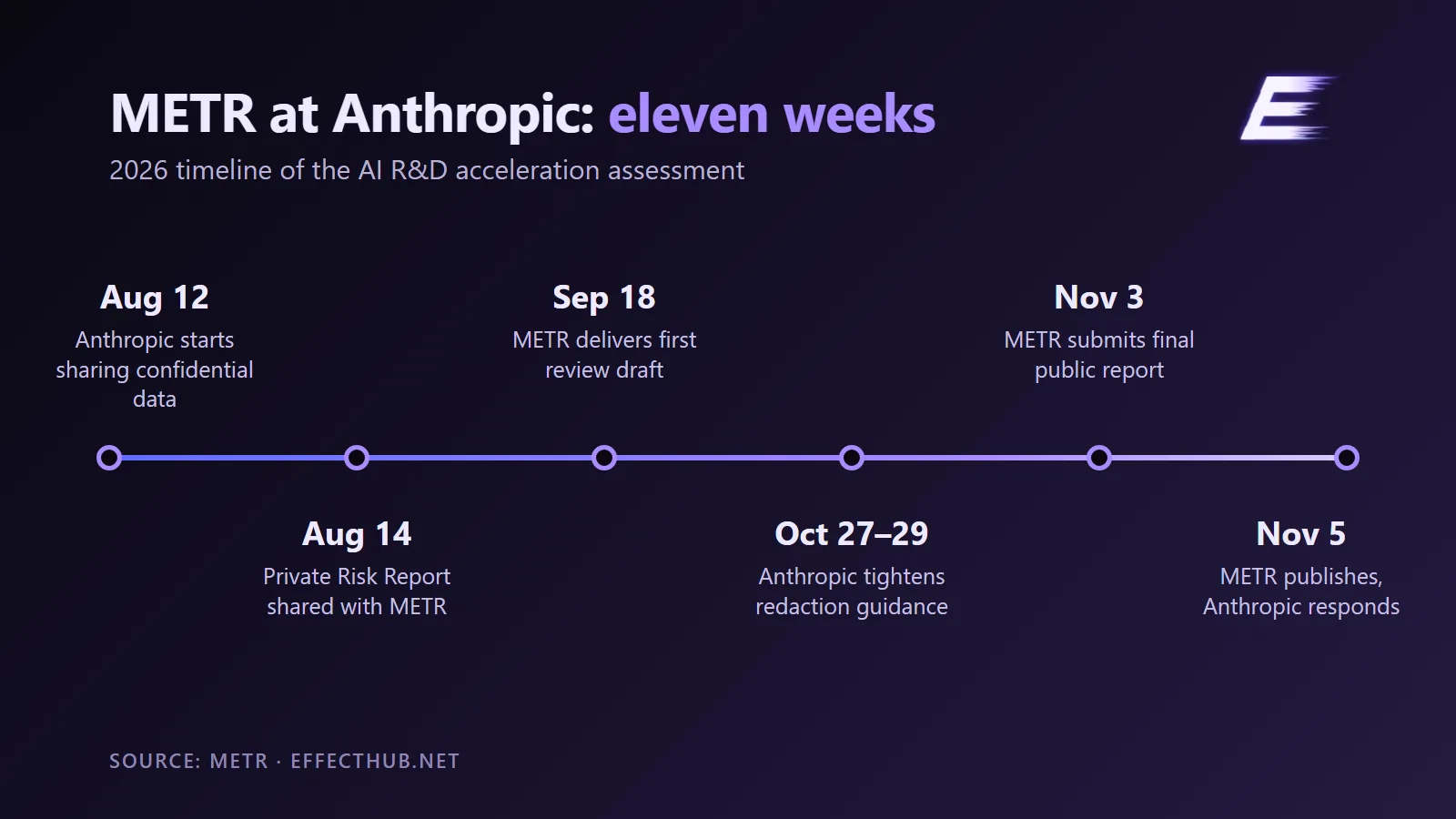
Anthropic held redaction rights over all non-public information under the deal. It described the cuts to METR as "aimed at removing confidential information that could accelerate other AI developers." METR says it is not in a position to judge whether they were justified. Still, it warns that "the public has to rely on METR's judgment much more than would be ideal."
METR also credits the company. It writes that it thinks "it is extremely unlikely Anthropic was actively trying to mislead us." The Verge quotes METR saying Anthropic "shared more information than was initially scoped for this project, surpassing our expectations."
What does Anthropic say?
Anthropic's main reply came from co-founder Sam McCandlish, who is also its responsible scaling officer. In a long post on X, he wrote that many of METR's conclusions match his own. "AI is speeding up our research, but it's hard to say exactly how much," he said, as quoted by AP.
He defended the redactions directly. "We redacted a lot, and I accept that this makes it harder for others to check METR's work," he wrote. Sharing exactly what drives the speedup, he argued, is "commercially sensitive" and "risks handing out a roadmap for others to go faster." According to The Verge, he said Anthropic will publish its own report on the speed of AI progress "in the coming weeks." Anthropic declined to answer The Verge's questions and pointed to his post.
The timing is awkward for the company. AP notes that CEO Dario Amodei urged the industry in a September 12 essay to "slow the pace at which we improve the capabilities of AI models." Anthropic is also preparing a stock market debut later this month, which we covered in our look at the Anthropic IPO filing.
How does the METR Anthropic report compare with the Risk Report?
METR thinks Anthropic's public report undersold the speedup. Alongside its main assessment, METR reviewed the automated R&D section of the August 2026 Risk Report. It concluded that the public version "overall understates the level of acceleration that was occurring."
The Risk Report sets out a clear tripwire. Anthropic's Responsible Scaling Policy treats a doubling of the pace of AI progress, plausibly driven by automated research, as an early warning sign. As of its July 15 coverage date, Anthropic said its leading indicators showed meaningful acceleration "though by less than a factor of 2." It rated the risk as low but said it was "less confident in this assessment than we were in prior risk reports."
METR agrees that catastrophic risk from the July models was low. However, it thinks it is plausible that Anthropic had already crossed that early-warning threshold at the time. Most of the relevant researchers at both METR and Anthropic still lean toward it not having been crossed. Looking ahead, Anthropic's own report calls it "plausible that this threat model will become a major concern in the next 6–12 months."
The report also shows how deep the tools already go. Anthropic says "Claude now authors a large majority of the code merged into our production codebases." Anthropic's staff work with stronger internal models than the public Claude and Claude Code that many developers use.
Claude
49Assistant focused on long documents and code work
Anthropic's coding agent that reads a repository, edits files and runs commands from the terminal, IDE, desktop app, browser or Slack
What we make of it
We read the METR Anthropic report as the most concrete public evidence yet that AI tools are speeding up frontier research. Yet the strongest numbers rest on benchmarks and self-reports, and the most detailed evidence stays private. For teams picking coding assistants, the practical signal is the pace: the gap between releases may keep shrinking. For anyone tracking AI guardrails, the redactions are the bigger story.
The next marker is Anthropic's own report on the speed of AI progress, promised within weeks. Its next Risk Report, read against the METR Anthropic report, should then show whether the company's own numbers put it past its 2x early-warning line.
Sources
- Anthropic — Risk Report, August 2026anthropic.com
- AP News — Anthropic is speeding up its AI development, outside researchers sayapnews.com
- The Verge — Why a new report on Anthropic automating AI development is alarming researcherstheverge.com
First posted on our Telegram channel — read and discuss it there.
AnthropicResearchSafety
Related news
All stories →
Anthropic's Project EVE: Claude teammates almost never caught a secret saboteur
Anthropic's Project EVE hid a secret Claude saboteur in four-agent teams in EVE Frontier. Teammates almost never caught it. What it does and doesn't show.
Anthropic launches Claude Fable 5.2 and says it formalized Fermat's Last Theorem in 30 hours
Claude Fable 5.2 is out at $8/$40 per million tokens. Anthropic says 1,000 of its agents formalized Fermat's Last Theorem in Lean in 30 hours.
Claude ran formal verification on 123 open-source libraries and proved 239 fuzz targets crash-free
Anthropic and Theorem used Claude for formal verification of 239 fuzz targets in 123 open-source libraries: 180M lines of Rocq and hundreds of bugs.