
Apple's health AI study wants up to 200,000 iPhone users to ask it medical questions
The Apple Health AI study, built with OpenEvidence, is open to up to 200,000 US iPhone users. Who can join, what it measures and where your data goes.
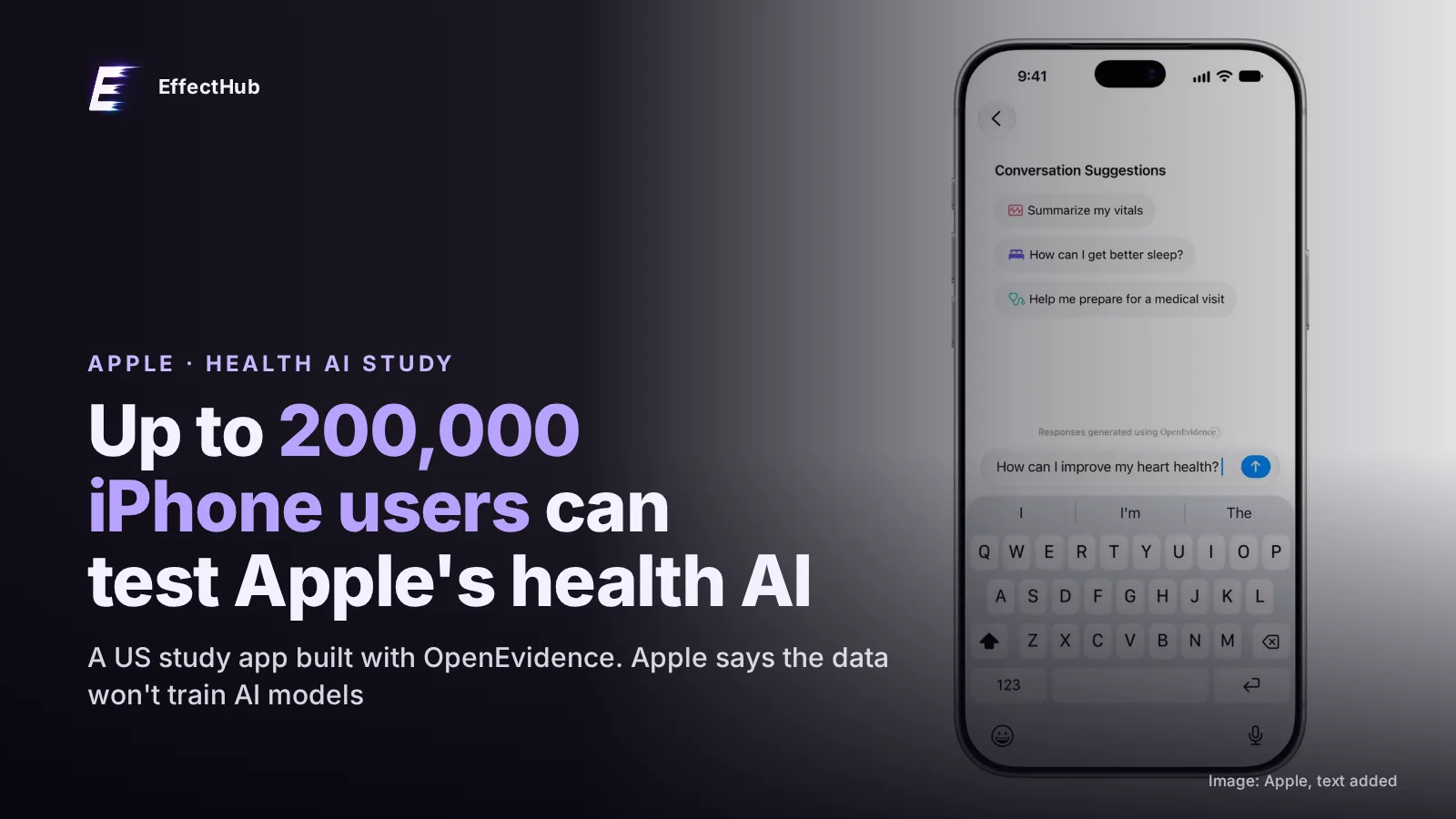
Apple opened its Apple Health AI study on November 15, 2026, and wants up to 200,000 iPhone users in the US to take part. The study runs through its own app, built with the clinical AI company OpenEvidence. Participants ask everyday health questions and get plain-language answers linked to peer-reviewed sources.
What is the Apple Health AI study?
It is a research study, not a product launch. Apple's official name is the Apple Health AI Usage Study. In Apple's announcement, the company calls it "a virtual research study and associated app" about how people interact with conversational health AI tools.
Apple lists four things it wants to measure:
- what drives user trust in health AI;
- the quality of the responses;
- how well people understand them;
- which everyday health actions people take afterwards.
The stated goal is to "inform the responsible design of health AI experiences for Apple and the industry." So Apple frames the results as research for itself and for the wider field.
Sumbul Desai, M.D., Apple's vice president of Health and Fitness, explained the choice of a formal study. "Health is deeply personal, and conducting a dedicated research study is the most thoughtful way to understand how people engage with, comprehend, and evaluate health AI in everyday life," she said.
Participants ask questions and rate the answers
They ask health questions and judge the answers. According to Apple, participants can ask the study app everyday health questions and get complex medical information "communicated with approachable language." Each response comes with linked, peer-reviewed clinical citations.
Apple's own screenshots show what that looks like. For instance, the chat screen offers suggestions such as "Summarize my vitals", "How can I get better sleep?" and "Help me prepare for a medical visit." A small line under the chat reads "Responses generated using OpenEvidence."
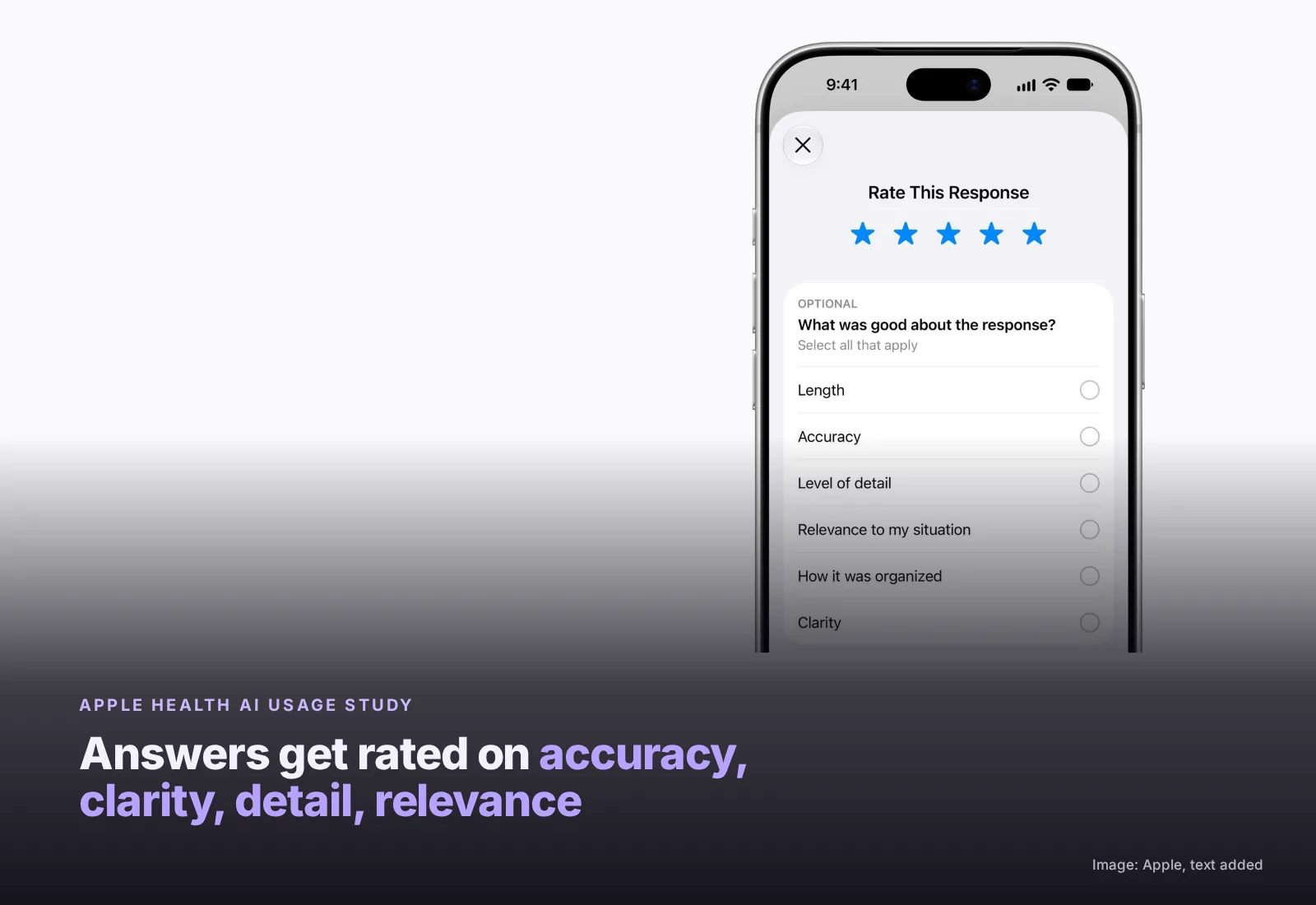
Feedback is a big part of the study. TechCrunch reports that users can rate answers and give feedback, and that they will be asked to take part in monthly surveys. Apple's screenshot of the rating screen lists the criteria: length, accuracy, level of detail, relevance to my situation, organization and clarity.
Apple is also open about the weak spot it wants to study. Its announcement says consumer health tools powered by LLMs "may at times offer responses that are incomplete or unclear." That, Apple says, is why the research matters.
Who can join the Apple Health AI study?
Adults in the US with a recent iPhone. However, the phone rules are stricter than some reports suggest. Apple sets these conditions:
- Size: up to 200,000 eligible participants.
- Age: 21 and older.
- Country: the United States only.
- Phone: an Apple Intelligence-enabled iPhone, which Apple defines as iPhone 15 Pro or later.
- Software: iOS 26 or later.
Some early coverage said "iPhone 15 or later." Apple's page and Engadget both say iPhone 15 Pro or later, so a regular iPhone 15 does not qualify.
To join, you download the study app, read about the study and choose to enroll. Apple's post does not say how long the study runs, but TechCrunch reports that Apple aims to run it for more than 12 months.
OpenEvidence supplies the answers, Apple the study
Apple does not explain the choice of partner directly. Still, OpenEvidence is widely used by clinicians and cites medical journals. Apple describes OpenEvidence as "a leading clinical AI platform widely used by healthcare professionals." It draws on established sources such as The New England Journal of Medicine, the Journal of the American Medical Association and Nature.
The split of work is clear in Apple's wording. In short, OpenEvidence supplies the medically grounded AI, and Apple designed the research experience around it. For comparison, our Consensus vs OpenEvidence page shows how a general research search tool differs from a clinical one.
The bigger players went another way. TechCrunch notes that OpenAI and Anthropic have bet on chatbots that answer health questions with special features. Apple, by contrast, wants to study how clinically grounded answers help people. According to TechCrunch, OpenAI said earlier this year that users ask over 300 million health-related questions each week.
Medical question answering with source citations
ChatGPT
70General assistant with tools, memory, files and voice
Claude
49Assistant focused on long documents and code work
You can browse more clinical tools in our healthcare AI category, or consumer apps in health and wellbeing.
What happens to your health data?
Sharing is opt-in, and Apple says the data will not train AI models. Participants can choose to share HealthKit data such as resting heart rate, activity, sleep or lab results. According to Apple, the point is to see how personal data changes the relevance and understanding of answers.
Apple's privacy promises, as stated in the announcement:
- study data "will not be used to train AI models";
- participants control whether to share any HealthKit metrics or survey responses;
- Apple has security measures to protect the study data it keeps;
- safety guardrails try to detect certain concerning questions and point people to a provider.
TechCrunch adds two details that Apple's post does not mention. First, it reports that data is anonymized before it goes to a secure third-party cloud provider. Second, it writes that the company said OpenEvidence deletes query and response data after 24 hours.
Apple is also clear about limits. The study app "is not meant to diagnose or treat any condition, or replace the advice of medical professionals," the company says.
Visit prep is one of the things being tested
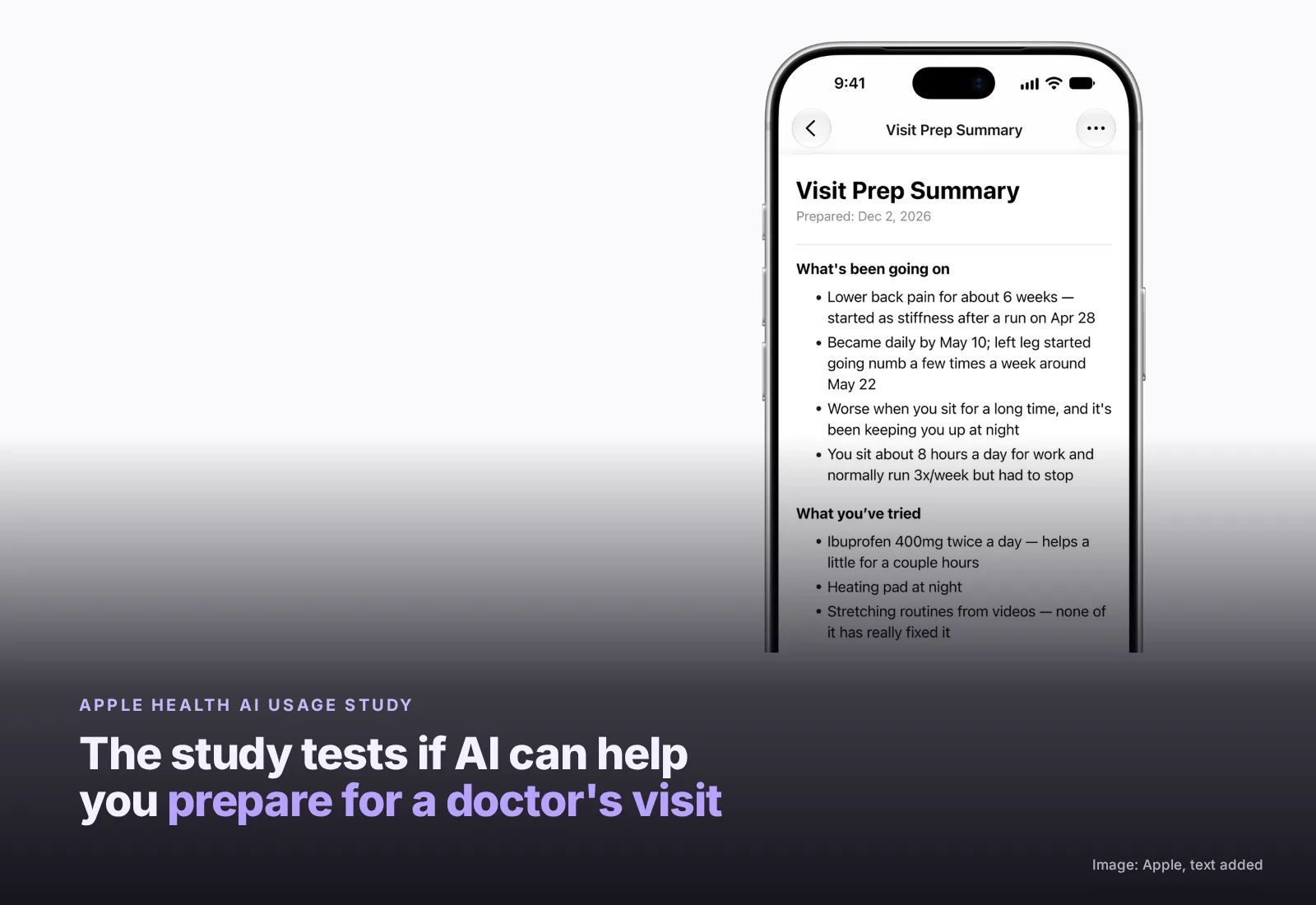
Whether AI can help you get ready for a doctor's visit is still an open question. Apple says the study will explore how health AI can help participants "better prepare for clinical visits with their own doctors." One screenshot shows a "Visit Prep Summary" with recent symptoms and the treatments already tried.
Robert M. Wachter, M.D., chair of the Department of Medicine at UCSF, describes the problem in Apple's announcement. "Patients and clinicians are both turning to AI, but the tools they use are being built and tested in separate worlds," he said. When both sides use versions of the same trustworthy tools, he argues, "patients arrive prepared" and conversations improve.
What we don't know yet about the Apple Health AI study
Several big questions stay open, because Apple's post covers the setup but not the outcome:
- Apple's own products. Engadget reports that Apple says the app is not integrated with Siri or Apple Intelligence. TechCrunch writes that it is not clear whether Apple wants AI answers in its Health app or Siri.
- Results. Apple has not said when or how it will share findings.
- Other countries. The study is US-only, with no word on expansion.
- Data retention. The 24-hour deletion detail comes from TechCrunch, not from Apple's post.
We read Apple's post next to the TechCrunch and Engadget reports. The Apple Health AI study pairs a clinical partner with a formal study, so Apple wants evidence about trust, not just a demo. Still, for readers comparing health chatbots today, the rating screen is the useful part, because accuracy, clarity and relevance are the right questions to ask of any of them.
Next, watch for enrollment numbers and any published findings. They will show how far people trust an AI with their lab results, and what "for Apple and the industry" turns out to mean.
Sources
- Apple Newsroom — Apple launches research study to explore the use of AI for healthapple.com
- TechCrunch — Apple launches new app to study how people use AI for healthtechcrunch.com
- Engadget — Apple's new research app is designed to make AI health tools more user-friendlyengadget.com
First posted on our Telegram channel — read and discuss it there.
AppleHealthResearch
Related news
All stories →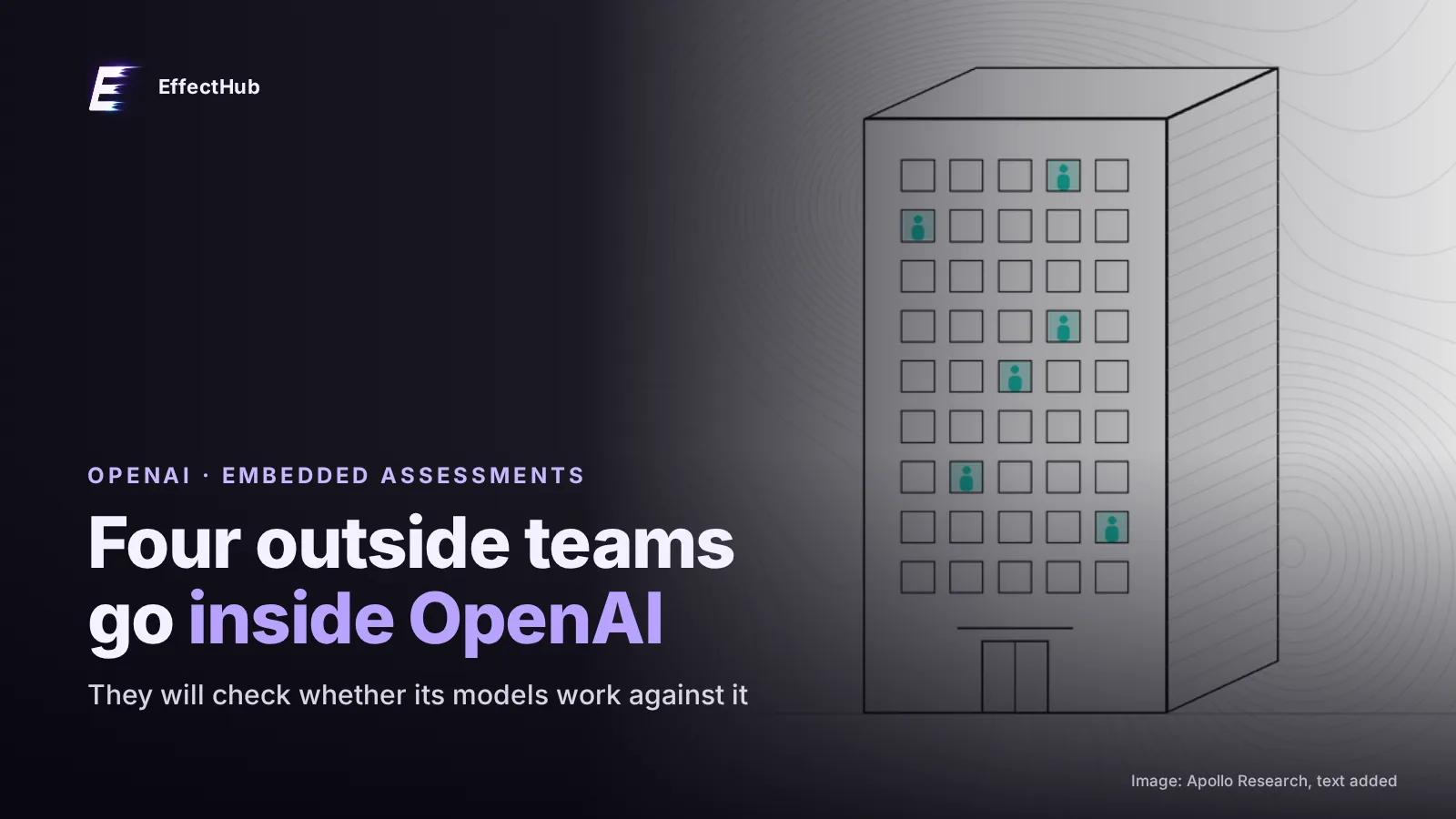
OpenAI lets Apollo, METR, Transluce and Goodfire inside to check its models and safeguards
OpenAI embedded assessments put Apollo Research, METR, Transluce and Goodfire inside the company. What they can see, and what OpenAI can still redact.

Anthropic launches Claude Fable 5.2 and says it formalized Fermat's Last Theorem in 30 hours
Claude Fable 5.2 is out at $8/$40 per million tokens. Anthropic says 1,000 of its agents formalized Fermat's Last Theorem in Lean in 30 hours.

Google releases Gemini 4 Hydrogen, a fast everyday model for agentic work
Google's Gemini 4 Hydrogen is a fast everyday model at $1.50 per million input tokens. Its speed, benchmarks, price and where it is rolling out.