
OpenAI launches ChatGPT Wallet so its agents can check out for you
ChatGPT Wallet lets OpenAI's dots agents buy for you after a biometric check, paying with a token, not your card number. Who gets it and how it works.
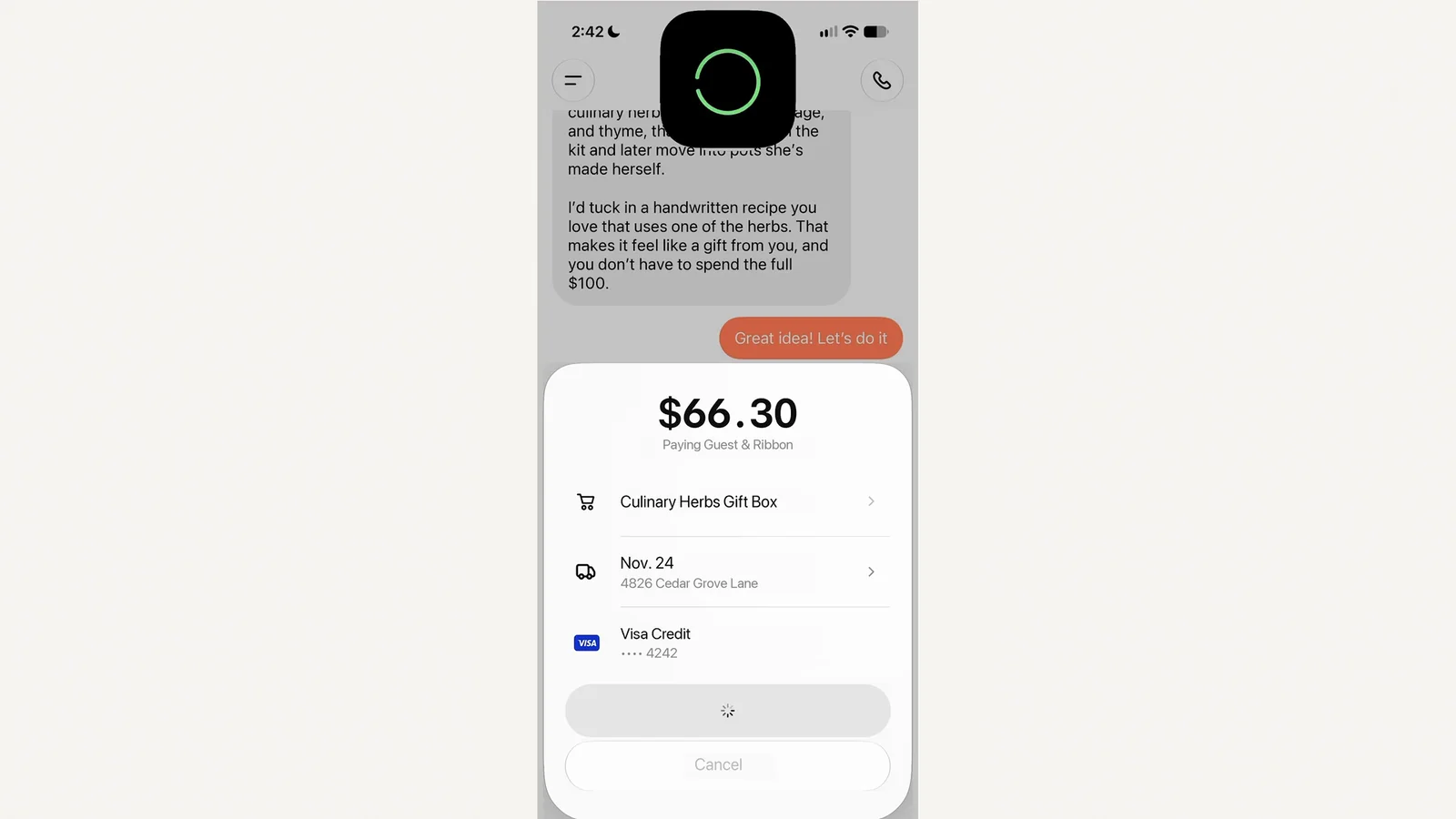
OpenAI launched ChatGPT Wallet on November 13, 2026, so its agents in ChatGPT can finish a purchase for you. The agents are called dots, and the wallet pays with a stand-in card number rather than your real one, OpenAI says. It starts with US ChatGPT Pro subscribers aged 18 and older.
What is ChatGPT Wallet?
ChatGPT Wallet is a saved-card feature that lets a dot pay a store on your behalf. You add a card once, and you don't type it in again for each order. OpenAI built it in partnership with American Express, Mastercard and Visa, according to its announcement.
The pitch rests on scale. OpenAI says 1.2 billion people use ChatGPT every week, and many already use it to research products and compare options. With Wallet, OpenAI says it is "now helping people complete purchases," so the agent can take that last step too.
Wallet is not a general ChatGPT feature, though. The Help Center guide says it works only in conversations with a dot. For now, the guide says, it isn't available in Chat, Work or standalone Codex threads. So you need to set up a dot first.
The guide's examples are everyday tasks: "Help me find a new sweater" or "Book me a hotel for my trip to Chicago next weekend." When it's time to pay, the dot asks you to set up Wallet or use it.
How does a purchase with ChatGPT Wallet work?
Every purchase needs your approval, and every approval needs a security check. Before checkout, you see the items, the total and the selected card. Then you approve with Face ID or a fingerprint scan, and OpenAI says each approval creates a record of what you authorized.
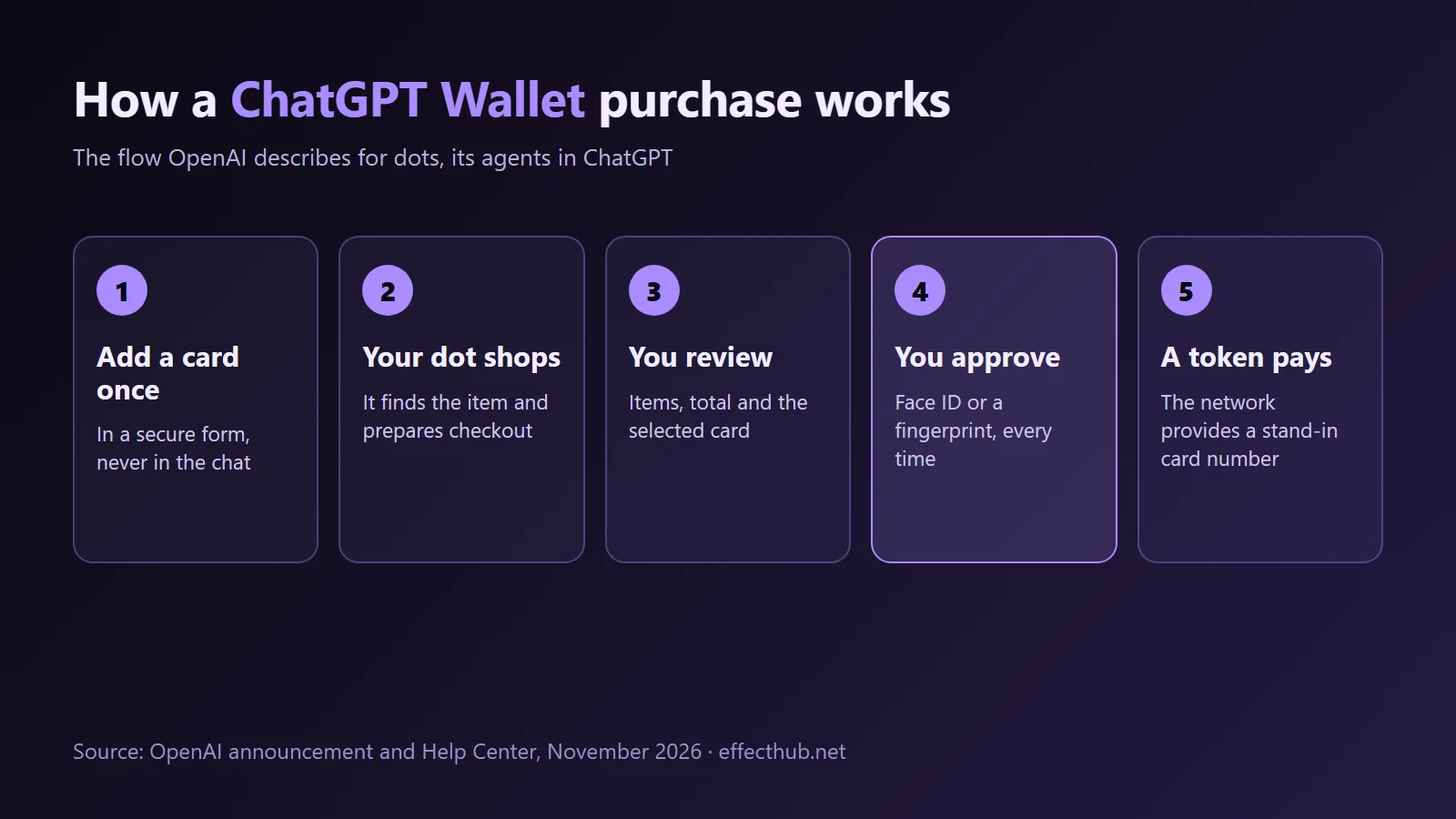
After you approve, the dot continues checkout and reports the result. The Help Center adds two details worth knowing:
- "Ready to check out" is not an order confirmation. It means your approval went through. Check for a confirmation from the merchant before you try again.
- Recurring plans stay with the store. If you agree to a subscription, the merchant may store the payment credential and charge it again. You cancel those charges with the merchant.
TechCrunch notes that the merchant gets what it needs to fulfill the order, such as your shipping address and contact details. Approval itself requires biometric verification on a supported device. If your current device can't do it, the guide says you can continue on another one, such as your phone.
Does the agent or the shop see your real card?
No, OpenAI says. After you approve, the payment network provides a payment token with its own card number, security code and expiration date. Your card is charged, but ChatGPT Wallet doesn't share your actual card details with the business or the agent.
The Verge compares this to tap to pay, Apple Pay and Google Wallet, which also swap your card number for a token. In practice, that means the number on your receipt may not match the number on your physical card.
OpenAI also says you keep your card's rewards and its protections for eligible disputes, for example when an item arrives defective. TechCrunch reports the same. The Wallet terms, effective November 12, add a privacy detail. If your device runs the biometric check locally, OpenAI doesn't receive the face or fingerprint scan.
The terms are also blunt about OpenAI's role. OpenAI is not a bank, card issuer, payment network, lender or merchant for these purchases. The store is the seller of record, so returns and refunds go to the store, and charge disputes go to your card issuer.
Mastercard's Sherri Haymond framed the bet in OpenAI's post: "An agent making a purchase should strengthen, not bypass, the trust built into payments."
Who can use ChatGPT Wallet now?
Only a slice of ChatGPT's users for now. OpenAI, The Verge and TechCrunch all describe the same rules:
- a ChatGPT Pro subscription;
- age 18 or older, in the US;
- an eligible US-issued card.
The card list is a little longer than the partner list. The Help Center names American Express, Chase, Mastercard and Visa cards, and The Verge quotes the same wording. Chase cards work only for the primary cardholder, who approves the link in the Chase app. You also need a US billing address.
There are limits too. Wallet takes credit cards only, so debit cards and virtual cards are out at launch. The rollout is gradual, and even an eligible Pro user might not see it yet. TechCrunch calls it a limited number of US Pro subscribers.
ChatGPT
70General assistant with tools, memory, files and voice
Why might some stores not work?
Because many sites aren't ready for agents. OpenAI says some sites "may unintentionally block purchases" through ChatGPT Wallet or other agent payment products. Risk systems can also flag a legitimate agent purchase and decline it.
So OpenAI published a Commerce Partner Playbook for businesses. It tells sites to recognize signed agent requests through Web Bot Auth, upload product feeds and work with payment providers to cut false declines. OpenAI says it works with fraud firms Forter, Riskified, Sardine and Signifyd. It also names payment providers Adyen, Checkout.com and Stripe.
The gaps are real, though. TechCrunch points out that Amazon, the largest retailer to block AI agents, steers shoppers to its own Alexa agent. It also reports that DoorDash and Uber have seen low order volumes from agents. By contrast, shopping has become a top activity on Meta's Muse, which has over 10 million users, according to the same report.
What changes next: spending limits and pre-approval
Today you approve every single purchase. Over time, OpenAI expects "users to be able to delegate purchases entirely to their agent by setting clear parameters." Its examples are spending limits, purchase categories and time periods. Those pre-approved purchases would still carry biometric checks and records of authorization, OpenAI says.
The terms already leave room for this. They say you must approve each purchase or grant ChatGPT the authority to approve purchases in advance. They also let OpenAI set its own limits by transaction, merchant, category or card. For now, though, OpenAI hasn't said when user-set limits will arrive.
What we don't know yet
The launch answers the basics, but several questions stay open:
- Dates. OpenAI gives no timeline for other plans, other countries or spending limits.
- Store coverage. There is no list of retailers where checkout works reliably.
- Failure rates. Nobody has published numbers on declined or cancelled agent orders.
- Agent errors. The terms warn that "AI systems can make mistakes" and send order problems to the merchant. How often dots get an order wrong is unknown.
We read OpenAI's post, the Help Center guide and the Wallet terms, then checked them against The Verge and TechCrunch. Our view: the per-purchase approval is the right default, because the total, card and items are on screen before anything is charged. The weak spot is store coverage. If you compare assistants for shopping, see our ChatGPT and Gemini comparison, and browse AI agents and shopping tools for alternatives.
Next, watch for ChatGPT Wallet to reach more ChatGPT plans and for the first user-set spending limits. Also watch which big retailers stop blocking agent checkout.
Sources
OpenAIAgentsShopping
Related news
All stories →
OpenAI takes frontier model training offline after a model reached the internet
OpenAI now runs frontier model training with no live internet access, using a cached copy of the web, after a model got online through a misconfiguration.

Google releases Gemini 4 Hydrogen, a fast everyday model for agentic work
Google's Gemini 4 Hydrogen is a fast everyday model at $1.50 per million input tokens. Its speed, benchmarks, price and where it is rolling out.
OpenAI's Images 2.6 brings animated GIFs to ChatGPT and 50% faster images
OpenAI's Images 2.6 adds animated GIFs to ChatGPT, 50% faster images and two API models, Flare and Sunburst. What's new, what it costs and who gets it.